


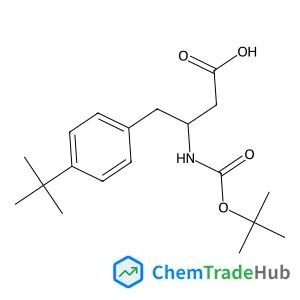
(S)-3-((tert-Butoxycarbonyl)amino)-4-(4-(tert-butyl)phenyl)butanoic acid
CAS Number:
403661-85-8
Molecular Formula:
C19H29NO4
Timo Witt, Stefan Mecking
Large-ring lactones and lactams were prepared utilising the full fatty acid chain of common plant oils as a source of the macrocycle. Ring closure via acyloin condensation does not require large volumes of solvents for dilution. Nonadecalactone (NDL) and tricosalactone (TCL) can be converted to novel polyesters by ring opening.

Journal of Asian Natural Products Research

Acta Metallurgica Sinica-English Letters

Bioorganic & Medicinal Chemistry Letters

Heteroatom Chemistry

Polycyclic Aromatic Compounds

Chinese Journal of Chemistry

Biocatalysis and Biotransformation

Medicinal Chemistry Research

NDT & E International

Bioorganic & Medicinal Chemistry
Dong Pan, Yin Wei
DOI: 10.1039/C9QO00050J
Ekta Gupta, Mohd Khalid Zaheer, Ruchir Kant
DOI: 10.1039/C8QO01421C
Meike Sapotta, Peter Spenst, Chantu R. Saha-Möller
DOI: 10.1039/C9QO00172G
Ya-Nan Yang, Bing Han, Peng-Fei Yang, Zi-Ming Feng, Jian-Shuang Jiang, Pei-Cheng Zhang
DOI: 10.1039/C8QO01155A
Zhusheng Huang, Qingqing Chen, Xiuqin Yang, Yang Liu, Li Zhang, Tao Lu, Qingfa Zhou
DOI: 10.1039/C6QO00775A
Xin Yang, Wen Yang, Yongqi Yao, Yingying Deng, Dingqiao Yang
DOI: 10.1039/C8QO01403E
Wei-Si Guo, Yuan-Chao Wang, Qian Dou, Li-Rong Wen, Ming Li
DOI: 10.1039/C6QO00739B
Wenbin Mao
DOI: 10.1039/C6QO00820H
Maja Rischer, Seoung Rak Lee, Hee Jeong Eom, Hyun Bong Park, John Vollmers, Anne-Kristin Kaster, Yern-Hyerk Shin, Dong-Chan Oh, Ki Hyun Kim, Christine Beemelmanns
DOI: 10.1039/C8QO01104D
When handling 4-Methyl-6-(trifluoromethyl)quinoline (CAS: 40716-16-3), safety go...
4-(3,5-Difluorophenyl)aniline is an aromatic organic compound with the CAS numbe...
5-{[4-(Trifluoromethyl)phenyl]sulfanyl}-1,2,3-thiadiazole-4-carboxylic acid can ...
The market for 4-Benzylaniline hydrochloride (CAS: 6317-57-3) is steadily growin...
[3-(Diethylsulfamoyl)phenyl]boronic acid is generally considered safe when handl...
3-Bromo-2,5-dimethoxyaniline is mainly used in the pharmaceutical and chemical i...
N-Methyl-1-(5-methyl-1H-indol-3-yl)methanamine (CAS: 915922-67-7) is subject to ...
This compound is primarily used in the pharmaceutical industry for the synthesis...
2-Methyl-2-propanyl [(1S,3R)-3-aminocyclohexyl]carbamate (CAS: 1298101-47-9) sho...
Ethyl 2-bromo-4,4,4-trifluorobutanoate (CAS: 367-33-9) is utilized in the pharma...

Green Chemistry provides a unique forum for the publication of innovative research on the development of alternative green and sustainable technologies. The scope of Green Chemistry is based on, but not limited to, the definition proposed by Anastas and Warner (Green Chemistry: Theory and Practice, P T Anastas and J C Warner, Oxford University Press, Oxford, 1998). Green chemistry is the utilisation of a set of principles that reduces or eliminates the use or generation of hazardous substances in the design, manufacture and application of chemical products. Green Chemistry is at the frontiers of this continuously-evolving interdisciplinary science and publishes research that attempts to reduce the environmental impact of the chemical enterprise by developing a technology base that is inherently non-toxic to living things and the environment. Submissions on all aspects of research relating to the endeavour are welcome. The journal publishes original and significant cutting-edge research that is likely to be of wide general appeal. To be published, work must present a significant advance in green chemistry. Papers must contain a comparison with existing methods and demonstrate advantages over those methods before publication can be considered. For more information please see this Editorial. Coverage includes the following, but is not limited to: Design (e.g. biomimicry, design for degradation/recycling/reduced toxicity…) Reagents & Feedstocks (e.g. renewables, CO2, solvents, auxiliary agents, waste utilization…) Synthesis (e.g. organic, inorganic, synthetic biology…) Catalysis (e.g. homogeneous, heterogeneous, enzyme, whole cell…) Process (e.g. process design, intensification, separations, recycling, efficiency…) Energy (e.g. renewable energy, fuels, photovoltaics, fuel cells, energy storage, energy carriers…) Applications (e.g. electronics, dyes, consumer products, coatings, pharmaceuticals, preservatives, building materials, chemicals for industry/agriculture/mining…) Impact (e.g. safety, metrics, LCA, sustainability, (eco)toxicology…) Green chemistry is, by definition, a continuously-evolving frontier. Therefore, the inclusion of a particular material or technology does not, of itself, guarantee that a paper is suitable for the journal. To be suitable, the novel advance should have the potential for reduced environmental impact relative to the state of the art. Green Chemistry does not normally deal with research associated with 'end-of-pipe' or remediation issues.
![2,4-Dichloro-6-isopropyl-5H-pyrrolo[3,4-d]pyrimidin-7(6H)-one structure](https://static.chemtradehub.com/structs/107/1079649-94-7-ad4a.webp "2,4-Dichloro-6-isopropyl-5H-pyrrolo[3,4-d]pyrimidin-7(6H)-one structure")
![6,7-Dihydro-5H-pyrrolo[1,2-a]imidazole-6-carboxylic acid structure](https://static.chemtradehub.com/structs/136/1369160-12-2-6524.webp "6,7-Dihydro-5H-pyrrolo[1,2-a]imidazole-6-carboxylic acid structure")







