












Chiral phosphoric acid-catalyzed asymmetric C(sp3)–H functionalization of biomass-derived 2,5-dimethylfuran via two sequential Cope-type rearrangements
Literature Information
Publication Date
2019-02-26
DOI
10.1039/C8QO01375F
Impact Factor
5.281
Authors
Lubin Xu, Haohua Chen, Jian Liu, Lan Zhou, Qing Liu
View Original
Abstract
Reported herein is the first organocatalytic asymmetric C(sp3)–H functionalization of biomass-derived 2,5-dimethylfuran with 3-hydroxy-3-indolyoxindoles to afford enantioenriched furan-derived 3,3′-disubstituted oxindoles in high enantioselectivity. This reaction is realized through chiral acid-catalyzed two sequential Cope-type rearrangements as proved by DFT calculations, which demonstrates a strategically new reactivity of 2,5-dimethylfuran, enabling the direct production of chiral chemicals from biomass-derived molecules.
Recommended Journals
Related Literature
A facile route to a highly stabilized hierarchical hybrid of titania nanotube and gold nanoparticle
Jianguo Huang, Toyoki Kunitake
2004-03-22
Communication
DOI: 10.1039/B401071J
Preparation of metal sulfide–polymer composite microspheres with patterned surface structures
Yu Fang, Chaoliang Bai, Ying Zhang
2004-02-23
Communication
DOI: 10.1039/B314533F
Calix[4]bipyrrole—a big, flexible, yet effective chloride-selective anion receptor
Jonathan L. Sessler, Deqiang An, Won-Seob Cho, Vincent Lynch
2004-12-08
Communication
DOI: 10.1039/B412737D
A bis-salicylaldiminato Schiff base and its zinc complex as new highly fluorescent red dopants for high performance organic electroluminescence devices
Pengfei Wang, Ziruo Hong, Zhiyuan Xie, Shiwen Tong, Oiyan Wong, Chun-Sing Lee, Ningbew Wong, Liangsun Hung, Shuittong Lee
2003-06-05
Communication
DOI: 10.1039/B303591C
An N-heterocyclic carbene as a bidentate hemilabile ligand: a synchrotron X-ray diffraction and density functional theory study
Vladimir K. Dioumaev, David J. Szalda, Jonathan Hanson, James A. Franz, R. Morris Bullock
2003-06-11
Communication
DOI: 10.1039/B303762B
Highly enantioselective hydrogenation of enol ester phosphonates catalyzed by rhodium phosphine-phosphite complexes
Miguel Rubio, Andrés Suárez, Eleuterio Álvarez, Antonio Pizzano
2004-12-10
Communication
DOI: 10.1039/B414288H
Linear arrangements of polypyrrole microcontainers
Jinying Yuan, Liangti Qu, Deqiang Zhang, Gaoquan Shi
2004-03-18
Communication
DOI: 10.1039/B400614C
Synthesis and optical properties of metallo-supramolecular polymers
Parameswar K. Iyer, J. Benjamin Beck, Christoph Weder, Stuart J. Rowan
2004-12-10
Communication
DOI: 10.1039/B410734A
Polycationic dendrimers interact with RNA molecules: polyamine dendrimers inhibit the catalytic activity of Candida ribozymes
Jiangyu Wu, Jiehua Zhou, Fanqi Qu, Penghui Bao, Yi Zhang
2004-12-09
Communication
DOI: 10.1039/B414241A
You might also like
Compound Q&A
What precautions should be taken when handling 4-Methyl-6-(trifluoromethyl)quinoline (CAS: 40716-16-3)?
When handling 4-Methyl-6-(trifluoromethyl)quinoline (CAS: 40716-16-3), safety go...
40716-16-34-Methyl-6-(trifluor...
Compound Q&A
What is 4-(3,5-Difluorophenyl)aniline (CAS: 405058-00-6)?
4-(3,5-Difluorophenyl)aniline is an aromatic organic compound with the CAS numbe...
405058-00-64-(3,5-Difluoropheny...
Compound Q&A
How is 5-{[4-(Trifluoromethyl)phenyl]sulfanyl}-1,2,3-thiadiazole-4-carboxylic acid (CAS: 338982-07-3) typically synthesized?
5-{[4-(Trifluoromethyl)phenyl]sulfanyl}-1,2,3-thiadiazole-4-carboxylic acid can ...
338982-07-35-{[4-(Trifluorometh...
Compound Q&A
What is the market or research trend for 4-Benzylaniline hydrochloride (CAS: 6317-57-3)?
The market for 4-Benzylaniline hydrochloride (CAS: 6317-57-3) is steadily growin...
6317-57-34-Benzylaniline hydr...
Compound Q&A
Is [3-(Diethylsulfamoyl)phenyl]boronic acid (CAS: 871329-58-7) safe?
[3-(Diethylsulfamoyl)phenyl]boronic acid is generally considered safe when handl...
871329-58-7[3-(Diethylsulfamoyl...
Compound Q&A
What are the main uses of 3-Bromo-2,5-dimethoxyaniline (CAS: 115929-62-9)?
3-Bromo-2,5-dimethoxyaniline is mainly used in the pharmaceutical and chemical i...
115929-62-93-Bromo-2,5-dimethox...
Compound Q&A
What regulatory guidelines apply to N-Methyl-1-(5-methyl-1H-indol-3-yl)methanamine (CAS: 915922-67-7)?
N-Methyl-1-(5-methyl-1H-indol-3-yl)methanamine (CAS: 915922-67-7) is subject to ...
915922-67-7N-Methyl-1-(5-methyl...
Compound Q&A
What industries use Carbamic acid, N-[(5S)-5,6-diamino-6-oxohexyl]-, 1,1-dimethylethyl ester (CAS: 24828-96-4)?
This compound is primarily used in the pharmaceutical industry for the synthesis...
24828-96-4Carbamic acid, N-[(5...
Compound Q&A
How should 2-Methyl-2-propanyl [(1S,3R)-3-aminocyclohexyl]carbamate (CAS: 1298101-47-9) be stored?
2-Methyl-2-propanyl [(1S,3R)-3-aminocyclohexyl]carbamate (CAS: 1298101-47-9) sho...
1298101-47-92-Methyl-2-propanyl ...
Compound Q&A
What industries use Ethyl 2-bromo-4,4,4-trifluorobutanoate (CAS: 367-33-9)?
Ethyl 2-bromo-4,4,4-trifluorobutanoate (CAS: 367-33-9) is utilized in the pharma...
367-33-9Ethyl 2-bromo-4,4,4-...
Source Journal
Organic Chemistry Frontiers

CiteScore:
7.8
Self-citation Rate:
8.7%
Articles per Year:
724
Organic Chemistry Frontiers publishes high-quality research from across organic chemistry. Emphases are placed on studies that make significant contributions to the field of organic chemistry by reporting either new or significantly improved protocols or methodologies. Topics include, but are not limited to the following: Organic synthesis Development of synthetic methodologies Catalysis Natural products Functional organic materials Supramolecular and macromolecular chemistry Physical and computational organic chemistry
Recommended Compounds
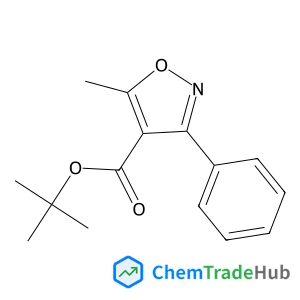
2-Methyl-2-propanyl 5-methyl-3-phenyl-1,2-oxazole-4-carboxylate
CAS Number:
211429-79-7
Molecular Formula:
C15H17NO3

Recommended Suppliers





Disclaimer
This page provides academic journal information for reference and research purposes only. We are not affiliated with any journal publishers and do not handle publication submissions. For publication-related inquiries, please contact the respective journal publishers directly.
If you notice any inaccuracies in the information displayed, please contact us at support@chemtradehub.com. We will promptly review and address your concerns.