












Distinguishing Förster resonance energy transfer and solvent-mediated charge-transfer relaxation dynamics in a zinc(ii) indicator: a femtosecond time-resolved transient absorption spectroscopic study
Literature Information
Publication Date
2014-02-03
DOI
10.1039/C3CP55382E
Impact Factor
3.676
Authors
Kesavapillai Sreenath, Chongyue Yi, Kenneth L. Knappenberger, Jr., Lei Zhu
View Original
Abstract
A bifluorophoric molecule (1) capable of intramolecular Förster Resonance Energy Transfer (FRET) is reported. The emission intensity of the FRET acceptor in 1 depends on the molar absorptivity of the donor, which is a function of zinc(II) complexation. The FRET dynamics of [Zn(1)](ClO4)2 is characterized by femtosecond time-resolved transient absorption spectroscopy. The solvent-mediated relaxation of the charge-transfer (CT) state of the isolated donor and the FRET process of the donor–acceptor conjugate are on similar time scales (40–50 ps in CH3CN), but distinguishable by the opposite solvent polarity dependency. As the solvent polarity increases, the efficiency of Columbic-based FRET is reduced, whereas CT relaxation is accelerated. In addition to revealing a method to distinguish CT and FRET dynamics, this work provides a photophysical foundation for developing indicators based on the FRET strategy.
Related Literature
Characterization of the furin cleavage motif for HIV-1 trimeric envelope glycoprotein by intact LC-MS analysis
Nicole A. Schneck, Vera B. Ivleva, Cindy X. Cai, Jonathan W. Cooper, Q. Paula Lei
2020-01-02
Communication
DOI: 10.1039/C9AN02098E
Mathematical chromatography deciphers the molecular fingerprints of dissolved organic matter
Urban J. Wünsch, Jeffrey A. Hawkes
2020-01-09
Paper
DOI: 10.1039/C9AN02176K
A facile one-pot synthesis of carbon nitride dots–reduced graphene oxide nanocomposites for simultaneous enhanced detecting of dopamine and uric acid
Ziyin Yang, Xiaohui Zheng, Zhi Li, Jianbin Zheng
2016-05-31
Paper
DOI: 10.1039/C6AN00640J
Use of fluorescence signals generated by elastic scattering under monochromatic incident light for determining the scattering efficiencies of various plasmonic nanoparticles
Ji Eun Song, Ji Hoon Park, Ju A. La, Seyeon Park, Min Kuk Jeong, Eun Chul Cho
2016-05-11
Paper
DOI: 10.1039/C6AN00399K
Enzymatically catalytic signal tracing by a glucose oxidase and ferrocene dually functionalized nanoporous gold nanoprobe for ultrasensitive electrochemical measurement of a tumor biomarker
Hui Cheng, Lingling Xu, Haili Zhang, Guosong Lai
2016-05-04
Paper
DOI: 10.1039/C6AN00651E
Mass spectrometric quantification of microRNAs in biological samples based on multistage signal amplification
Xiangtang Li, Rui Xu, Li Pan, Yi-Ming Liu
2019-12-30
Paper
DOI: 10.1039/C9AN02064K
A miniaturized electrochemical device integrating a biconical microchannel and carbon fiber disk ultramicroelectrode
Fengxia Chang, Xia Xie, Meixian Li, Zhiwei Zhu
2016-07-05
Communication
DOI: 10.1039/C6AN01205A
Development of a femtosecond time-resolved near-IR multiplex stimulated Raman spectrometer in resonance with transitions in the 900–1550 nm region
Tomohisa Takaya, Koichi Iwata
2016-06-08
Paper
DOI: 10.1039/C6AN01051B
Interface engineering of microelectrodes toward ultrasensitive monitoring of β-amyloid peptides in cerebrospinal fluid in Alzheimer's disease
Shushu Ding, Yunxia Xu, Qi Liu, Hui Gu, Anwei Zhu, Guoyue Shi
2020-01-13
Paper
DOI: 10.1039/C9AN02285F
A paper-based colorimetric assay system for sensitive cysteine detection using a fluorescent probe
Xiaoya Ma
2020-01-15
Paper
DOI: 10.1039/C9AN02271F
You might also like
Compound Q&A
What precautions should be taken when handling lithium chloride hydrate (1:1:1) (CAS: 16712-20-2)?
When handling lithium chloride hydrate (1:1:1) (CAS: 16712-20-2), it is importan...
16712-20-2Lithium chloride hyd...
Compound Q&A
Is 4-(4H-1,2,4-Triazol-4-yl)piperidine (CAS: 690261-92-8) safe?
4-(4H-1,2,4-Triazol-4-yl)piperidine is generally considered safe for use in phar...
690261-92-84-(4H-1,2,4-Triazol-...
Compound Q&A
How should waste containing 1,3-Thiazole-2-carboxamide (CAS: 16733-85-0) be handled?
Waste containing 1,3-Thiazole-2-carboxamide (CAS: 16733-85-0) should be collecte...
16733-85-01,3-Thiazole-2-carbo...
Compound Q&A
What regulatory guidelines apply to 5-(Difluoromethyl)-2-fluorobenzonitrile (CAS: 934175-58-3)?
5-(Difluoromethyl)-2-fluorobenzonitrile (CAS: 934175-58-3) is subject to regulat...
934175-58-35-(Difluoromethyl)-2...
Compound Q&A
How is Methyl 3-acetamido-2-thiophenecarboxylate (CAS: 22288-79-5) typically synthesized?
Methyl 3-acetamido-2-thiophenecarboxylate can be synthesized by the reaction of ...
22288-79-5Methyl 3-acetamido-2...
Compound Q&A
What is 4-Isoquinolinecarbonitrile (CAS: 34846-65-6)?
4-Isoquinolinecarbonitrile is a chemical compound with the CAS number 34846-65-6...
34846-65-64-Isoquinolinecarbon...
Compound Q&A
How should Methyl 1H-1,2,3-triazole-4-carboxylate (CAS: 877309-59-6) be stored?
Store Methyl 1H-1,2,3-triazole-4-carboxylate (CAS: 877309-59-6) in a cool, dry p...
877309-59-6Methyl 1H-1,2,3-tria...
Compound Q&A
What regulatory guidelines apply to 6-Bromo[1,3]thiazolo[5,4-b]pyridin-2-amine (CAS: 1160791-13-8)?
6-Bromo[1,3]thiazolo[5,4-b]pyridin-2-amine (CAS: 1160791-13-8) is subject to the...
1160791-13-86-Bromo[1,3]thiazolo...
Compound Q&A
Is (2S,3S)-2-Ammonio-3-(3,4-dihydroxyphenyl)-3-hydroxypropanoate (CAS: 23651-95-8) safe?
(2S,3S)-2-Ammonio-3-(3,4-dihydroxyphenyl)-3-hydroxypropanoate (CAS: 23651-95-8) ...
23651-95-8(2S,3S)-2-Ammonio-3-...
Compound Q&A
What are the physical and chemical properties of 7-bromo-3-methyl-3,4-dihydroquinazolin-4-one (CAS: 1293987-84-4)?
7-Bromo-3-methyl-3,4-dihydroquinazolin-4-one is a solid with a crystalline form....
1293987-84-47-bromo-3-methyl-3,4...
Source Journal
Physical Chemistry Chemical Physics

CiteScore:
5.5
Self-citation Rate:
10.3%
Articles per Year:
3036
Physical Chemistry Chemical Physics (PCCP) is an international journal co-owned by 19 physical chemistry and physics societies from around the world. This journal publishes original, cutting-edge research in physical chemistry, chemical physics and biophysical chemistry. To be suitable for publication in PCCP, articles must include significant innovation and/or insight into physical chemistry; this is the most important criterion that reviewers and Editors will judge against when evaluating submissions. The journal has a broad scope and welcomes contributions spanning experiment, theory, computation and data science. Topical coverage includes spectroscopy, dynamics, kinetics, statistical mechanics, thermodynamics, electrochemistry, catalysis, surface science, quantum mechanics, quantum computing and machine learning. Interdisciplinary research areas such as polymers and soft matter, materials, nanoscience, energy, surfaces/interfaces, and biophysical chemistry are welcomed if they demonstrate significant innovation and/or insight into physical chemistry. Joined experimental/theoretical studies are particularly appreciated when complementary and based on up-to-date approaches.
Recommended Compounds
![(1R,5R)-3-{[(2-Methyl-2-propanyl)oxy]carbonyl}-3-azabicyclo[3.1.0]hexane-1-carboxylic acid structure](https://static.chemtradehub.com/structs/116/1165450-63-4-bfe1.webp "(1R,5R)-3-{[(2-Methyl-2-propanyl)oxy]carbonyl}-3-azabicyclo[3.1.0]hexane-1-carboxylic acid structure")
(1R,5R)-3-{[(2-Methyl-2-propanyl)oxy]carbonyl}-3-azabicyclo[3.1.0]hexane-1-carboxylic acid
CAS Number:
1165450-63-4
Molecular Formula:
C11H17NO4
![[(2R)-6,6-Dimethyl-2-morpholinyl]methanol hydrochloride (1:1) structure](https://static.chemtradehub.com/structs/141/1416444-88-6-e06a.webp "[(2R)-6,6-Dimethyl-2-morpholinyl]methanol hydrochloride (1:1) structure")
[(2R)-6,6-Dimethyl-2-morpholinyl]methanol hydrochloride (1:1)
CAS Number:
1416444-88-6
Molecular Formula:
C7H16ClNO2
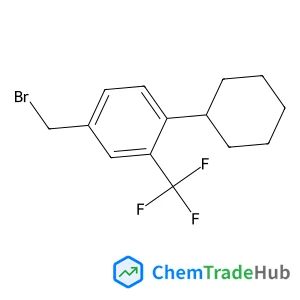
4-(Bromomethyl)-1-cyclohexyl-2-(trifluoromethyl)benzene
CAS Number:
800381-60-6
Molecular Formula:
C14H16BrF3
Recommended Suppliers






Disclaimer
This page provides academic journal information for reference and research purposes only. We are not affiliated with any journal publishers and do not handle publication submissions. For publication-related inquiries, please contact the respective journal publishers directly.
If you notice any inaccuracies in the information displayed, please contact us at support@chemtradehub.com. We will promptly review and address your concerns.