


![N-[(6-Bromo-3-pyridinyl)methyl]ethanamine structure](https://static.chemtradehub.com/structs/120/120740-05-8-ca55.webp "N-[(6-Bromo-3-pyridinyl)methyl]ethanamine structure")
Isothermal Onsager matrices and acceptor size effect on mass/charge transport properties of La1.9A0.1NiO3.95+δ (A = Ca, Sr)
Literature Information
Publication Date
2014-07-03
DOI
10.1039/C3CP55228D
Impact Factor
3.676
Authors
Hong-Seok Kim, Han-Ill Yoo
View Original
Abstract
Isothermal Onsager transport coefficient matrices have been established experimentally for the systems of La1.9A0.1NiO3.95+δ doped with different-sized acceptors A = Ca2+ and Sr2+, in the range of oxygen activity −6 < log aO2 < 0 at 800°, 900° and 1000 °C, respectively. The oxygen self-diffusivity, oxygen defect (interstitial) diffusivity, hole mobility, and partial conductivities in the reversible electrode condition are thereby evaluated against defect concentration, and compared with those of the host La2NiO4+δ. It has been found that acceptor-doping suppresses the oxygen defect diffusivity by ca. an order of magnitude compared with the undoped host by increasing the migrational enthalpy by 0.3 eV or so. Hole mobility is in the range of 0.15 to 0.20 cm2 V−1 s−1 for both the undoped and Ca-doped specimens, and 0.21–0.25 cm2 V−1 s−1 for the Sr-doped specimens, with their temperature dependence indicating band conduction. The ionic charge-of-transport, corresponding phenomenologically to the number of holes dragged by an oxygen interstitial upon its transfer, appears to increase with increasing defect concentration and decreasing temperature in the range of 0 to 0.5. The ionic and electronic mobilities depending on the types of dopants are discussed in terms of dopant size.
Recommended Journals

Cement and Concrete Research

Canadian Metallurgical Quarterly

Bulletin of the Chemical Society of Japan

Journal of the Chinese Chemical Society

Chemical Reviews

Chemical & Pharmaceutical Bulletin

Accounts of Chemical Research

Chemistry of Natural Compounds

Corrosion Science

Journal of the American Chemical Society
Related Literature
Lyotropic liquid crystalline phases formed in an ionic liquid
Luyan Wang, Xiao Chen, Yongcun Chai, Jingcheng Hao, Zhenming Sui, Wenchang Zhuang, Zhenwen Sun
2004-10-28
Communication
DOI: 10.1039/B411163J
Stereospecific isomerisation of P-heterocycles triggered by coordination: synthesis of the first P,N-chelates featuring a 2-phospholene moiety
François Leca, Mathieu Sauthier, Boris le Guennic, Christophe Lescop, Loic Toupet, Jean-François Halet, Régis Réau
2003-06-16
Communication
DOI: 10.1039/B304308H
3-Chloropropenyl pivaloate in organic synthesis: the first asymmetric catalytic entry to syn-alk-1-ene-3,4-diols
Marco Lombardo, Sebastiano Licciulli, Stefano Morganti, Claudio Trombini
2003-06-18
Communication
DOI: 10.1039/B304485H
An apatite for fast oxide ion conduction
M. Saiful Islam, Julian R. Tolchard, Peter R. Slater
2003-05-21
Communication
DOI: 10.1039/B301179H
Straightforward detection of the secondary ionisation of the phosphate group and pK determinations by high-resolution solid-state 31P NMR
Carole Gardiennet, Bernard Henry, Paul Kuad, Bernard Spiess, Piotr Tekely
2004-10-25
Communication
DOI: 10.1039/B413415J
A photochromic thiophenophan-1-ene
Michinori Takeshita, Miki Nagai, Takehiko Yamato
2003-05-20
Communication
DOI: 10.1039/B303916A
Induction of optical activity in oligosilanes within the internal cavity of cyclodextrins
Takanobu Sanji, Akihiko Yoshiwara, Hideki Sakurai, Masato Tanaka
2003-05-21
Communication
DOI: 10.1039/B303771A
Nonpolar biphasic catalysis: Sonogashira and Suzuki coupling of aryl bromides and chlorides
Anupama Datta, Herbert Plenio
2003-05-21
Communication
DOI: 10.1039/B303602B
C2 C70F38 is aromatic, contains three planar hexagons, and has equatorial addends
Peter B. Hitchcock, Anthony G. Avent, Natalia Martsinovich, Pavel A. Troshin, Roger Taylor
2004-11-19
Communication
DOI: 10.1039/B412599A
You might also like
Compound Q&A
What are the main uses of (3.beta.)-3-Hydroxy-N,N-dimethyl-chol-5-en-24-amide (CAS: 79066-03-8)?
(3.beta.)-3-Hydroxy-N,N-dimethyl-chol-5-en-24-amide (CAS: 79066-03-8) is primari...
79066-03-8(3.beta.)-3-Hydroxy-...
Compound Q&A
What regulatory guidelines apply to 5-(aminomethyl)-2-methoxyphenol (CAS: 89702-89-6)?
5-(Aminomethyl)-2-methoxyphenol (CAS: 89702-89-6) is classified under GHS as a s...
89702-89-65-(aminomethyl)-2-me...
Compound Q&A
What is Thieno[2,3-c]pyridin-7(6H)-one (CAS: 28981-13-7)?
Thieno[2,3-c]pyridin-7(6H)-one (CAS: 28981-13-7) is a heterocyclic organic compo...
28981-13-7Thieno[2,3-c]pyridin...
Compound Q&A
Is 1-[(6-Methoxy-3-pyridinyl)methyl]-4-piperidinamine dihydrochloride (CAS: 1185311-28-7) safe?
1-[(6-Methoxy-3-pyridinyl)methyl]-4-piperidinamine dihydrochloride is generally ...
1185311-28-71-[(6-Methoxy-3-pyri...
Compound Q&A
What regulatory guidelines apply to [(2E)-3-Phenyl-2-propen-1-yl]phosphonic acid (CAS: 146404-58-2)?
[(2E)-3-Phenyl-2-propen-1-yl]phosphonic acid (CAS: 146404-58-2) is regulated und...
146404-58-2[(2E)-3-Phenyl-2-pro...
Compound Q&A
What regulatory guidelines apply to 6-Bromo-7-methoxyquinoline (CAS: 1620515-86-7)?
6-Bromo-7-methoxyquinoline (CAS: 1620515-86-7) falls under the scope of the Glob...
1620515-86-76-Bromo-7-methoxyqui...
Compound Q&A
What industries use (2R)-1-(1-Benzofuran-2-yl)-N-propyl-2-pentanamine (CAS: 260550-89-8)?
This compound is primarily used in the pharmaceutical industry for the developme...
260550-89-8(2R)-1-(1-Benzofuran...
Compound Q&A
What are the main uses of 1-Ethyl-7-[2-methyl-6-(4H-1,2,4-triazol-3-yl)-3-pyridinyl]-3,5-dihydropyrazino[2,3-b]pyrazin-2(1H)-one (CAS: 1228013-15-7)?
1-Ethyl-7-[2-methyl-6-(4H-1,2,4-triazol-3-yl)-3-pyridinyl]-3,5-dihydropyrazino[2...
1228013-15-71-Ethyl-7-[2-methyl-...
Compound Q&A
Are there alternatives to {5-(Acryloylamino)-2-[(dimethylamino)methyl]phenyl}boronic acid (CAS: 1217500-78-1) in synthesis?
Alternative reagents such as 2-[(dimethylamino)methyl]phenylboronic acid or rela...
1217500-78-1{5-(Acryloylamino)-2...
Compound Q&A
What is 3-(Piperidin-4-yloxy)pyridine (CAS: 310881-48-2)?
3-(Piperidin-4-yloxy)pyridine (CAS: 310881-48-2) is an organic compound with the...
310881-48-23-(Piperidin-4-yloxy...
Source Journal
Physical Chemistry Chemical Physics

CiteScore:
5.5
Self-citation Rate:
10.3%
Articles per Year:
3036
Physical Chemistry Chemical Physics (PCCP) is an international journal co-owned by 19 physical chemistry and physics societies from around the world. This journal publishes original, cutting-edge research in physical chemistry, chemical physics and biophysical chemistry. To be suitable for publication in PCCP, articles must include significant innovation and/or insight into physical chemistry; this is the most important criterion that reviewers and Editors will judge against when evaluating submissions. The journal has a broad scope and welcomes contributions spanning experiment, theory, computation and data science. Topical coverage includes spectroscopy, dynamics, kinetics, statistical mechanics, thermodynamics, electrochemistry, catalysis, surface science, quantum mechanics, quantum computing and machine learning. Interdisciplinary research areas such as polymers and soft matter, materials, nanoscience, energy, surfaces/interfaces, and biophysical chemistry are welcomed if they demonstrate significant innovation and/or insight into physical chemistry. Joined experimental/theoretical studies are particularly appreciated when complementary and based on up-to-date approaches.
Recommended Compounds
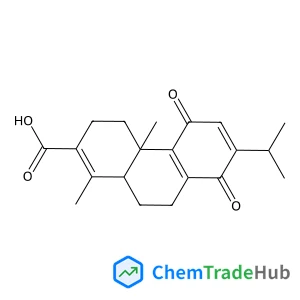
(4aS,10aS)-7-Isopropyl-1,4a-dimethyl-5,8-dioxo-3,4,4a,5,8,9,10,10a-octahydro-2-phenanthrenecarboxylic acid
CAS Number:
142950-86-5
Molecular Formula:
C20H24O4


Recommended Suppliers




Disclaimer
This page provides academic journal information for reference and research purposes only. We are not affiliated with any journal publishers and do not handle publication submissions. For publication-related inquiries, please contact the respective journal publishers directly.
If you notice any inaccuracies in the information displayed, please contact us at support@chemtradehub.com. We will promptly review and address your concerns.