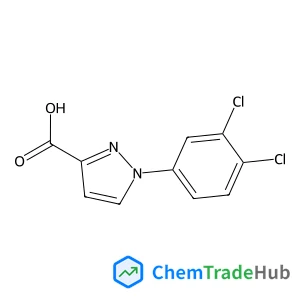
1-(3,4-Dichlorophenyl)-1H-pyrazole-3-carboxylic acid
CAS Number:
1152949-12-6
Molecular Formula:
C10H6Cl2N2O2
Javed M. Khan, Syed A. Abdulrehman, Fatima K. Zaidi, Samudrala Gourinath, Rizwan H. Khan
Amyloid fibrils are associated with neurodegenerative disorders and are formed by a number of proteins. In this study, the amyloid-forming behavior of several different serum albumins was examined at pH 3.5 i.e., about two pH units below their isoelectric points (pI ∼ 5.5) to examine the roles played by negative charge and hydrophobicity of exogenously added surfactants such as SDS, SDBS and AOT. The propensities of SDS, SDBS and AOT to promote the formation of amyloid fibrils were investigated by using measurements of turbidity, Rayleigh scattering, ThT and CR dye binding, DLS as well as far-UV CD. At submicellar concentrations of SDS and SDBS (0.5–2.5 mM) amyloid fibrils were formed by all albumins studied whereas at higher concentrations amyloid fibril formation was completely inhibited. Interestingly AOT promoted amyloid fibril formation up to 11 mM without any inhibition. The interaction between the albumins and the surfactants was exothermic, as confirmed by isothermal titration calorimetry (ITC). From the turbidity, Rayleigh scattering and dynamic light scattering data, it was concluded that amyloid induction was promoted most by AOT followed by SDBS and SDS. Similar studies were performed at pH 7.4 i.e., about two units of pH above the albumins pI, and no amyloid fibrils were formed. From these studies we conclude that negatively charged surfactants induce amyloid fibril formation in serum albumins with the help of electrostatic and hydrophobic interactions. Besides the study performed at pH 7.4 indicates that hydrophobic interactions alone can not induce aggregation in serum albumins.
Edward R. Smith, Panagiotis E. Theodorakis
DOI: 10.1039/D3CP03579D
Chiara Liliana Boldrini, Andrea Francesca Quivelli, Filippo Maria Perna, Paolo Biagini, Vito Capriati, Alessandro Abbotto, Norberto Manfredi
DOI: 10.1039/D3SE00949A
Alexander Jankowski, Paul Fischer, Klavs Hansen, Lutz Schweikhard
DOI: 10.1039/D3CP04476A
Fakhrul H. Bhuiyan, Ashlie Martini
DOI: 10.1039/D3CP05320B
Zhiye Wang, Yunchuan Li, Mingjun Sun
DOI: 10.1039/D3CP04593E
Jianglu Huang, Donggang Zhao, Yu Zhao
DOI: 10.1039/D3SE01403G
Shouqiang Wu, An Yong Li
DOI: 10.1039/D3CP05101C
Liying Pan, Xuxin Kang
DOI: 10.1039/D3CP04660E
Akira Yamaguchi, Tomoki Kujirai, Takeshi Fujita, Hideki Abe, Masahiro Miyauchi
DOI: 10.1039/D3SE01346D
Li Shen, Xiaobo Gao, Zhanqing Chang, Changhao Zhang, Yue Li, Jitao Lu, Qingguo Meng, Qian Wu
DOI: 10.1039/D3CP05199D
Waste containing N-Methoxy-N-methyl-1,3-thiazole-5-carboxamide (CAS: 898825-89-3...
N-(4-Biphenylyl)dibenzo[b,d]furan-4-amine should be stored in a tightly sealed c...
The market for 3-Acetamido-5-amino-2,4,6-triiodobenzoic acid (CAS: 1713-07-1) is...
Benzyl 2-O-acetyl-3,4,6-tri-O-benzyl-beta-D-galactopyranoside (CAS: 61820-03-9) ...
2-Ethylpiperazine dihydrochloride (CAS: 438050-52-3) is regulated under the Glob...
1,1'-[1,3-Phenylenebis(methylene)]bis(3-methyl-1H-pyrrole-2,5-dione) (CAS: 11946...
Several alternatives can be used in the synthesis of 5-Fluoro-2-(1-pyrrolidinyl)...
Proper personal protective equipment (PPE) must be worn when handling this compo...
When handling 6-Bromoimidazo[1,2-a]pyridin-8-amine, it is important to wear appr...
Alternatives to (2S,4R)-4-(4-Nitrobenzyl)pyrrolidine-2-carboxylic acid hydrochlo...

Physical Chemistry Chemical Physics (PCCP) is an international journal co-owned by 19 physical chemistry and physics societies from around the world. This journal publishes original, cutting-edge research in physical chemistry, chemical physics and biophysical chemistry. To be suitable for publication in PCCP, articles must include significant innovation and/or insight into physical chemistry; this is the most important criterion that reviewers and Editors will judge against when evaluating submissions. The journal has a broad scope and welcomes contributions spanning experiment, theory, computation and data science. Topical coverage includes spectroscopy, dynamics, kinetics, statistical mechanics, thermodynamics, electrochemistry, catalysis, surface science, quantum mechanics, quantum computing and machine learning. Interdisciplinary research areas such as polymers and soft matter, materials, nanoscience, energy, surfaces/interfaces, and biophysical chemistry are welcomed if they demonstrate significant innovation and/or insight into physical chemistry. Joined experimental/theoretical studies are particularly appreciated when complementary and based on up-to-date approaches.
![[5-fluoro-2-(morpholine-4-carbonyl)phenyl]boronic acid structure](https://static.chemtradehub.com/structs/121/1217501-26-2-505c.webp "[5-fluoro-2-(morpholine-4-carbonyl)phenyl]boronic acid structure")