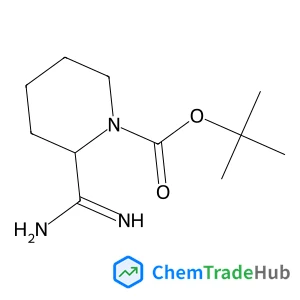
2-Methyl-2-propanyl 2-carbamimidoyl-1-piperidinecarboxylate
CAS Number:
1258640-98-0
Molecular Formula:
C11H21N3O2
Atomistic simulation of chemical systems is currently limited by the elementary description of electrostatics that atomic point-charges offer. Unfortunately, a model of one point-charge for each atom fails to capture the anisotropic nature of electronic features such as lone pairs or π-systems. Higher order electrostatic terms, such as those offered by a multipole moment expansion, naturally recover these important electronic features. The question remains as to why such a description has not yet been widely adopted by popular molecular mechanics force fields. There are two widely-held misconceptions about the more rigorous formalism of multipolar electrostatics: (1) Accuracy: the implementation of multipole moments, compared to point-charges, offers little to no advantage in terms of an accurate representation of a system's energetics, structure and dynamics. (2) Efficiency: atomistic simulation using multipole moments is computationally prohibitive compared to simulation using point-charges. Whilst the second of these may have found some basis when computational power was a limiting factor, the first has no theoretical grounding. In the current work, we disprove the two statements above and systematically demonstrate that multipole moments are not discredited by either. We hope that this perspective will help in catalysing the transition to more realistic electrostatic modelling, to be adopted by popular molecular simulation software.
David R. Kelly, Stanley M. Roberts
DOI: 10.1039/B404390C
Yuzhong Wang, Brandon Quillian, Pingrong Wei, Xiao-Juan Yang, Gregory H. Robinson
DOI: 10.1039/B408860N
Madeleine M. Joullié, David J. Richard
DOI: 10.1039/B400334A
Evonne A. Baldauff
DOI: 10.1039/B406230B
G. N. A. Rahman, Jeff Ramey, Massimo Marcaccio, Demis Paolucci, Francesco Paolucci, Shuhui Qin, Warren T. Ford, Domenico Balbinot, Norbert Jux, Nikos Tagmatarchis, Maurizio Prato
DOI: 10.1039/B406933A
Chi-Fung Choi, Po-Ting Tsang, Jian-Dong Huang, Elaine Y. M. Chan, Wing-Hung Ko, Wing-Ping Fong, Dennis K. P. Ng
DOI: 10.1039/B405868B
Katell Sénéchal, Loïc Toupet, Isabelle Ledoux, Joseph Zyss, Hubert Le Bozec, Olivier Maury
DOI: 10.1039/B407073A
Ian J. Munslow, Andrew R. Wade, Robert J. Deeth, Peter Scott
DOI: 10.1039/B409113B
Lionel Nicole, Cédric Boissière, David Grosso, Peter Hesemann, Joël Moreau, Clément Sanchez
DOI: 10.1039/B408869G
Guang Yang, Raphael G. Raptis
DOI: 10.1039/B404269G
Waste containing 6-Chloro-5-(2'-hydroxy-3'-methoxy-4-biphenylyl)-3-(3-methoxyphe...
(3alpha,5alpha)-3-Hydroxypregnane-11,20-dione is primarily used in the pharmaceu...
The market for 4-Amino-6-chloro-2-pyridinecarboxylic acid (CAS: 546141-56-4) is ...
Alternatives to (2-Benzoylethyl)trimethylammonium chloride (CAS: 24472-88-6) in ...
N-[4-Nitro-3-(trifluoromethyl)phenyl]acetamide (CAS: 393-12-4) is generally safe...
Alternative reagents such as other phosphates or similar functional groups can b...
There are alternatives to N,N'-Bis(3-aminopropyl)-1,3-propanediamine (CAS: 4605-...
When handling Aluminium trihexadecanoate, it is important to use appropriate per...
(1,1-Dioxido-3-oxo-1,2-benzothiazol-2(3H)-yl)acetic acid is a chemical compound ...
Several alternatives to 5,5-dimethyloxolan-2-one (CAS: 3123-97-5) can be used in...

Physical Chemistry Chemical Physics (PCCP) is an international journal co-owned by 19 physical chemistry and physics societies from around the world. This journal publishes original, cutting-edge research in physical chemistry, chemical physics and biophysical chemistry. To be suitable for publication in PCCP, articles must include significant innovation and/or insight into physical chemistry; this is the most important criterion that reviewers and Editors will judge against when evaluating submissions. The journal has a broad scope and welcomes contributions spanning experiment, theory, computation and data science. Topical coverage includes spectroscopy, dynamics, kinetics, statistical mechanics, thermodynamics, electrochemistry, catalysis, surface science, quantum mechanics, quantum computing and machine learning. Interdisciplinary research areas such as polymers and soft matter, materials, nanoscience, energy, surfaces/interfaces, and biophysical chemistry are welcomed if they demonstrate significant innovation and/or insight into physical chemistry. Joined experimental/theoretical studies are particularly appreciated when complementary and based on up-to-date approaches.
![N-{[(2-Methyl-2-propanyl)oxy]carbonyl}-L-methionylglycine structure](https://static.chemtradehub.com/structs/234/23446-03-9-e1e5.webp "N-{[(2-Methyl-2-propanyl)oxy]carbonyl}-L-methionylglycine structure")