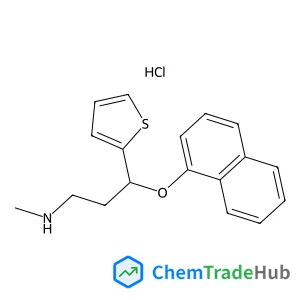
N-Methyl-3-(1-naphthyloxy)-3-(2-thienyl)-1-propanamine hydrochloride (1:1)
CAS Number:
1188266-11-6
Molecular Formula:
C18H20ClNOS
Utpal Rana, P. M. G. Nambissan, Sudip Malik, Kuntal Chakrabarti
Graphene oxide (GO)–polyaniline (PANI) composites were prepared with different relative abundance of PANI and GO by in situ polymerization of aniline in the presence of GO and ammonium persulphate at different temperatures. In the process, GO also got reduced to graphene. Positron lifetimes and coincidence Doppler broadening of the electron–positron annihilation gamma ray spectra originating from the composite samples were measured and the results are reported. The positron lifetimes indicated the presence of very large size defects in the form of vacancy clusters within the samples. Another interesting observation was the increase of relative intensity of the defect specific positron lifetime component when an increase in relative abundance of PANI led to increased reduction of GO to graphene. The reduction also shrank the volume occupied by GO and the free volume thereby released added to the overall defect concentration, resulting in a simultaneous increase of the intensity of the positron lifetime component. The variation of the positron lifetime and its intensity with the synthesis temperature suggested an optimum temperature suitable for the process. The above observations are corroborated by other experimental investigations like electron microscopy, X-ray diffraction and electrical conductivity.
Lu Zhang, Wesley A. Whitfield, Lei Zhu
DOI: 10.1039/B719644J
Ying-Feng Han, Yue-Jian Lin, Wei-Guo Jia, Guo-Liang Wang, Guo-Xin Jin
DOI: 10.1039/B717554J
Nicolas Bouquin, Vladimir L. Malinovskii, Robert Häner
DOI: 10.1039/B802193G
Lidong Shao, Tsung-Wu Lin, Gerard Tobias, Malcolm L. H. Green
DOI: 10.1039/B800881G
Marites A. Guino-o, Charles F. Campana, Karin Ruhlandt-Senge
DOI: 10.1039/B715701K
Hideyuki Yoshiyama, Norio Shibata, Takefumi Sato, Shuichi Nakamura, Takeshi Toru
DOI: 10.1039/B800918J
N-(4-Methoxybenzyl)-2-pyridinamine (CAS: 52818-63-0) is increasingly being used ...
When handling Ethyl 4-(2-chlorophenyl)-1,3-thiazole-2-carboxylate, appropriate p...
Diethyldiselane (CAS: 628-39-7) is classified under the Globally Harmonized Syst...
The market for oxocopper (CAS: 12053-18-8) is primarily driven by its use in cat...
The market for 5-{[(2-Methyl-2-propanyl)oxy]carbonyl}-5-azaspiro[2.4]heptane-7-c...
2-(1-Pyrrolidinyl)-4-pyridinamine is a chemical compound with the CAS number 359...
2-(3-Pyridinyl)-1-azabicyclo[2.2.2]octane (CAS: 91556-75-1) is a crystalline sol...
(S)-Alpha-allyl-proline hydrochloride is usually synthesized via a Wittig reacti...
3-Methyl-1,2-oxazole-5-carboxylic acid (CAS: 4857-42-5) is an organic compound w...
Lys-SMCC-DM1 is synthesized via a multi-step process involving the coupling of S...

Physical Chemistry Chemical Physics (PCCP) is an international journal co-owned by 19 physical chemistry and physics societies from around the world. This journal publishes original, cutting-edge research in physical chemistry, chemical physics and biophysical chemistry. To be suitable for publication in PCCP, articles must include significant innovation and/or insight into physical chemistry; this is the most important criterion that reviewers and Editors will judge against when evaluating submissions. The journal has a broad scope and welcomes contributions spanning experiment, theory, computation and data science. Topical coverage includes spectroscopy, dynamics, kinetics, statistical mechanics, thermodynamics, electrochemistry, catalysis, surface science, quantum mechanics, quantum computing and machine learning. Interdisciplinary research areas such as polymers and soft matter, materials, nanoscience, energy, surfaces/interfaces, and biophysical chemistry are welcomed if they demonstrate significant innovation and/or insight into physical chemistry. Joined experimental/theoretical studies are particularly appreciated when complementary and based on up-to-date approaches.
![1-{3-[4-Amino-3-(4-phenoxyphenyl)-1H-pyrazolo[3,4-d]pyrimidin-1-yl]-1-piperidinyl}-2,3-dihydroxy-1-propanone structure](https://static.chemtradehub.com/structs/122/1226872-27-0-e037.webp "1-{3-[4-Amino-3-(4-phenoxyphenyl)-1H-pyrazolo[3,4-d]pyrimidin-1-yl]-1-piperidinyl}-2,3-dihydroxy-1-propanone structure")