


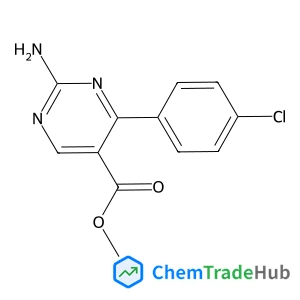
Methyl 2-amino-4-(4-chlorophenyl)-5-pyrimidinecarboxylate
CAS Number:
1133115-56-6
Molecular Formula:
C12H10ClN3O2
Imogen S. Parry, Alexander C. Hermes, Aras Kartouzian, Stuart R. Mackenzie
The spectroscopy and UV photodissociation dynamics of Cu2 and CuO have been studied using a combination of one- and two-colour excitation and velocity map imaging. Resonant excitation of Cu2via the J ← X 1Σg+ transition leads to significant fragmentation which is interpreted in terms of a combination of direct dissociation of Cu2+ 2Π produced in the resonant two-photon ionization process and dissociation of excited Cu2 states above the ionization threshold. By fitting of the kinetic energy release spectra obtained from the velocity map images, we determine a value for the dissociation energy of the cation of D0 (Cu2+, X 2Σg+) of 1.713 ± 0.025 eV, which, when combined with known ionization energies, yields D0 (Cu2, X 1Σg+) = 1.886 ± 0.026 eV. In other experiments, resonant two colour (1 + 1′) excitation of CuO via a range of excited states (C, D, F, H), yields unusually simple VMI images indicating fragmentation into a single dissociation channel which has been identified as Cu* 2D3/2 + O* 1D. Taken together, this data gives a CuO bond dissociation energy of 3.041 ± 0.030 eV. Finally, the production of Cu2+ with kinetic energy = 705 ± 75 cm−1 is tentatively interpreted as photolysis of Cu3 yielding Cu* + Cu2 X 1Σg+ from which a dissociation energy of Cu3 of 0.605 ± 0.030 eV is deduced.

Journal of Saudi Chemical Society

Chemistry Education Research and Practice

Russian Journal of Applied Chemistry

Russian Journal of General Chemistry

Saudi Pharmaceutical Journal

Russian Journal of Organic Chemistry

Nature Medicine

Journal of Peptide Science

Current Opinion in Solid State & Materials Science

Russian Chemical Bulletin
Fahad Abdulaziz, Salman Latif, Abdulaziz Alanazi
DOI: 10.1039/D3CP01926H
Haiye Zhu, Yingjie Feng, Desheng Zheng, Xiuyun Zhao, Yue Zhou, Xiaoyue Fu, Lei Zhao, Xin Chen
DOI: 10.1039/D3CP04142E
Ravanny W. M. Komalig, Afriyanti Sumboja, Ryo Maezono
DOI: 10.1039/D3CP03396A
Quang Trung Le, Hyeok Yun, Hyeonbeom Park, Hyun-Dam Jeong
DOI: 10.1039/D3CP03842D
Jérôme F. L. Duval, Lorenzo Maffei, Eva Delatour, Marie Zaffino, Christophe Pagnout
DOI: 10.1039/D3CP04653B
Engin Deligöz
DOI: 10.1039/D3CP01698F
Anatolii Spesyvyi, Patrik Španěl
DOI: 10.1039/D3CP03604A
Lingyun Ye, Liuming Wei, Yu Hao, Mengyan Ge, Xiaobo Shi, Hanxing Zhang
DOI: 10.1039/D3CP03896C
Peter Baláž, Erika Dutková, Matej Baláž, Nina Daneu, Lenka Findoráková, Jiří Hejtmánek, Petr Levinský, Karel Knížek, Mária Bali Hudáková, Róbert Džunda, Radovan Bureš, Viktor Puchý
DOI: 10.1039/D3CP01788E
Mayank Saraswat, Adrian Portela-Gonzalez, Enrique Mendez-Vega, Ginny Karir, Wolfram Sander, Patrick Hemberger
DOI: 10.1039/D3CP04064J
2-Methylbenzene-1,4-diamine dihydrochloride (CAS: 615-45-2) should be stored in ...
(1S,4S)-2,5-Diazabicyclo[2.2.1]heptane dihydrobromide is generally considered sa...
(6-Chloropyridazin-3-YL)methanamine finds applications in the pharmaceutical ind...
2-Fluoro-3-methylphenol is primarily used in the synthesis of pharmaceuticals, p...
When handling 3-Methoxy-4-nitrobenzonitrile, it is important to wear appropriate...
When handling 1,3-Oxazolo[4,5-b]pyridine-2(3H)-thione (CAS: 211949-57-4), it is ...
4-Ethynylbenzamide (CAS: 90347-86-7) falls under various regulatory guidelines i...
3-(2-Ethylphenyl)-2-thioxo-4-imidazolidinone is primarily used as an intermediat...
(2-Fluoro-6-methoxyphenyl)acetic acid, also known as 4-fluoro-3-methoxybenzoic a...
Market trends for 2-[4-(Hydroxymethyl)phenoxy]ethanol (CAS: 102196-18-9) indicat...

Physical Chemistry Chemical Physics (PCCP) is an international journal co-owned by 19 physical chemistry and physics societies from around the world. This journal publishes original, cutting-edge research in physical chemistry, chemical physics and biophysical chemistry. To be suitable for publication in PCCP, articles must include significant innovation and/or insight into physical chemistry; this is the most important criterion that reviewers and Editors will judge against when evaluating submissions. The journal has a broad scope and welcomes contributions spanning experiment, theory, computation and data science. Topical coverage includes spectroscopy, dynamics, kinetics, statistical mechanics, thermodynamics, electrochemistry, catalysis, surface science, quantum mechanics, quantum computing and machine learning. Interdisciplinary research areas such as polymers and soft matter, materials, nanoscience, energy, surfaces/interfaces, and biophysical chemistry are welcomed if they demonstrate significant innovation and/or insight into physical chemistry. Joined experimental/theoretical studies are particularly appreciated when complementary and based on up-to-date approaches.
![1H-Imidazo[4,5-c]pyridine-7-carboxylic acid structure](https://static.chemtradehub.com/structs/123/1234616-39-7-1344.webp "1H-Imidazo[4,5-c]pyridine-7-carboxylic acid structure")





