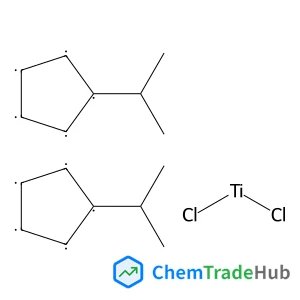
BIS(I-PROPYLCYCLOPENTADIENYL)TITANIUM DICHLORIDE
CAS Number:
12130-65-3
Molecular Formula:
C16H22Cl2Ti
Fahad Abdulaziz, Salman Latif, Abdulaziz Alanazi
The need for cutting-edge energy storage technologies, such as supercapacitors, has been enhanced tremendously to meet the demands of the growing population and depleting fossil fuel reserves. Herein, we reported the synthesis of FeS2 and WO3 nanoparticles decorated on the biochar derived from peanut shells using a facile ultrasonication approach. SEM, TEM, XPS, XRD, FTIR and N2 adsorption–desorption isotherms characterized the structural and physical properties of the as-synthesized materials. BET analysis revealed a specific surface area of 259.87 m2 g−1 for the ternary composite, which serves as a better foundation for transmitting ions and electrons. The composite material derives its advantages from the synergistic effect of biochar's high electronic conductivity and the better capacity retention of FeS2 and WO3 nanoparticles. The ternary composite exhibits excellent electrochemical performance when used as the electrode material for supercapacitors. It offers a high specific capacitance of 319.96 F g−1 at a current density of 1.0 A g−1 and an impressive rate capability, maintaining 82.93% of its initial performance at a current density of 6 A g−1, even after 1000 cycles. Preparing biochar/FeS2/WO3 material with improved electrochemical properties offers a viable pathway for advancing its utilization in supercapacitor applications.
Saptarsi Mondal, Biswajit Biswas, Tonima Nandy, Prashant Chandra Singh
DOI: 10.1039/C7CP04663D
E. Bohl, B. Mignolet, J. O. Johansson, F. Remacle
DOI: 10.1039/C7CP03913A
Mi Rang Son, Yang-Jin Cho, So-Yeon Kim, Ho-Jin Son, Sang Ook Kang
DOI: 10.1039/C7CP04505K
Arpa Galestian Pour, Craig Norman Lincoln, Václav Perlík, František Šanda, Jürgen Hauer
DOI: 10.1039/C7CP05189A
Chengyu Hou, Xiaoliang Ma, Lin Ye, Li Chang, Liping Shi, Xiaodong He
DOI: 10.1039/C7CP04838F
Yih-Chung Chang, Bo Xiong, David H. Bross, C. Y. Ng
DOI: 10.1039/C6CP08200A
Yuki Uchida, Tasuku Iwaizako, Seigi Mizuno, Masaharu Tsuji
DOI: 10.1039/C6CP08903H
Roya Momen, Alireza Azizi, Lingling Wang, Yang Ping, Tianlv Xu, Steven R. Kirk, Wenxuan Li, Sergei Manzhos, Samantha Jenkins
DOI: 10.1039/C7CP05124G
2-Methylbenzene-1,4-diamine dihydrochloride (CAS: 615-45-2) should be stored in ...
(1S,4S)-2,5-Diazabicyclo[2.2.1]heptane dihydrobromide is generally considered sa...
(6-Chloropyridazin-3-YL)methanamine finds applications in the pharmaceutical ind...
2-Fluoro-3-methylphenol is primarily used in the synthesis of pharmaceuticals, p...
When handling 3-Methoxy-4-nitrobenzonitrile, it is important to wear appropriate...
When handling 1,3-Oxazolo[4,5-b]pyridine-2(3H)-thione (CAS: 211949-57-4), it is ...
4-Ethynylbenzamide (CAS: 90347-86-7) falls under various regulatory guidelines i...
3-(2-Ethylphenyl)-2-thioxo-4-imidazolidinone is primarily used as an intermediat...
(2-Fluoro-6-methoxyphenyl)acetic acid, also known as 4-fluoro-3-methoxybenzoic a...
Market trends for 2-[4-(Hydroxymethyl)phenoxy]ethanol (CAS: 102196-18-9) indicat...

Physical Chemistry Chemical Physics (PCCP) is an international journal co-owned by 19 physical chemistry and physics societies from around the world. This journal publishes original, cutting-edge research in physical chemistry, chemical physics and biophysical chemistry. To be suitable for publication in PCCP, articles must include significant innovation and/or insight into physical chemistry; this is the most important criterion that reviewers and Editors will judge against when evaluating submissions. The journal has a broad scope and welcomes contributions spanning experiment, theory, computation and data science. Topical coverage includes spectroscopy, dynamics, kinetics, statistical mechanics, thermodynamics, electrochemistry, catalysis, surface science, quantum mechanics, quantum computing and machine learning. Interdisciplinary research areas such as polymers and soft matter, materials, nanoscience, energy, surfaces/interfaces, and biophysical chemistry are welcomed if they demonstrate significant innovation and/or insight into physical chemistry. Joined experimental/theoretical studies are particularly appreciated when complementary and based on up-to-date approaches.
![(1R,6R)-6-({[(2-Methyl-2-propanyl)oxy]carbonyl}amino)-3-cyclohexene-1-carboxylic acid structure](https://static.chemtradehub.com/structs/865/865689-24-3-5fef.webp "(1R,6R)-6-({[(2-Methyl-2-propanyl)oxy]carbonyl}amino)-3-cyclohexene-1-carboxylic acid structure")