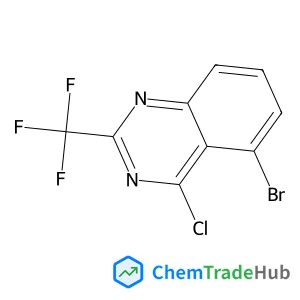
5-Bromo-4-chloro-2-(trifluoromethyl)quinazoline
CAS Number:
2089311-03-3
Molecular Formula:
C9H3BrClF3N2
Justyna Wójcik, Jerzy Peszke, Alicja Ratuszna, Piotr Kuś, Roman Wrzalik
Porphyrins are compounds which are fundamental for designing many photosensitizers assigned for use in photodynamic therapy (PDT). However, photosensitizers available on the drug market are not ideal for use in PDT among others because of their low absorption in the wavelength range optimal for tissue penetration, i.e. the near-infrared (NIR) spectral region. In the present study the density functional theory and its time dependent extension calculations have been used to design new porphyrin-based photosensitizers with absorption in the therapeutic window of PDT of 700–800 nm. Theoretical investigation of four different derivatives of the 5,10,15,20-tetrakis(4-hydroxyphenyl)porphyrin (p-THPP) revealed specific ‘bridge’ configurations which have a significant influence on absorption spectra. The results of the present study may be a useful starting point for future design of porphyrin derivatives as improved photosensitizers.
Yong Jiang, Zhong Liang, Qian Zhang, Yaping Du
DOI: 10.1039/D3CS00708A
Vincent Ming-Yau Leung, Hong-Chai Fabio Wong, Chun-Man Pook, Ying-Lung Steve Tse, Ying-Yeung Yeung
DOI: 10.1039/D3SC03081D
Ritabrita Goswami, Aarohi Gupta, Olga Bednova, Gaël Coulombe, Dipika Patel, Vincent M. Rotello
DOI: 10.1039/D1CS00269D
Hao Lan, Jiawei Wang, Liwei Cheng, Dandan Yu, Hua Wang, Lin Guo
DOI: 10.1039/D3CS00860F
Quanpu Wang, Chao Fang
DOI: 10.1039/D3CS00489A
Qilong Wu, Fangfang Zhu, Gordon Wallace, Xiangdong Yao, Jun Chen
DOI: 10.1039/D3CS00714F
Preeti Chauhan, Ragendu V., Mohan Kumar, Rajib Molla, Surya Dev Mishra, Sneha Basa, Vishal Rai
DOI: 10.1039/D3CS00715D
Xingxing Tan, Xiaodong Ma, Jiaqi Feng
DOI: 10.1039/D3SC02871B
Waste containing 6-Chloro-5-(2'-hydroxy-3'-methoxy-4-biphenylyl)-3-(3-methoxyphe...
(3alpha,5alpha)-3-Hydroxypregnane-11,20-dione is primarily used in the pharmaceu...
The market for 4-Amino-6-chloro-2-pyridinecarboxylic acid (CAS: 546141-56-4) is ...
Alternatives to (2-Benzoylethyl)trimethylammonium chloride (CAS: 24472-88-6) in ...
N-[4-Nitro-3-(trifluoromethyl)phenyl]acetamide (CAS: 393-12-4) is generally safe...
Alternative reagents such as other phosphates or similar functional groups can b...
There are alternatives to N,N'-Bis(3-aminopropyl)-1,3-propanediamine (CAS: 4605-...
When handling Aluminium trihexadecanoate, it is important to use appropriate per...
(1,1-Dioxido-3-oxo-1,2-benzothiazol-2(3H)-yl)acetic acid is a chemical compound ...
Several alternatives to 5,5-dimethyloxolan-2-one (CAS: 3123-97-5) can be used in...

Physical Chemistry Chemical Physics (PCCP) is an international journal co-owned by 19 physical chemistry and physics societies from around the world. This journal publishes original, cutting-edge research in physical chemistry, chemical physics and biophysical chemistry. To be suitable for publication in PCCP, articles must include significant innovation and/or insight into physical chemistry; this is the most important criterion that reviewers and Editors will judge against when evaluating submissions. The journal has a broad scope and welcomes contributions spanning experiment, theory, computation and data science. Topical coverage includes spectroscopy, dynamics, kinetics, statistical mechanics, thermodynamics, electrochemistry, catalysis, surface science, quantum mechanics, quantum computing and machine learning. Interdisciplinary research areas such as polymers and soft matter, materials, nanoscience, energy, surfaces/interfaces, and biophysical chemistry are welcomed if they demonstrate significant innovation and/or insight into physical chemistry. Joined experimental/theoretical studies are particularly appreciated when complementary and based on up-to-date approaches.