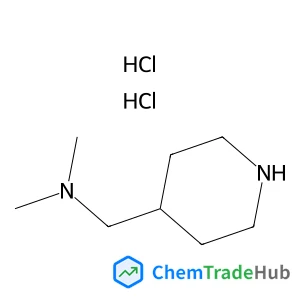
N,N-dimethyl(piperidin-4-yl)methanamine hydrochloride
CAS Number:
172281-72-0
Molecular Formula:
C8H20Cl2N2
Asim Jana, Prabhas Bhaumick, Anoop Kumar Panday, Richa Mishra, Lokman H. Choudhury
Synthesis of a series of 2-arylbenzo[d]imidazo[2,1-b] thiazoles tethered with barbituric acid moiety has been reported from the three component reaction of 2-aminobenzothiazoles, barbituric acids and terminal aryl acetylenes or aryl methyl ketones in the presence of I2 in DMSO medium. Both conventional and microwave heating conditions can be used for this multicomponent reaction. The salient features of this methodology are: (i) formation of one C–C and two C–N bonds in one-pot under metal-free oxidation followed by cyclization, (ii) selective formation of the fused imidazole ring, (iii) wide substrate scope, (iv) easy purification of the products, (v) products having more than one pharmaceutically important motifs and (vi) gram scale synthesis possible.
Eric B. Lindgren, Ho-Kei Chan, Anthony J. Stace, Elena Besley
DOI: 10.1039/C5CP07709E
Ghazal Jabbari, Tsveta Miteva, Vasili Stumpf, Kirill Gokhberg, Patrick O'Keeffe, Alessandra Ciavardini, Paola Bolognesi, Marcello Coreno, Lorenzo Avaldi, Elham Keshavarz, Maryam Ghandehari, Manijeh Tozihi, Carlo Callegari, Michele Alagia, Antti Kivimäki, Robert Richter
DOI: 10.1039/C5CP03276H
Michael W. Jones, Thembanikosi G. Gaule, Michael J. McPherson, Jonathan R. Dilworth, Christiane R. Timmel
DOI: 10.1039/C5CP06096F
Irshad Ahmad, Ajaz Ahmad, Masood Ahmad
DOI: 10.1039/C5CP07351K
José M. Méndez-Reyes, B. Marel Monroy, Monserrat Bizarro, Frank Güell, Ana Martínez, Estrella Ramos
DOI: 10.1039/C5CP01415H
Geon-Hyoung An, Bon-Ryul Koo, Hyo-Jin Ahn
DOI: 10.1039/C6CP00035E
Qiao-Zhi Li, Jia-Jia Zheng, Xiang Zhao
DOI: 10.1039/C5CP03737A
Xinyuan Che, Shiming Gong, Heng Zhang, Bin Liu, Yinghan Wang
DOI: 10.1039/C5CP06488K
DOI: 10.1039/C6CP00602G
Tao Yang, Lloyd Muzangwa, Ralf I. Kaiser, Adeel Jamal
DOI: 10.1039/C5CP03285G
1-(2,4,6-Trifluorophenyl)ethanol is an organic compound with the CAS number 1250...
1-(2,4-Dimethoxybenzyl)-4-(hydroxymethyl)-2-pyrrolidinone (CAS: 919111-34-5) is ...
(7S,15R)-6β,15-Diacetoxy-7α,20-epoxy-7-hydroxykaura-2,16-dien-1-one is a crystal...
The compound rac-ethyl (1r,4r)-4-hydroxycyclohexane-1-carboxylate, trans (CAS: 3...
The market for 2-(2,4-Difluorophenoxy)-3-nitropyridine (CAS: 175135-62-3) is cur...
The main uses of 6-Diazo-5-oxo-L-norleucine (CAS: 157-03-9) include research in ...
When handling 2-Aminoethyl-mono-amide-DOTA-tris(tBu ester) (CAS: 173308-19-5), i...
5-Methylimidazo[1,2-a]pyridine-3-carbaldehyde (CAS: 178488-37-4) can be synthesi...
There are alternative reagents that can be used in the synthesis of 2,4,6-Trihyd...
(2Z)-3-(5-Fluoro-1H-indol-3-yl)-2-sulfanylacrylic acid is a chemical compound wi...

Organic & Biomolecular Chemistry (OBC) publishes original and high impact research and reviews in organic chemistry. We welcome research that shows new or significantly improved protocols or methodologies in total synthesis, synthetic methodology or physical and theoretical organic chemistry as well as research that shows a significant advance in the organic chemistry or molecular design aspects of chemical biology, catalysis, supramolecular and macromolecular chemistry, theoretical chemistry, mechanism-oriented physical organic chemistry, medicinal chemistry or natural products. Articles published in the journal should report new work which makes a highly-significant impact in the field. Routine and incremental work is generally not suitable for publication in the journal. More details about key areas of our scope are below. In all cases authors should include in their article clear rationale for why their research has been carried out.
![2-(Methylsulfonyl)-2,4,5,6-tetrahydropyrrolo[3,4-c]pyrazole structure](https://static.chemtradehub.com/structs/122/1226781-80-1-09d5.webp "2-(Methylsulfonyl)-2,4,5,6-tetrahydropyrrolo[3,4-c]pyrazole structure")
![Imidazo[1,5-a]pyrazine structure](https://static.chemtradehub.com/structs/274/274-49-7-d749.webp "Imidazo[1,5-a]pyrazine structure")