












Hybrid QM/QM simulations of photochemical reactions in the molecular crystal N-salicylidene-2-chloroaniline‡
Literature Information
Publication Date
2013-05-14
DOI
10.1039/C3CP51263K
Impact Factor
3.676
Authors
Michał A. Kochman, Carole A. Morrison
View Original
Abstract
In this paper, we report the application of the QM/QM hybrid simulation technique to the photoisomerisation reactions of anils (i.e., Schiff bases of salicylaldehyde with aniline derivatives) in the solid state, on the example of the photochromic polymorph of N-salicylidene-2-chloroaniline. By propagating molecular dynamics on a potential energy surface constructed using a combination of time-dependent DFT and ground-state DFT calculations, two reaction pathways of the cis-enol isomer were observed, which occur with approximately equal probability. In the first pathway, the photoexcited molecule undergoes an intramolecular proton transfer reaction on average 25 fs after photoexcitation. It then persists in the cis-keto form for a few hundred femtoseconds before undergoing a pedal motion through which it reaches an S1/S0 conical intersection. This pathway, whose existence has previously been proposed in the literature to rationalize the feasibility of the photoisomerisation reaction in the confined environment of the crystal lattice, is predicted to lead to the formation of the trans-keto form. The second pathway is nonreactive and is analogous to a previously characterised radiationless de-excitation pathway of the isolated molecule. The cis-enol to trans-keto photoisomerisation is reversible. Following the photoexcitation of a trans-keto molecule, it persists in a largely unchanged geometry for a period of time ranging from a few hundred femtoseconds to over a picosecond, and subsequently undergoes a pedal motion in the same direction as the one involved in the cis-enol to trans-keto photoisomerisation, leading to the cis-keto isomer through another S1/S0 conical intersection.
Related Literature
Correction: Large-scale electricity storage utilizing reversible solid oxide cells combined with underground storage of CO2 and CH4
S. H. Jensen, C. Graves, M. Mogensen, C. Wendel, R. Braun, G. Hughes, Z. Gao, S. A. Barnett
2016-11-25
Correction
DOI: 10.1039/C6EE90064J
Nanoparticle counting: towards accurate determination of the molar concentration
Jing Shang, Xiaohu Gao
2014-08-07
Tutorial Review
DOI: 10.1039/C4CS00128A
Freestanding interconnected nanocluster textiles for efficient oxygen evolution reaction
Shougo Higashi, Takashi Tachikawa, Keiichiro Oh-ishi, Keisuke Shigetoh, Kensuke Takechi, Atsushi Beniya
2020-09-24
Paper
DOI: 10.1039/D0TA07707K
Facile growth of transition metal hydroxide nanosheets on porous nickel foam for efficient electrooxidation of benzyl alcohol
Xiao-Yuan Wu, Sa-Sa Wang, Weiming Wu
2021-09-06
Paper
DOI: 10.1039/D1GC02218K
Depolymerization of lignocellulosic biomass to fuel precursors: maximizing carbon efficiency by combining hydrolysis with pyrolysis
Jungho Jae, Geoffrey A. Tompsett, Yu-Chuan Lin, Torren R. Carlson, Jiacheng Shen, Taiying Zhang, Bin Yang, Charles E. Wyman, W. Curtis Conner, George W. Huber
2010-02-12
Paper
DOI: 10.1039/B924621P
A hierarchical carbon nitride tube with oxygen doping and carbon defects promotes solar-to-hydrogen conversion
Wu Wang, Qianwen Chen, Yayun Pu, Weiman Zhuang
2020-01-03
Paper
DOI: 10.1039/C9TA13012H
Diketopyrrolopyrrole-based semiconducting polymer nanoparticles for in vivo second near-infrared window imaging and image-guided tumor surgery
Yufu Tang, Hao Chen, Si Chen, Lei Zhang, Ao Zhang, Quli Fan, Aixi Yu, Zhen Cheng
2018-02-06
Edge Article
DOI: 10.1039/C8SC00206A
You might also like
Compound Q&A
What are the main uses of (5-Sulfamoyl-3-pyridinyl)boronic acid (CAS: 951233-61-7)?
(5-Sulfamoyl-3-pyridinyl)boronic acid is primarily used in chemical synthesis, p...
951233-61-7(5-Sulfamoyl-3-pyrid...
Compound Q&A
How is Benzyl 2-methyl-2-(methylsulfonyl)-4-pentenoate (CAS: 1942858-50-5) typically synthesized?
Benzyl 2-methyl-2-(methylsulfonyl)-4-pentenoate is typically synthesized via est...
1942858-50-5Benzyl 2-methyl-2-(m...
Compound Q&A
What precautions should be taken when handling 8-Fluoroquinolin-6-ol (CAS: 209353-22-0)?
When handling 8-Fluoroquinolin-6-ol (CAS: 209353-22-0), it is important to use p...
209353-22-08-Fluoroquinolin-6-o...
Compound Q&A
What are the physical and chemical properties of 1,3-Dibromo-5-(2-methyl-2-propanyl)benzene (CAS: 129316-09-2)?
1,3-Dibromo-5-(2-methyl-2-propanyl)benzene (CAS: 129316-09-2) is a crystalline c...
129316-09-21,3-Dibromo-5-(2-met...
Compound Q&A
What industries use Ethyl 7-chloro-4-oxo-1-(1,3-thiazol-2-yl)-1,4-dihydro-1,8-naphthyridine-3-carboxylate (CAS: 174726-87-5)?
Ethyl 7-chloro-4-oxo-1-(1,3-thiazol-2-yl)-1,4-dihydro-1,8-naphthyridine-3-carbox...
174726-87-5Ethyl 7-chloro-4-oxo...
Compound Q&A
What precautions should be taken when handling Delta-7-Avenasterol (CAS: 23290-26-8)?
When handling Delta-7-Avenasterol (CAS: 23290-26-8), it is important to wear app...
23290-26-8Delta-7-Avenasterol
Compound Q&A
What precautions should be taken when handling N-({(5R)-3-[3-Fluoro-4-(4-morpholinyl)phenyl]-2-oxo-1,3-oxazolidin-5-yl}methyl)acetamide (CAS: 872992-20-6)?
Proper handling involves the use of personal protective equipment such as gloves...
872992-20-6N-({(5R)-3-[3-Fluoro...
Compound Q&A
What precautions should be taken when handling 2-Methyl-2-proanyl 4-[(2-aminophenyl)amino]-1-piperidinecarboxylate (CAS: 79099-00-6)?
When handling 2-Methyl-2-proanyl 4-[(2-aminophenyl)amino]-1-piperidinecarboxylat...
79099-00-62-Methyl-2-propanyl ...
Compound Q&A
What is N-Methyl-4-chlorobenzylamine hydrochloride (CAS: 65542-24-7)?
N-Methyl-4-chlorobenzylamine hydrochloride (CAS: 65542-24-7) is a organic compou...
65542-24-7N-Methyl-4-chloroben...
Compound Q&A
Is [2-(Dodecyloxy)ethoxy]acetic acid (CAS: 27306-90-7) safe?
[2-(Dodecyloxy)ethoxy]acetic acid (CAS: 27306-90-7) is generally considered safe...
27306-90-7[2-(Dodecyloxy)ethox...
Source Journal
Physical Chemistry Chemical Physics

CiteScore:
5.5
Self-citation Rate:
10.3%
Articles per Year:
3036
Physical Chemistry Chemical Physics (PCCP) is an international journal co-owned by 19 physical chemistry and physics societies from around the world. This journal publishes original, cutting-edge research in physical chemistry, chemical physics and biophysical chemistry. To be suitable for publication in PCCP, articles must include significant innovation and/or insight into physical chemistry; this is the most important criterion that reviewers and Editors will judge against when evaluating submissions. The journal has a broad scope and welcomes contributions spanning experiment, theory, computation and data science. Topical coverage includes spectroscopy, dynamics, kinetics, statistical mechanics, thermodynamics, electrochemistry, catalysis, surface science, quantum mechanics, quantum computing and machine learning. Interdisciplinary research areas such as polymers and soft matter, materials, nanoscience, energy, surfaces/interfaces, and biophysical chemistry are welcomed if they demonstrate significant innovation and/or insight into physical chemistry. Joined experimental/theoretical studies are particularly appreciated when complementary and based on up-to-date approaches.
Recommended Compounds
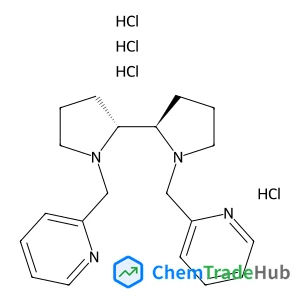
(2R,2'R)-1,1'-Bis(2-pyridinylmethyl)-2,2'-bipyrrolidine tetrahydrochloride
CAS Number:
1228077-88-0
Molecular Formula:
C20H30Cl4N4
![N-[(6-Bromo-3-pyridinyl)methyl]ethanamine structure](https://static.chemtradehub.com/structs/120/120740-05-8-ca55.webp "N-[(6-Bromo-3-pyridinyl)methyl]ethanamine structure")

Recommended Suppliers



Disclaimer
This page provides academic journal information for reference and research purposes only. We are not affiliated with any journal publishers and do not handle publication submissions. For publication-related inquiries, please contact the respective journal publishers directly.
If you notice any inaccuracies in the information displayed, please contact us at support@chemtradehub.com. We will promptly review and address your concerns.