












Facile growth of transition metal hydroxide nanosheets on porous nickel foam for efficient electrooxidation of benzyl alcohol
Literature Information
Publication Date
2021-09-06
DOI
10.1039/D1GC02218K
Impact Factor
10.182
Authors
Xiao-Yuan Wu, Sa-Sa Wang, Weiming Wu
View Original
Abstract
Porous transition metal hydroxide (M(OH)2, M = Ni or Co) nanosheet/Ni foam electrodes were prepared by a facile electrodeposition method. The catalytic activities of the as-prepared porous electrodes for the electrooxidation of benzyl alcohol were investigated in NaOH aqueous solution. It was found that the Ni(OH)2 nanosheet/Ni foam electrode exhibited a superior current density to the obtained Co(OH)2 nanosheet/Ni foam electrode for the electrooxidation of benzyl alcohol, in which the Ni(OH)2 nanosheet electrode required an extremely low potential of ∼1.33 V vs. RHE to achieve a current density of 100 mA cm−2. The results of the durability test revealed that it exhibited an outstanding stability for the electrooxidation of benzyl alcohol. Moreover, the electrooxidation of benzyl alcohol for the green synthesis of benzoic acid with the simultaneous generation of hydrogen could be easily implemented in a two-electrode configuration by using noble-metal-free catalysts. When benzyl alcohol was fully oxidized, the optimized selectivity of benzoic acid and the faradaic efficiency for the electrooxidation of BnOH could reach 96% and 95%, respectively.
Related Literature
In silico prediction of MOFs with high deliverable capacity or internal surface area
Yi Bao, Richard L. Martin, Maciej Haranczyk
2015-02-19
Paper
DOI: 10.1039/C5CP00002E
Equilibration processes during gas uptake inside narrow pores
Joshua M. Vann, Samantha L. Molnar, M. Mercedes Calbi
2015-04-16
Paper
DOI: 10.1039/C5CP00502G
A microfluidic platform for quantitative measurements of effective protein charges and single ion binding in solution
Therese W. Herling, Paolo Arosio, Thomas Müller, Sara Linse, Tuomas P. J. Knowles
2015-04-16
Paper
DOI: 10.1039/C5CP00746A
Theoretical study of electronic and tribological properties of h-BNC2/graphene, h-BNC2/h-BN and h-BNC2/h-BNC2 bilayers
Narjes Ansari, Francesc Illas
2015-03-20
Paper
DOI: 10.1039/C5CP00381D
Oxygen diffusion in single crystal barium titanate
Markus Kessel, Roger A. De Souza, Manfred Martin
2015-04-14
Paper
DOI: 10.1039/C5CP01187F
Towards multielectron photocatalysis: a porphyrin array for lateral hole transfer and capture on a metal oxide surface
Bradley J. Brennan, Alec C. Durrell, Matthieu Koepf, Robert H. Crabtree, Gary W. Brudvig
2015-04-16
Paper
DOI: 10.1039/C5CP01683E
Bringing light into the dark triplet space of molecular systems
Jing Ge, Zhigang Geng, Shenlong Jiang, Kaili Fan, Zhenkun Guo, Jiahua Hu, Zongwei Chen
2015-04-20
Paper
DOI: 10.1039/C5CP00323G
Dynamics and mechanisms of DNA repair by photolyase
Zheyun Liu, Lijuan Wang, Dongping Zhong
2015-03-26
Perspective
DOI: 10.1039/C4CP05286B
Self-assembly and coverage dependent thermally induced conformational changes of Ni(ii)-meso-tetrakis (4-tert-butylphenyl) benzoporphyrin on Cu(111)
2015-04-20
Paper
DOI: 10.1039/C5CP01490E
The histone H3 N-terminal tail: a computational analysis of the free energy landscape and kinetics
Yuqing Zheng
2015-04-24
Paper
DOI: 10.1039/C5CP01858G
You might also like
Compound Q&A
What are the main uses of (5-Sulfamoyl-3-pyridinyl)boronic acid (CAS: 951233-61-7)?
(5-Sulfamoyl-3-pyridinyl)boronic acid is primarily used in chemical synthesis, p...
951233-61-7(5-Sulfamoyl-3-pyrid...
Compound Q&A
How is Benzyl 2-methyl-2-(methylsulfonyl)-4-pentenoate (CAS: 1942858-50-5) typically synthesized?
Benzyl 2-methyl-2-(methylsulfonyl)-4-pentenoate is typically synthesized via est...
1942858-50-5Benzyl 2-methyl-2-(m...
Compound Q&A
What precautions should be taken when handling 8-Fluoroquinolin-6-ol (CAS: 209353-22-0)?
When handling 8-Fluoroquinolin-6-ol (CAS: 209353-22-0), it is important to use p...
209353-22-08-Fluoroquinolin-6-o...
Compound Q&A
What are the physical and chemical properties of 1,3-Dibromo-5-(2-methyl-2-propanyl)benzene (CAS: 129316-09-2)?
1,3-Dibromo-5-(2-methyl-2-propanyl)benzene (CAS: 129316-09-2) is a crystalline c...
129316-09-21,3-Dibromo-5-(2-met...
Compound Q&A
What industries use Ethyl 7-chloro-4-oxo-1-(1,3-thiazol-2-yl)-1,4-dihydro-1,8-naphthyridine-3-carboxylate (CAS: 174726-87-5)?
Ethyl 7-chloro-4-oxo-1-(1,3-thiazol-2-yl)-1,4-dihydro-1,8-naphthyridine-3-carbox...
174726-87-5Ethyl 7-chloro-4-oxo...
Compound Q&A
What precautions should be taken when handling Delta-7-Avenasterol (CAS: 23290-26-8)?
When handling Delta-7-Avenasterol (CAS: 23290-26-8), it is important to wear app...
23290-26-8Delta-7-Avenasterol
Compound Q&A
What precautions should be taken when handling N-({(5R)-3-[3-Fluoro-4-(4-morpholinyl)phenyl]-2-oxo-1,3-oxazolidin-5-yl}methyl)acetamide (CAS: 872992-20-6)?
Proper handling involves the use of personal protective equipment such as gloves...
872992-20-6N-({(5R)-3-[3-Fluoro...
Compound Q&A
What precautions should be taken when handling 2-Methyl-2-proanyl 4-[(2-aminophenyl)amino]-1-piperidinecarboxylate (CAS: 79099-00-6)?
When handling 2-Methyl-2-proanyl 4-[(2-aminophenyl)amino]-1-piperidinecarboxylat...
79099-00-62-Methyl-2-propanyl ...
Compound Q&A
What is N-Methyl-4-chlorobenzylamine hydrochloride (CAS: 65542-24-7)?
N-Methyl-4-chlorobenzylamine hydrochloride (CAS: 65542-24-7) is a organic compou...
65542-24-7N-Methyl-4-chloroben...
Compound Q&A
Is [2-(Dodecyloxy)ethoxy]acetic acid (CAS: 27306-90-7) safe?
[2-(Dodecyloxy)ethoxy]acetic acid (CAS: 27306-90-7) is generally considered safe...
27306-90-7[2-(Dodecyloxy)ethox...
Source Journal
Green Chemistry

CiteScore:
16.1
Self-citation Rate:
7.5%
Articles per Year:
944
Green Chemistry provides a unique forum for the publication of innovative research on the development of alternative green and sustainable technologies. The scope of Green Chemistry is based on, but not limited to, the definition proposed by Anastas and Warner (Green Chemistry: Theory and Practice, P T Anastas and J C Warner, Oxford University Press, Oxford, 1998). Green chemistry is the utilisation of a set of principles that reduces or eliminates the use or generation of hazardous substances in the design, manufacture and application of chemical products. Green Chemistry is at the frontiers of this continuously-evolving interdisciplinary science and publishes research that attempts to reduce the environmental impact of the chemical enterprise by developing a technology base that is inherently non-toxic to living things and the environment. Submissions on all aspects of research relating to the endeavour are welcome. The journal publishes original and significant cutting-edge research that is likely to be of wide general appeal. To be published, work must present a significant advance in green chemistry. Papers must contain a comparison with existing methods and demonstrate advantages over those methods before publication can be considered. For more information please see this Editorial. Coverage includes the following, but is not limited to: Design (e.g. biomimicry, design for degradation/recycling/reduced toxicity…) Reagents & Feedstocks (e.g. renewables, CO2, solvents, auxiliary agents, waste utilization…) Synthesis (e.g. organic, inorganic, synthetic biology…) Catalysis (e.g. homogeneous, heterogeneous, enzyme, whole cell…) Process (e.g. process design, intensification, separations, recycling, efficiency…) Energy (e.g. renewable energy, fuels, photovoltaics, fuel cells, energy storage, energy carriers…) Applications (e.g. electronics, dyes, consumer products, coatings, pharmaceuticals, preservatives, building materials, chemicals for industry/agriculture/mining…) Impact (e.g. safety, metrics, LCA, sustainability, (eco)toxicology…) Green chemistry is, by definition, a continuously-evolving frontier. Therefore, the inclusion of a particular material or technology does not, of itself, guarantee that a paper is suitable for the journal. To be suitable, the novel advance should have the potential for reduced environmental impact relative to the state of the art. Green Chemistry does not normally deal with research associated with 'end-of-pipe' or remediation issues.
Recommended Compounds
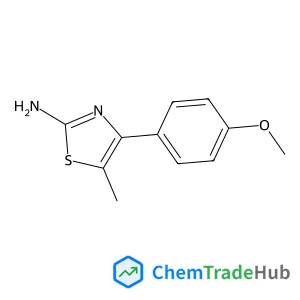
4-(4-Methoxyphenyl)-5-methyl-1,3-thiazol-2-amine
CAS Number:
105512-88-7
Molecular Formula:
C11H12N2OS
Recommended Suppliers





Disclaimer
This page provides academic journal information for reference and research purposes only. We are not affiliated with any journal publishers and do not handle publication submissions. For publication-related inquiries, please contact the respective journal publishers directly.
If you notice any inaccuracies in the information displayed, please contact us at support@chemtradehub.com. We will promptly review and address your concerns.