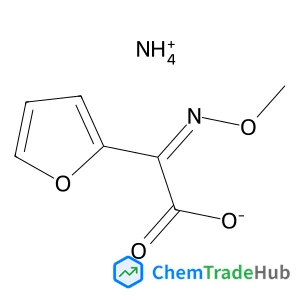
Ammonium (Z)-2-(furan-2-yl)-2-(methoxyimino)acetate
CAS Number:
97148-39-5
Molecular Formula:
C7H10N2O4
A statistical theory of temperature-induced spin-crossover-like transitions has been developed for spin chains with a few exchange clusters in a unit cell. Using static magnetic susceptibility measurements, a general expression for the effective magnetic moment μeff of exchange clusters is obtained for an arbitrary structure of cluster terms. For heterospin Cu(hfac)2LR complexes (“breathing crystals”) with a “head-to-head” chain motif, a two-point approximation for a partition function of the Jahn–Teller Cu+2 paramagnetic center (spin 1/2) is suggested. Theoretical results are compared with available experimental data on thermal spin-crossover-like transitions in the “breathing crystal” compounds. It is shown that the model developed is able to successfully describe both of the cases of smooth and abrupt (cooperative) spin transitions for chains of three-spin exchange clusters. Spin-crossover-like transitions of a new type with step-wise changes in a positive exchange integral are predicted.
DOI: 10.1039/C0CP02776F
Dakui Zhang, Virginia Martín, Inmaculada García-Moreno, Angel Costela, M. Eugenia Pérez-Ojeda, Yi Xiao
DOI: 10.1039/C1CP21038F
Xiang Shao, Jan-Frederik Jerratsch, Niklas Nilius, Hans-Joachim Freund
DOI: 10.1039/C1CP21113G
Ulrich Hasse, Gottfried J. Palm, Winfried Hinrichs, Fritz Scholz
DOI: 10.1039/C0CP01469A
Lorenz Gubler, Alexander Wokaun, Willem H. Koppenol
DOI: 10.1039/C1CP20499H
Yongcai Qiu, Xinfeng Zhang, Shihe Yang
DOI: 10.1039/C1CP21148J
Ramdas Pophale, Phillip A. Cheeseman, Michael W. Deem
DOI: 10.1039/C0CP02255A
1H-Indazole-6-carbonitrile finds applications in pharmaceuticals, where it serve...
Waste containing Dioctyl (2E)-2-butenedioate (CAS: 2997-85-5) should be collecte...
Sodium [(1,2-benzoxazol-3-ylmethyl)sulfonyl]azanide is primarily used in pharmac...
Dimethyl 4-(4,4,5,5-tetramethyl-1,3,2-dioxaborolan-2-yl)-2,6-pyridinedicarboxyla...
Waste containing 2-Fluoro-6-hydrazinopyridine (CAS: 80714-39-2) should be manage...
6-Formyl-2-pyridinecarboxylic acid is an organic compound with the molecular for...
Research trends for this compound indicate a focus on its potential applications...
9H-Tribenzo[b,d,f]azepine is typically synthesized via a multi-step process invo...
1-Cyclopropyl-7-ethoxy-6-fluoro-8-methoxy-4-oxo-1,4-dihydro-3-quinolinecarboxyli...
Waste containing Methyl 3-oxo-1,2,3,4-tetrahydro-6-quinoxalinecarboxylate (CAS: ...

Physical Chemistry Chemical Physics (PCCP) is an international journal co-owned by 19 physical chemistry and physics societies from around the world. This journal publishes original, cutting-edge research in physical chemistry, chemical physics and biophysical chemistry. To be suitable for publication in PCCP, articles must include significant innovation and/or insight into physical chemistry; this is the most important criterion that reviewers and Editors will judge against when evaluating submissions. The journal has a broad scope and welcomes contributions spanning experiment, theory, computation and data science. Topical coverage includes spectroscopy, dynamics, kinetics, statistical mechanics, thermodynamics, electrochemistry, catalysis, surface science, quantum mechanics, quantum computing and machine learning. Interdisciplinary research areas such as polymers and soft matter, materials, nanoscience, energy, surfaces/interfaces, and biophysical chemistry are welcomed if they demonstrate significant innovation and/or insight into physical chemistry. Joined experimental/theoretical studies are particularly appreciated when complementary and based on up-to-date approaches.
![Sodium 3-[(E)-(4-anilinophenyl)diazenyl]benzenesulfonate structure](https://static.chemtradehub.com/structs/587/587-98-4-035f.webp "Sodium 3-[(E)-(4-anilinophenyl)diazenyl]benzenesulfonate structure")