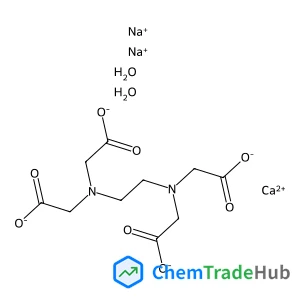
EthylenediaminetetraaceticacidcalciumDisodiumsalthydrate
CAS Number:
23411-34-9
Molecular Formula:
C10H16CaN2Na2O10
Xiang Shao, Jan-Frederik Jerratsch, Niklas Nilius, Hans-Joachim Freund
Low-temperature scanning tunneling microscopy and spectroscopy have been employed to analyze the local electronic structure of the (111) surface of a ceria thin film grown on Ru(0001). On pristine, defect-free oxide terraces, the empty 4f states of Ce4+ ions appear as the only spectral feature inside the 6 eV oxide band gap. In contrast, occupied states are detected between −1.0 and −1.5 eV below EFermi in conductance spectra of different point and line defects, such as surface oxygen vacancies, grain boundaries and step edges. They are assigned to partially filled 4f states localized at the Ce3+ ions. The presence of excess electrons indicates the oxygen-deficient nature of the direct oxide environment. The f state spectroscopy with the STM allows us to probe the spatial distribution of Ce3+ ions in the ceria surface, providing unique insight into the local reduction state of this chemically important material system.
Xi Liu, Yulia Ryabenkova, Marco Conte
DOI: 10.1039/C4CP03568B
Rares Stiufiuc, Cristian Iacovita, Gabriela Stiufiuc, Ede Bodoki, Vasile Chis, Constantin M. Lucaciu
DOI: 10.1039/C4CP03413A
Preeyaporn Chaiyasat, Sayrung Noppalit, Amorn Chaiyasat
DOI: 10.1039/C4CP03458A
Shuanglong Chen, Mingguang Yao, Ye Yuan, Fengxian Ma, Zhaodong Liu, Ran Liu, Wen Cui, Xue Yang, Bo Liu, Bo Zou, Tian Cui, Bingbing Liu
DOI: 10.1039/C3CP55164D
Néstor Guijarro, Elena Guillén, Teresa Lana-Villarreal, Roberto Gómez
DOI: 10.1039/C4CP00294F
Ping Wu, Pan Du, Hui Zhang, Chenxin Cai
DOI: 10.1039/C4CP04181J
Kyoung E. Kweon, Gyeong S. Hwang, Jinhan Kim, Sungjin Kim, SeongMin Kim
DOI: 10.1039/C4CP03666B
B. Wang, Z. Lou, B. Park, Y. Kwon, H. Zhang, B. Xu
DOI: 10.1039/C4CP03190C
Qiang Cui, Marcus Elstner
DOI: 10.1039/C4CP00908H
William Paul, David Oliver, Peter Grütter
DOI: 10.1039/C3CP54869D
1H-Indazole-6-carbonitrile finds applications in pharmaceuticals, where it serve...
Waste containing Dioctyl (2E)-2-butenedioate (CAS: 2997-85-5) should be collecte...
Sodium [(1,2-benzoxazol-3-ylmethyl)sulfonyl]azanide is primarily used in pharmac...
Dimethyl 4-(4,4,5,5-tetramethyl-1,3,2-dioxaborolan-2-yl)-2,6-pyridinedicarboxyla...
Waste containing 2-Fluoro-6-hydrazinopyridine (CAS: 80714-39-2) should be manage...
6-Formyl-2-pyridinecarboxylic acid is an organic compound with the molecular for...
Research trends for this compound indicate a focus on its potential applications...
9H-Tribenzo[b,d,f]azepine is typically synthesized via a multi-step process invo...
1-Cyclopropyl-7-ethoxy-6-fluoro-8-methoxy-4-oxo-1,4-dihydro-3-quinolinecarboxyli...
Waste containing Methyl 3-oxo-1,2,3,4-tetrahydro-6-quinoxalinecarboxylate (CAS: ...

Physical Chemistry Chemical Physics (PCCP) is an international journal co-owned by 19 physical chemistry and physics societies from around the world. This journal publishes original, cutting-edge research in physical chemistry, chemical physics and biophysical chemistry. To be suitable for publication in PCCP, articles must include significant innovation and/or insight into physical chemistry; this is the most important criterion that reviewers and Editors will judge against when evaluating submissions. The journal has a broad scope and welcomes contributions spanning experiment, theory, computation and data science. Topical coverage includes spectroscopy, dynamics, kinetics, statistical mechanics, thermodynamics, electrochemistry, catalysis, surface science, quantum mechanics, quantum computing and machine learning. Interdisciplinary research areas such as polymers and soft matter, materials, nanoscience, energy, surfaces/interfaces, and biophysical chemistry are welcomed if they demonstrate significant innovation and/or insight into physical chemistry. Joined experimental/theoretical studies are particularly appreciated when complementary and based on up-to-date approaches.