












![N-[(6-Bromo-3-pyridinyl)methyl]ethanamine structure](https://static.chemtradehub.com/structs/120/120740-05-8-ca55.webp "N-[(6-Bromo-3-pyridinyl)methyl]ethanamine structure")
Electronic structures and magnetic properties of MoS2nanostructures: atomic defects, nanoholes, nanodots and antidots
Literature Information
Publication Date
2013-04-22
DOI
10.1039/C3CP50381J
Impact Factor
3.676
Authors
Yungang Zhou, Ping Yang, Haoyue Zu, Fei Gao, Xiaotao Zu
View Original
Abstract
Developing approaches to effectively induce and control the magnetic states is critical to the use of magnetic nanostructures in quantum information devices but is still challenging. Here MoS2-based nanostructures including atomic defects, nanoholes, nanodots and antidots are characterized with spin-polarized density functional theory. The S-vacancy defect is more likely to form than the Mo-vacancy defect due to the form of Mo–Mo metallic bonds. Among different shaped nanoholes and nanodots, triangle ones associated with ferromagnetic characteristic are most energetically favorable, and exhibit unexpected large spin moments that scale linearly with edged length. In particular, S-terminated triangle nanodots show strong spin anisotropy around the Fermi level with a substantial collective characteristic of spin states at edges, enabling it to a desired spin-filtering structure. However, in the antidot, the net spin, coupled order and stability of spin states can be engineered by controlling type and distance of internal nanoholes. Based on the analysis of the spin coupled mechanism, a specific antidot structure, the only S-terminated antidot, was determined to exhibit a large net spin with long-range ferromagnetic coupling above room temperature. Given the recent achievement of graphene- and BN-based nanohole, nanodot and antidot structures, we believe that our calculated results are suitable for experimental verification and implementation opening a new path to explore MoS2-based magnetic nanostructures.
Related Literature
A stochastic, local mode study of neon–liquid surface collision dynamics
Daniel M. Packwood, Leon F. Phillips
2010-11-01
Paper
DOI: 10.1039/C0CP00787K
In situ X-ray probing reveals fingerprints of surface platinum oxide
Daniel Friebel, Daniel J. Miller, Christopher P. O’Grady, Toyli Anniyev, John Bargar, Uwe Bergmann, Hirohito Ogasawara, Kjartan Thor Wikfeldt, Lars G. M. Pettersson, Anders Nilsson
2010-11-09
Paper
DOI: 10.1039/C0CP01434F
Enhanced open circuit voltage by hydrophilic ionic liquids as buffer layer in conjugated polymer–nanoporous titania hybrid solar cells
Hyosung Choi, Heesook Cho, Suhee Song, Hongsuk Suh, Soojin Park, Jin Young Kim
2010-10-26
Paper
DOI: 10.1039/C0CP01754J
Density functional theory for strongly-interacting electrons: perspectives for physics and chemistry
Paola Gori-Giorgi, Michael Seidl
2010-10-01
Perspective
DOI: 10.1039/C0CP01061H
Benzocarbazole anions intercalated layered double hydroxide and its tunable fluorescence
Dongpeng Yan, Jun Lu, Jing Ma, Min Wei, David G. Evans, Xue Duan
2010-10-20
Paper
DOI: 10.1039/C0CP00854K
Infrared spectra and quantum chemical characterization of weakly bound clusters of the benzoyl cation with Ar and H2O
Alexander Patzer, Shamik Chakraborty, Otto Dopfer
2010-08-16
Paper
DOI: 10.1039/C0CP00696C
Direct formation of a 2D redox-active adlayer based on a bisterpyridine derivative and Co2+ on a Au(111)electrode
Soichiro Yoshimoto, Yuta Ono, Katsuhiko Nishiyama, Isao Taniguchi
2010-09-24
Communication
DOI: 10.1039/C0CP00981D
Mechanistical studies on the electron-induced degradation of polymethylmethacrylate and Kapton
Courtney P. Ennis, Ralf I. Kaiser
2010-10-26
Paper
DOI: 10.1039/C0CP01130D
Structure and dynamics of the Zr4+ ion in water
Christoph B. Messner, Thomas S. Hofer, Bernhard R. Randolf, Bernd M. Rode
2010-11-22
Paper
DOI: 10.1039/C0CP01330G
You might also like
Compound Q&A
What are the main uses of (5-Sulfamoyl-3-pyridinyl)boronic acid (CAS: 951233-61-7)?
(5-Sulfamoyl-3-pyridinyl)boronic acid is primarily used in chemical synthesis, p...
951233-61-7(5-Sulfamoyl-3-pyrid...
Compound Q&A
How is Benzyl 2-methyl-2-(methylsulfonyl)-4-pentenoate (CAS: 1942858-50-5) typically synthesized?
Benzyl 2-methyl-2-(methylsulfonyl)-4-pentenoate is typically synthesized via est...
1942858-50-5Benzyl 2-methyl-2-(m...
Compound Q&A
What precautions should be taken when handling 8-Fluoroquinolin-6-ol (CAS: 209353-22-0)?
When handling 8-Fluoroquinolin-6-ol (CAS: 209353-22-0), it is important to use p...
209353-22-08-Fluoroquinolin-6-o...
Compound Q&A
What are the physical and chemical properties of 1,3-Dibromo-5-(2-methyl-2-propanyl)benzene (CAS: 129316-09-2)?
1,3-Dibromo-5-(2-methyl-2-propanyl)benzene (CAS: 129316-09-2) is a crystalline c...
129316-09-21,3-Dibromo-5-(2-met...
Compound Q&A
What industries use Ethyl 7-chloro-4-oxo-1-(1,3-thiazol-2-yl)-1,4-dihydro-1,8-naphthyridine-3-carboxylate (CAS: 174726-87-5)?
Ethyl 7-chloro-4-oxo-1-(1,3-thiazol-2-yl)-1,4-dihydro-1,8-naphthyridine-3-carbox...
174726-87-5Ethyl 7-chloro-4-oxo...
Compound Q&A
What precautions should be taken when handling Delta-7-Avenasterol (CAS: 23290-26-8)?
When handling Delta-7-Avenasterol (CAS: 23290-26-8), it is important to wear app...
23290-26-8Delta-7-Avenasterol
Compound Q&A
What precautions should be taken when handling N-({(5R)-3-[3-Fluoro-4-(4-morpholinyl)phenyl]-2-oxo-1,3-oxazolidin-5-yl}methyl)acetamide (CAS: 872992-20-6)?
Proper handling involves the use of personal protective equipment such as gloves...
872992-20-6N-({(5R)-3-[3-Fluoro...
Compound Q&A
What precautions should be taken when handling 2-Methyl-2-proanyl 4-[(2-aminophenyl)amino]-1-piperidinecarboxylate (CAS: 79099-00-6)?
When handling 2-Methyl-2-proanyl 4-[(2-aminophenyl)amino]-1-piperidinecarboxylat...
79099-00-62-Methyl-2-propanyl ...
Compound Q&A
What is N-Methyl-4-chlorobenzylamine hydrochloride (CAS: 65542-24-7)?
N-Methyl-4-chlorobenzylamine hydrochloride (CAS: 65542-24-7) is a organic compou...
65542-24-7N-Methyl-4-chloroben...
Compound Q&A
Is [2-(Dodecyloxy)ethoxy]acetic acid (CAS: 27306-90-7) safe?
[2-(Dodecyloxy)ethoxy]acetic acid (CAS: 27306-90-7) is generally considered safe...
27306-90-7[2-(Dodecyloxy)ethox...
Source Journal
Physical Chemistry Chemical Physics

CiteScore:
5.5
Self-citation Rate:
10.3%
Articles per Year:
3036
Physical Chemistry Chemical Physics (PCCP) is an international journal co-owned by 19 physical chemistry and physics societies from around the world. This journal publishes original, cutting-edge research in physical chemistry, chemical physics and biophysical chemistry. To be suitable for publication in PCCP, articles must include significant innovation and/or insight into physical chemistry; this is the most important criterion that reviewers and Editors will judge against when evaluating submissions. The journal has a broad scope and welcomes contributions spanning experiment, theory, computation and data science. Topical coverage includes spectroscopy, dynamics, kinetics, statistical mechanics, thermodynamics, electrochemistry, catalysis, surface science, quantum mechanics, quantum computing and machine learning. Interdisciplinary research areas such as polymers and soft matter, materials, nanoscience, energy, surfaces/interfaces, and biophysical chemistry are welcomed if they demonstrate significant innovation and/or insight into physical chemistry. Joined experimental/theoretical studies are particularly appreciated when complementary and based on up-to-date approaches.
Recommended Compounds
![7-Bromo-5-chloro-1H-pyrazolo[4,3-b]pyridine structure](https://static.chemtradehub.com/structs/135/1351813-70-1-a716.webp "7-Bromo-5-chloro-1H-pyrazolo[4,3-b]pyridine structure")
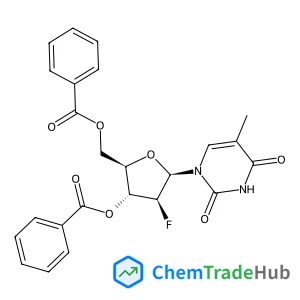
1-(3',5'-Di-O-benzoyl-2'-deoxy-2'-fluoro-b-D-arabinofuranosyl)thymine
CAS Number:
97614-47-6
Molecular Formula:
C24H21FN2O7
amine structure](https://static.chemtradehub.com/structs/629/62924-61-2-0728.webp "[(2-chlorophenyl)methyl](ethyl)amine structure")
Recommended Suppliers



Disclaimer
This page provides academic journal information for reference and research purposes only. We are not affiliated with any journal publishers and do not handle publication submissions. For publication-related inquiries, please contact the respective journal publishers directly.
If you notice any inaccuracies in the information displayed, please contact us at support@chemtradehub.com. We will promptly review and address your concerns.