












Structural and energetic factors controlling the enantioselectivity of dinucleotide formation under prebiotic conditions
Literature Information
Publication Date
2013-02-27
DOI
10.1039/C3CP44156C
Impact Factor
3.676
Authors
View Original
Abstract
Recently, it has been reported that the montmorillonite-catalyzed oligomerization of activated nucleotides exhibits remarkable enantioselectivity. In the current paper we investigate the structures and intrinsic energies of homochiral and heterochiral cyclic dinucleotides by means of accurate quantum chemical calculations in gas-phase and in bulk water. The steric effect of the clay is represented with geometrical constraints. Our computations reveal that the heterochiral dimer geometries are systematically less stable than their homochiral counterparts due to steric clashes inside the sugar–phosphate ring geometry. Thus we suggest that the homochiral selectivity observed in the cyclic dinucleotide formation in confined spaces may arise from the energetic destabilization of the heterochiral ring geometries as compared to their homochiral analogues. In the present paper we provide the first model of the 3D structure of D,L cyclic dinucleotides, which until now has eluded experimental observation.
Related Literature
The self assembly of proteins; probing patchy protein interactions
Susan James, Michelle K. Quinn, Jennifer J. McManus
2015-01-13
Paper
DOI: 10.1039/C4CP05892E
Effects of the electron polarization on dynamic nuclear polarization in solids
Y. Hovav, D. Shimon, I. Kaminker, A. Feintuch, D. Goldfarb, S. Vega
2015-02-02
Paper
DOI: 10.1039/C4CP05625F
Joint spectroscopic and theoretical investigation of cationic cyanine dye Astrazon Orange-R: solvent viscosity controlled relaxation of excited states
Christian Ley, Patrice Bordat, Luciano H. di Stefano, Lola Remongin, Ahmad Ibrahim, Patrice Jacques, Xavier Allonas
2015-01-12
Paper
DOI: 10.1039/C4CP05103C
Quantitative depth profiling of Ce3+ in Pt/CeO2 by in situ high-energy XPS in a hydrogen atmosphere
Shunsuke Kato, Markus Ammann, Thomas Huthwelker, Cristina Paun, Markus Lampimäki, Ming-Tao Lee
2015-01-19
Paper
DOI: 10.1039/C4CP05643D
Negative thermal quenching of photoluminescence in annealed ZnO–Al2O3 core–shell nanorods
Yukun Wu, Junwen Li, Huaiyi Ding, Zhiwei Gao, Yiming Wu, Nan Pan
2014-12-12
Paper
DOI: 10.1039/C4CP04998E
Tuning the thermoelectric properties of a single-molecule junction by mechanical stretching
Alberto Torres, Renato B. Pontes, Antônio J. R. da Silva, Adalberto Fazzio
2015-01-07
Paper
DOI: 10.1039/C4CP04635H
Influence of zeolite pore structure on product selectivities for protolysis and hydride transfer reactions in the cracking of n-pentane
Akimitsu Miyaji, Yasuyoshi Iwase, Toshiki Nishitoba, Nguyen Quang Long, Ken Motokura, Toshihide Baba
2014-12-22
Paper
DOI: 10.1039/C4CP04438J
Conformational dynamics of carbohydrates: Raman optical activity of d-glucuronic acid and N-acetyl-d-glucosamine using a combined molecular dynamics and quantum chemical approach
Shaun T. Mutter, François Zielinski, James R. Cheeseman, Christian Johannessen, Paul L. A. Popelier, Ewan W. Blanch
2015-01-23
Paper
DOI: 10.1039/C4CP05517A
Lithium storage in disordered graphitic materials: a semi-quantitative study of the relationship between structure disordering and capacity
Tan Xing, Thrinathreddy Ramireddy, Lu Hua Li, Daniel Gunzelmann, Hong Zeng, Wen Qi, Shaoxiong Zhou, Ying Chen
2015-01-08
Paper
DOI: 10.1039/C4CP05589F
A soft/hard magnetic nanostructure based on multisegmented CoNi nanowires
A. Pereira, J. L. Palma, M. Vázquez
2015-01-09
Paper
DOI: 10.1039/C4CP05665E
You might also like
Compound Q&A
What precautions should be taken when handling 4-(2-Furylmethyl)thiomorpholine 1,1-dioxide (CAS: 79206-94-3)?
When handling 4-(2-Furylmethyl)thiomorpholine 1,1-dioxide (CAS: 79206-94-3), it ...
79206-94-34-(2-Furylmethyl)thi...
Compound Q&A
What precautions should be taken when handling 4-Chloro-N-[2-(4-morpholinyl)ethyl]benzamide (CAS: 71320-77-9)?
When handling 4-Chloro-N-[2-(4-morpholinyl)ethyl]benzamide (CAS: 71320-77-9), it...
71320-77-94-Chloro-N-[2-(4-mor...
Compound Q&A
How should waste containing 2-[2-(2-Methoxyethoxy)ethoxy]ethyl 4-methylbenzenesulfonate (CAS: 62921-74-8) be handled?
Waste containing this compound (CAS: 62921-74-8) should be handled according to ...
62921-74-82-[2-(2-Methoxyethox...
Compound Q&A
How should waste containing (S)-Methyl 2-amino-3-cyclohexylpropanoate be handled?
Waste containing (S)-Methyl 2-amino-3-cyclohexylpropanoate should be collected i...
40056-18-6(S)-Methyl 2-amino-3...
Compound Q&A
How is 5-({4-[(2S,4R)-4-Hydroxy-2-methyltetrahydro-2H-pyran-4-yl]-2-thienyl}sulfanyl)-1-methyl-1,3-dihydro-2H-indol-2-one (CAS: 166882-70-8) typically synthesized?
This compound can be synthesized using a multi-step process involving the conjug...
166882-70-85-({4-[(2S,4R)-4-Hyd...
Compound Q&A
Are there alternatives to (2E)-3-(3,4-Dichlorophenyl)acrylic acid (CAS: 7312-27-8) in synthesis?
There are several alternatives to (2E)-3-(3,4-Dichlorophenyl)acrylic acid in syn...
7312-27-8(2E)-3-(3,4-Dichloro...
Compound Q&A
How should Ethyl 6-(2-nitrophenyl)imidazo[2,1-b][1,3]thiazole-3-carboxylate (CAS: 925437-84-9) be stored?
Ethyl 6-(2-nitrophenyl)imidazo[2,1-b][1,3]thiazole-3-carboxylate (CAS: 925437-84...
925437-84-9Ethyl 6-(2-nitrophen...
Compound Q&A
How should waste containing 2-(1,3-Thiazol-2-yl)ethanamine (CAS: 18453-07-1) be handled?
Waste containing 2-(1,3-Thiazol-2-yl)ethanamine (CAS: 18453-07-1) should be coll...
18453-07-12-(1,3-Thiazol-2-yl)...
Compound Q&A
How is Methyl 5-iodo-2-methylbenzoate (CAS: 103440-54-6) typically synthesized?
Methyl 5-iodo-2-methylbenzoate can be synthesized through the iodination of meth...
103440-54-6Methyl 5-iodo-2-meth...
Compound Q&A
How is 5-Chloro[1,2,4]triazolo[1,5-a]pyridine (CAS: 1427399-34-5) typically synthesized?
5-Chloro[1,2,4]triazolo[1,5-a]pyridine is commonly synthesized via the condensat...
1427399-34-55-Chloro[1,2,4]triaz...
Source Journal
Physical Chemistry Chemical Physics

CiteScore:
5.5
Self-citation Rate:
10.3%
Articles per Year:
3036
Physical Chemistry Chemical Physics (PCCP) is an international journal co-owned by 19 physical chemistry and physics societies from around the world. This journal publishes original, cutting-edge research in physical chemistry, chemical physics and biophysical chemistry. To be suitable for publication in PCCP, articles must include significant innovation and/or insight into physical chemistry; this is the most important criterion that reviewers and Editors will judge against when evaluating submissions. The journal has a broad scope and welcomes contributions spanning experiment, theory, computation and data science. Topical coverage includes spectroscopy, dynamics, kinetics, statistical mechanics, thermodynamics, electrochemistry, catalysis, surface science, quantum mechanics, quantum computing and machine learning. Interdisciplinary research areas such as polymers and soft matter, materials, nanoscience, energy, surfaces/interfaces, and biophysical chemistry are welcomed if they demonstrate significant innovation and/or insight into physical chemistry. Joined experimental/theoretical studies are particularly appreciated when complementary and based on up-to-date approaches.
Recommended Compounds


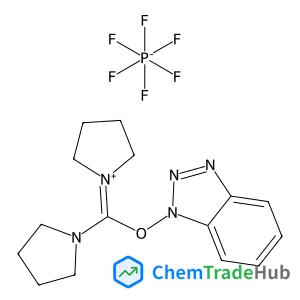
(1H-Benzotriazol-1-yloxy)(di-1-pyrrolidinyl)methylium hexafluorophosphate
CAS Number:
105379-24-6
Molecular Formula:
C15H21F6N5OP

(3beta,7beta,12beta)-3,7,12-Trihydroxy-11,15,23-trioxolanost-8-en-26-oic acid
CAS Number:
98665-22-6
Molecular Formula:
C30H44O8
Recommended Suppliers





Disclaimer
This page provides academic journal information for reference and research purposes only. We are not affiliated with any journal publishers and do not handle publication submissions. For publication-related inquiries, please contact the respective journal publishers directly.
If you notice any inaccuracies in the information displayed, please contact us at support@chemtradehub.com. We will promptly review and address your concerns.