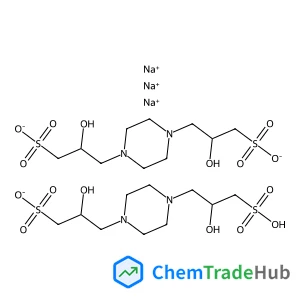
3,3'-(Piperazine-1,4-diyl)bis(2-hydroxypropane-1-sulfonic acid) Sodium Salt
CAS Number:
108321-08-0
Molecular Formula:
C20H41N4Na3O16S4
Kawon Oum, Peter W. Lohse, Johannes R. Klein, Oliver Flender, Mirko Scholz, Anders Hagfeldt, Gerrit Boschloo, Thomas Lenzer
The relaxation dynamics of the dye D35 has been characterized by transient absorption spectroscopy in acetonitrile and on TiO2 and ZrO2 thin films. In acetonitrile, upon photoexcitation of the dye via the S0 → S1 transition, we observed ultrafast solvation dynamics with subpicosecond time constants. Subsequent decay of the S1 excited state absorption (ESA) band with a 7.1 ps time constant is tentatively assigned to structural relaxation in the excited state, and a spectral decay with 203 ps time constant results from internal conversion (IC) back to S0. On TiO2, we observed fast (<90 fs) electron injection from the S1 state of D35 into the TiO2 conduction band, followed by a biphasic dynamics arising from changes in a transient Stark field at the interface, with time constants of 0.8 and 12 ps, resulting in a characteristic blue-shift of the S0 → S1 absorption band. Several processes can contribute to this spectral shift: (i) photoexcitation induces immediate formation of D35˙+ radical cations, which initially form electron–cation complexes; (ii) dissociation of these complexes generates mobile electrons, and when they start diffusing in the mesoporous TiO2, the local electrostatic field may change; (iii) this may trigger the reorientation of D35 molecules in the changing electric field. A slower spectral decay on a nanosecond timescale is interpreted as a reduction of the local Stark field, as mobile electrons move deeper into TiO2 and are progressively screened. Multiexponential electron–cation recombination occurs on much longer timescales, with time constants of 30 μs, 170 μs and 1.4 ms. For D35 adsorbed on ZrO2, there is no clear evidence for a transient Stark shift, which suggests that initially formed cation–electron (trap state) complexes do not dissociate to form mobile conduction band electrons. Multiexponential decay with time constants of 4, 35, and 550 ps is assigned to recombination between cations and trapped electrons, and also to a fraction of D35 molecules in S1 which decay by IC to S0. Differential steady-state absorption spectra of D35˙+ in acetonitrile and dichloromethane provide access to the complete D0 → D1 band. The absorption spectra of D35 and D35˙+ are well described by TDDFT calculations employing the MPW1K functional.
3-Fluoro-2-methylbenzylamine is an organic compound with the CAS number 771573-3...
Tert-butyl 2-(oxetan-3-ylidene)acetate is considered safe for its intended uses ...
Proper personal protective equipment (PPE) such as gloves, goggles, and a lab co...
2-Ethyl-4-methyl-1,3-thiazole is commonly synthesized via the reaction of thiour...
This compound should be stored in a cool, dry place away from direct sunlight an...
L-Lysine Acetate Salt (CAS: 52315-92-1) is subject to various regulatory guideli...
6-Fluoro-3-hydroxy-2-pyrazinecarboxamide (CAS: 259793-96-9) is generally conside...
1,1'-Sulfonylbis(1H-imidazole) is a crystalline solid with a molecular weight of...
4-Methyl-7-nitro-1H-indole-3-carbonitrile (CAS: 289483-82-5) is primarily used i...
Waste containing 5-Bromo-3-indolyl-beta-galactoside (CAS: 97753-82-7) should be ...

Physical Chemistry Chemical Physics (PCCP) is an international journal co-owned by 19 physical chemistry and physics societies from around the world. This journal publishes original, cutting-edge research in physical chemistry, chemical physics and biophysical chemistry. To be suitable for publication in PCCP, articles must include significant innovation and/or insight into physical chemistry; this is the most important criterion that reviewers and Editors will judge against when evaluating submissions. The journal has a broad scope and welcomes contributions spanning experiment, theory, computation and data science. Topical coverage includes spectroscopy, dynamics, kinetics, statistical mechanics, thermodynamics, electrochemistry, catalysis, surface science, quantum mechanics, quantum computing and machine learning. Interdisciplinary research areas such as polymers and soft matter, materials, nanoscience, energy, surfaces/interfaces, and biophysical chemistry are welcomed if they demonstrate significant innovation and/or insight into physical chemistry. Joined experimental/theoretical studies are particularly appreciated when complementary and based on up-to-date approaches.