












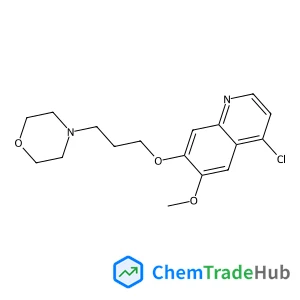
4-(3-((4-Chloro-6-methoxyquinolin-7-yl)oxy)propyl)morpholine
CAS Number:
205448-32-4
Molecular Formula:
C17H21ClN2O3
Ahu Arslan Yildiz, CongBao Kang, Eva-Kathrin Sinner
The hERG (human ether-à-go-go-related gene) potassium channel has been extensively studied by both academia and industry because of its relation to inherited or drug-induced long QT syndrome (LQTS). Unpredicted hERG and drug interaction affecting channel activity is of main concern for drug discovery. Although there are several methods to test hERG and drug interaction, it is still necessary to develop some efficient and economic ways to probe hERG and drug interactions. To contribute this aim, we have developed a biomimetic lipid membrane platform into which the hERG channel can be folded. Expression and integration of the hERG channel was achieved using a cell-free (CF) expression system. The folding of hERG in the biomimetic membrane system was investigated using Surface Plasmon Enhanced Fluorescence Spectroscopy (SPFS) and Imaging Surface Plasmon Resonance (iSPR). In addition, the hERG channel folded into our biomimetic membrane platform was used for probing the channel and drug interactions through fluorescence polarization (FP) assay. Our results suggest that the biomimetic system employed is capable of detecting the interaction between hERG and different channel blockers at varied concentrations. We believe that our current approach could be applied to other membrane proteins for drug screening or other protein-related interactions.
Vitaly Alexandrov, Kevin M. Rosso
DOI: 10.1039/C5CP00921A
Y. Yamauchi
DOI: 10.1039/C5CP02466H
Barbara Kirchner, Frank Neese
DOI: 10.1039/C5CP90040A
Hong Dao Li, Guo-Wei Lee, Po-Chun Huang, Po-Wei Yang, Yu-Ting Liu, Yen-Fa Liao, Horng-Tay Jeng, Deng-Sung Lin, Tsang-Lang Lin
DOI: 10.1039/C5CP01103E
Zhenzhen Feng, Yuli Yan, Guangbiao Zhang, Jueming Yang, Chao Wang
DOI: 10.1039/C5CP00972C
Wei Zhang, Wei Tao Zheng
DOI: 10.1039/C5CP01705J
Mohammad Reza Gharib-Zahedi, Mohsen Tafazzoli, Michael C. Böhm, Mohammad Alaghemandi
DOI: 10.1039/C5CP00752F
Deby Fapyane, Andrey Kartashov, Claes von Wachenfeldt, Elena E. Ferapontova
DOI: 10.1039/C5CP00960J
PengHui Wang, ZhiQiang Li, Walter J. Salcedo, Zhuo Sun, SuMei Huang, Alexandre G. Brolo
DOI: 10.1039/C5CP02249E
(5-Sulfamoyl-3-pyridinyl)boronic acid is primarily used in chemical synthesis, p...
Benzyl 2-methyl-2-(methylsulfonyl)-4-pentenoate is typically synthesized via est...
When handling 8-Fluoroquinolin-6-ol (CAS: 209353-22-0), it is important to use p...
1,3-Dibromo-5-(2-methyl-2-propanyl)benzene (CAS: 129316-09-2) is a crystalline c...
Ethyl 7-chloro-4-oxo-1-(1,3-thiazol-2-yl)-1,4-dihydro-1,8-naphthyridine-3-carbox...
When handling Delta-7-Avenasterol (CAS: 23290-26-8), it is important to wear app...
Proper handling involves the use of personal protective equipment such as gloves...
When handling 2-Methyl-2-proanyl 4-[(2-aminophenyl)amino]-1-piperidinecarboxylat...
N-Methyl-4-chlorobenzylamine hydrochloride (CAS: 65542-24-7) is a organic compou...
[2-(Dodecyloxy)ethoxy]acetic acid (CAS: 27306-90-7) is generally considered safe...

Analyst publishes analytical and bioanalytical research that reports premier fundamental discoveries and inventions, and the applications of those discoveries, unconfined by traditional discipline barriers.
![(4-Methyl-1H-benzo[d]imidazol-2-yl)methanamine structure](https://static.chemtradehub.com/structs/933/933756-31-1-7b0b.webp "(4-Methyl-1H-benzo[d]imidazol-2-yl)methanamine structure")



