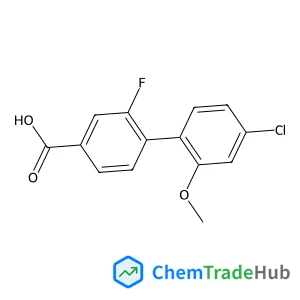
4-(4-Chloro-2-methoxyphenyl)-3-fluorobenzoic acid
CAS Number:
1261970-23-3
Molecular Formula:
C14H10ClFO3
Cheng Yang, Xiurong Yang
Contamination of food and drinking water by dangerous levels of nitrite has always been of strong concern and toxicity of this inorganic anion calls for convenient detection methods. Although some visible approaches were developed to deal with this problem, using environmentally incompatible organic reagents or functionalized nanoparticles may greatly limit their wide applications. In this article, we report a method to visibly detect nitrite in less than 1 min at room temperature. The efficacy of the method relies on a specific reaction of HNO2 with H2O2 to produce peroxynitrous acid (HOONO), which oxidizes colorless 3,3′,5,5′-tetramethylbenzidine (TMB) to its golden yellow diimine product in seconds, with the regeneration of HNO2. Therefore, HNO2 can be regarded as a catalyst for the oxidation of TMB by H2O2. Because color visualization of the TMB–H2O2 system (system I) is dependent upon the concentration of HNO2, it offers a unique avenue for the determination of nitrite. With this method, 1 μM of nitrite could be detected by the perception of yellow color in solution and less than 0.5 μM of nitrite be quantified with a spectrophotometer. The limit of detection (LOD) was 0.1 μM (S/N = 3). More interestingly, we found that the TMB–HNO2 system (system II) could be reversibly designed to detect H2O2 and then glucose with the help of glucose oxidase. We evaluated the applicability of the TMB–HOONO platform in the determination of nitrite in drinking water and urinary glucose, obtaining satisfactory results. Being sensitive, selective, time-efficient, and cost-effective, the two methods derived from the three-component reaction platform are feasible for quantification of nitrite and glucose in routine laboratory practice or rapid assay outside the laboratory.

Mini-Reviews in Medicinal Chemistry

Nature Reviews Drug Discovery

Journal of Enzyme inhibition and Medicinal Chemistry

Green Chemistry

Coloration Technology

Journal of Medical Biochemistry

Faraday Discussions

Physical Chemistry Chemical Physics

Angewandte Chemie International Edition

Advanced Engineering Materials
Sandeep Kumar Mishra, N. Suryaprakash
DOI: 10.1039/C5CP01505G
Nicolas Ferré, Nathalie Guihéry, Jean-Paul Malrieu
DOI: 10.1039/C4CP05531D
DOI: 10.1039/C5CP02582F
Brindaban Modak, Swapan K. Ghosh
DOI: 10.1039/C5CP01374G
Tao Zhang, Zhiguang Xu, Zengxiao Cai, Qipeng Guo
DOI: 10.1039/C5CP01157D
DOI: 10.1039/C4CP05550K
Le Wang, Hong Zhang, Xiao-Jun Wang, Benjamin Dierre, Takayuki Suehiro, Takahashi Takeda, Naoto Hirosaki
DOI: 10.1039/C5CP01860A
Sandro Jurinovich, Lucas Viani, Ingrid G. Prandi, Thomas Renger, Benedetta Mennucci
DOI: 10.1039/C4CP05647G
(5-Sulfamoyl-3-pyridinyl)boronic acid is primarily used in chemical synthesis, p...
Benzyl 2-methyl-2-(methylsulfonyl)-4-pentenoate is typically synthesized via est...
When handling 8-Fluoroquinolin-6-ol (CAS: 209353-22-0), it is important to use p...
1,3-Dibromo-5-(2-methyl-2-propanyl)benzene (CAS: 129316-09-2) is a crystalline c...
Ethyl 7-chloro-4-oxo-1-(1,3-thiazol-2-yl)-1,4-dihydro-1,8-naphthyridine-3-carbox...
When handling Delta-7-Avenasterol (CAS: 23290-26-8), it is important to wear app...
Proper handling involves the use of personal protective equipment such as gloves...
When handling 2-Methyl-2-proanyl 4-[(2-aminophenyl)amino]-1-piperidinecarboxylat...
N-Methyl-4-chlorobenzylamine hydrochloride (CAS: 65542-24-7) is a organic compou...
[2-(Dodecyloxy)ethoxy]acetic acid (CAS: 27306-90-7) is generally considered safe...

Analyst publishes analytical and bioanalytical research that reports premier fundamental discoveries and inventions, and the applications of those discoveries, unconfined by traditional discipline barriers.