












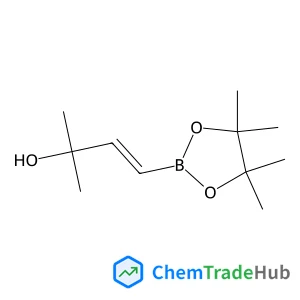
(E)-2-methyl-4-(4,4,5,5-tetramethyl-1,3,2-dioxaborolan-2-yl)but-3-en-2-ol
CAS Number:
581802-26-8
Molecular Formula:
C11H21BO3
Ying-Ling Liu
This review paper covers recent publications on the developments of highly proton-conductive sulfonated polymers for proton exchange membrane (PEM) fuel cells. The PEMs presenting proton conductivities exceeding that of Nafion membranes are especially focused on. The proton conductivities of PEMs have been correlated to their ion exchange values and morphological phase-separation. Formation of ionic channels is an effective approach to develop highly proton-conductive PEMs. The approaches could be grouped into (1) developments of microphase-separation with block copolymers, (2) side-chain and grafted sulfonated polymers, and (3) locally and densely sulfonated polymers. Formation of nanocomposites of PEMs with nanofillers has also shown great ability to increase the proton conductivities of the existed PEMs. Besides proton conductivities, the formation of nanocomposites also improves some PEM properties including mechanical strength, dimensional stability, and oxidative stability. The discussed publications have provided promising PEMs for the development of high performance fuel cells.
Claudio De Rosa, Finizia Auriemma, Oreste Tarallo, Rocco Di Girolamo, Enrico M. Troisi, Simona Esposito, Dario Liguori, Fabrizio Piemontesi, Gianni Vitale, Giampiero Morini
DOI: 10.1039/C6PY01950A
Niklas Lucht, Steffen Eggers
DOI: 10.1039/C6PY01751G
Chun Feng, Guolin Lu, Gang Sun, Xunwei Liu, Xiaoyu Huang
DOI: 10.1039/C4PY00772G
Yu Liu, Xiaochuan Shui, Meng Wang, Chenguang Zhang, Yuechuan Wang
DOI: 10.1039/C6PY02104B
Stephanie M. Barbon, Joe B. Gilroy
DOI: 10.1039/C6PY00441E
Chen Gao, Liwei Wang, Xiaoyu Li
DOI: 10.1039/C4PY00389F
DOI: 10.1039/C4PY00829D
Yingda Huang, Jianyun He, Zhanxiong Liu, Guilong Cai, Shaowen Zhang, Xiaofang Li
DOI: 10.1039/C6PY01859A
Chih-Chia Cheng, Jui-Hsu Wang, Wei-Tsung Chuang, Zhi-Sheng Liao, Jyun-Jie Huang, Shan-You Huang, Wen-Lu Fan
DOI: 10.1039/C7PY00684E
Mariem Bouzrati-Zerelli, Nicolas Zivic, Frédéric Dumur, Didier Gigmes, Bernadette Graff, Jean Pierre Fouassier, Jacques Lalevée
DOI: 10.1039/C7PY00202E
When considering alternatives to 1-(4-Chlorophenyl)-N-hydroxymethanimine (CAS: 3...
This compound should be stored in a cool, dry place away from direct sunlight. I...
3-(4-Bromophenyl)-5-(2-fluorophenyl)-1,2,4-oxadiazole is synthesized through a m...
5-Chloro-2-(4-chlorophenyl)-4-methyl-6-[3-(1-piperidinyl)propoxy]pyrimidine (CAS...
2-Chloro-4-(difluoromethoxy)pyridine is used in the pharmaceutical industry for ...
3-Chloro-6-methylpyridazine (CAS: 1121-79-5) is classified under the Globally Ha...
Several alternatives can be used in the synthesis of Methyl 4,5-dimethyl-2-nitro...
Alternatives to (2E,2'E)-3,3'-(1,4-Phenylene)bisacrylaldehyde include other acry...
3-Amino-5-chloropyridin-2-ol hydrochloride is an organic compound with the CAS n...
When handling 6,7-Difluoro-2,3-dihydro-4H-chromen-4-one, it is essential to wear...

Polymer Chemistry welcomes submissions in all areas of polymer science that have a strong focus on macromolecular chemistry. Manuscripts may cover a broad range of fields, yet no direct application focus is required.
![(2S)-2-{[(9H-Fluoren-9-ylmethoxy)carbonyl]amino}-4-(methylselanyl)butanoic acid structure](https://static.chemtradehub.com/structs/121/1217852-49-7-f252.webp "(2S)-2-{[(9H-Fluoren-9-ylmethoxy)carbonyl]amino}-4-(methylselanyl)butanoic acid structure")




