


Catalyst-free synthesis of diversely substituted 6H-benzo[c]chromenes and 6H-benzo[c]chromen-6-ones in aqueous media under MWI
Literature Information
Publication Date
2012-10-09
DOI
10.1039/C2GC36379H
Impact Factor
10.182
Authors
Yan He, Xinying Zhang, Liangyan Cui, Jianji Wang, Xuesen Fan
View Original
Abstract
In this paper, a catalyst-free synthesis of diversely substituted 6H-benzo[c]chromenes and 6H-benzo[c]chromen-8-ols via cascade reactions of 2-(2-(allyloxy)phenyl)furan and 2-(2-(prop-2-ynyloxy)phenyl)furan, featured with intramolecular Diels–Alder reactions of furan with unactivated alkene/alkyne in aqueous media under MWI, was developed. In addition, an environmentally friendly oxidation of 6H-benzo[c]chromenes into the corresponding benzo[c]chromen-6-ones using aqueous H2O2 as an oxidant, in the absence of any activator/catalyst, was also revealed.
Recommended Journals

European Journal of Organic Chemistry

Nature Reviews Drug Discovery

Physical Chemistry Chemical Physics

CrystEngComm

Foundations of Chemistry

Faraday Discussions

Angewandte Chemie International Edition

Mini-Reviews in Medicinal Chemistry

Journal of Enzyme inhibition and Medicinal Chemistry

Environmental Toxicology and Pharmacology
Related Literature
Highly-oriented molecular arrangements and enhanced magnetic interactions in thin films of CoTTDPz using PTCDA templates
Keitaro Eguchi, Chihiro Nanjo
2016-05-09
Paper
DOI: 10.1039/C6CP01932C
Stereochemical modulation of emission behaviour in E/Z isomers of diphenyldipyrroethene from aggregation induced emission to crystallization induced emission
K. Garg, E. Ganapathi, P. Rajakannu, M. Ravikanth
2015-06-24
Paper
DOI: 10.1039/C5CP02400E
Roles of adsorption sites in electron transfer from CdS quantum dots to molecular catalyst cobaloxime studied by time-resolved spectroscopy
Lei Huang, Zhaochi Feng, Xiuli Wang, Can Li
2016-06-01
Paper
DOI: 10.1039/C6CP02808J
Functionalized SPIONs: the surfactant nature modulates the self-assembly and cluster formation
Richard K. Heenan
2016-06-09
Paper
DOI: 10.1039/C6CP01694D
Methanol diffusion in zeolite HY: a combined quasielastic neutron scattering and molecular dynamics simulation study
Victoria García Sakai, Ian P. Silverwood, Nikolaos Dimitratos
2016-05-16
Paper
DOI: 10.1039/C6CP01151A
Correction: Gd(iii)–Gd(iii) EPR distance measurements – the range of accessible distances and the impact of zero field splitting
Arina Dalaloyan, Mian Qi, Sharon Ruthstein, Shimon Vega, Adelheid Godt, Akiva Feintuch, Daniella Goldfarb
2016-06-21
Correction
DOI: 10.1039/C6CP90156E
Temperature-dependent dynamic correlations in suspensions of magnetic nanoparticles in a broad range of concentrations: a combined experimental and theoretical study
Alexey O. Ivanov, Vladimir S. Zverev, Ekaterina A. Elfimova, Alexander V. Lebedev, Alexander F. Pshenichnikov
2016-06-06
Paper
DOI: 10.1039/C6CP02793H
Dissecting the cation–cation interaction between two uranyl units
Paweł Tecmer, Sung W. Hong, Katharina Boguslawski
2016-06-10
Paper
DOI: 10.1039/C6CP03542F
Direct 17O NMR experimental evidence for Al–NBO bonds in Si-rich and highly polymerized aluminosilicate glasses
Aleksander Jaworski, Baltzar Stevensson, Mattias Edén
2015-06-23
Communication
DOI: 10.1039/C5CP02985F
Ultrafast and slow charge recombination dynamics of diketopyrrolopyrrole–NiO dye sensitized solar cells
Lei Zhang, Ludovic Favereau, Yoann Farré, Edgar Mijangos, Yann Pellegrin, Errol Blart, Fabrice Odobel, Leif Hammarström
2016-06-10
Paper
DOI: 10.1039/C6CP01762B
You might also like
Compound Q&A
What regulatory guidelines apply to 4-Amino-3-bromophenol (CAS: 74440-80-5)?
4-Amino-3-bromophenol (CAS: 74440-80-5) falls under the classification of a haza...
74440-80-54-Amino-3-bromopheno...
Compound Q&A
How should (17beta)-3-Oxoestr-4-en-17-yl acetate (CAS: 1425-10-1) be stored?
(17beta)-3-Oxoestr-4-en-17-yl acetate should be stored in a cool, dry place away...
1425-10-1(17beta)-3-Oxoestr-4...
Compound Q&A
What are the physical and chemical properties of 2-[(2,2-Diethoxyethyl)disulfanyl]-1,1-diethoxyethane (CAS: 76505-71-0)?
2-[(2,2-Diethoxyethyl)disulfanyl]-1,1-diethoxyethane (CAS: 76505-71-0) is a colo...
76505-71-02-[(2,2-Diethoxyethy...
Compound Q&A
What is the market or research trend for 1-(β-D-ribofuranosyl)-1H-imidazo[4,5-c]pyridin-4-amine?
The market and research for 1-(β-D-ribofuranosyl)-1H-imidazo[4,5-c]pyridin-4-ami...
6736-58-91-(beta-D-Ribofurano...
Compound Q&A
How should waste containing Conjugated Estrogen (CAS: 12126-59-9) be handled?
Waste containing Conjugated Estrogen (CAS: 12126-59-9) should be collected and d...
12126-59-9Conjugated Estrogen
Compound Q&A
What is the market or research trend for Bis(2,2,2-trifluoroethyl) (methoxycarbonylmethyl)phosphonate?
The market for Bis(2,2,2-trifluoroethyl) (methoxycarbonylmethyl)phosphonate (CAS...
88738-78-7Bis(2,2,2-trifluoroe...
Compound Q&A
Are there alternatives to 3,4'-Di-O-methylellagic acid (CAS: 57499-59-9) in synthesis?
There are several alternatives to 3,4'-Di-O-methylellagic acid (CAS: 57499-59-9)...
57499-59-93,4'-Di-O-methylella...
Compound Q&A
What regulatory guidelines apply to 2-Chloro-N,N-dimethylpyridin-4-amine (CAS: 59047-70-0)?
2-Chloro-N,N-dimethylpyridin-4-amine (CAS: 59047-70-0) is regulated under the Gl...
59047-70-02-Chloro-N,N-dimethy...
Compound Q&A
What is cerium(3+);oxygen(2-);vanadium(5+) (CAS: 13597-19-8)?
Cerium(3+);oxygen(2-);vanadium(5+) (CAS: 13597-19-8) is a complex inorganic comp...
13597-19-8cerium(3+);oxygen(2-...
Compound Q&A
Is 7-Chloro-1-iodoisoquinoline (CAS: 1203579-27-4) safe?
7-Chloro-1-iodoisoquinoline (CAS: 1203579-27-4) is generally considered safe whe...
1203579-27-47-Chloro-1-iodoisoqu...
Source Journal
Green Chemistry

CiteScore:
16.1
Self-citation Rate:
7.5%
Articles per Year:
944
Green Chemistry provides a unique forum for the publication of innovative research on the development of alternative green and sustainable technologies. The scope of Green Chemistry is based on, but not limited to, the definition proposed by Anastas and Warner (Green Chemistry: Theory and Practice, P T Anastas and J C Warner, Oxford University Press, Oxford, 1998). Green chemistry is the utilisation of a set of principles that reduces or eliminates the use or generation of hazardous substances in the design, manufacture and application of chemical products. Green Chemistry is at the frontiers of this continuously-evolving interdisciplinary science and publishes research that attempts to reduce the environmental impact of the chemical enterprise by developing a technology base that is inherently non-toxic to living things and the environment. Submissions on all aspects of research relating to the endeavour are welcome. The journal publishes original and significant cutting-edge research that is likely to be of wide general appeal. To be published, work must present a significant advance in green chemistry. Papers must contain a comparison with existing methods and demonstrate advantages over those methods before publication can be considered. For more information please see this Editorial. Coverage includes the following, but is not limited to: Design (e.g. biomimicry, design for degradation/recycling/reduced toxicity…) Reagents & Feedstocks (e.g. renewables, CO2, solvents, auxiliary agents, waste utilization…) Synthesis (e.g. organic, inorganic, synthetic biology…) Catalysis (e.g. homogeneous, heterogeneous, enzyme, whole cell…) Process (e.g. process design, intensification, separations, recycling, efficiency…) Energy (e.g. renewable energy, fuels, photovoltaics, fuel cells, energy storage, energy carriers…) Applications (e.g. electronics, dyes, consumer products, coatings, pharmaceuticals, preservatives, building materials, chemicals for industry/agriculture/mining…) Impact (e.g. safety, metrics, LCA, sustainability, (eco)toxicology…) Green chemistry is, by definition, a continuously-evolving frontier. Therefore, the inclusion of a particular material or technology does not, of itself, guarantee that a paper is suitable for the journal. To be suitable, the novel advance should have the potential for reduced environmental impact relative to the state of the art. Green Chemistry does not normally deal with research associated with 'end-of-pipe' or remediation issues.
Recommended Compounds
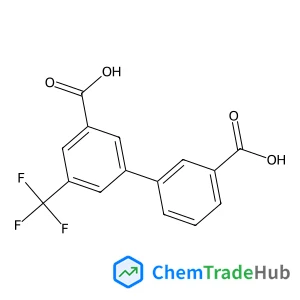
3-(3-Carboxyphenyl)-5-(trifluoromethyl)benzoic acid
CAS Number:
1261930-96-4
Molecular Formula:
C15H9F3O4
![N-[(1R,2R)-2-Amino-1,2-diphenylethyl]-1,1,1-trifluoromethanesulfonamide structure](https://static.chemtradehub.com/structs/852/852212-89-6-5ef9.webp "N-[(1R,2R)-2-Amino-1,2-diphenylethyl]-1,1,1-trifluoromethanesulfonamide structure")
N-[(1R,2R)-2-Amino-1,2-diphenylethyl]-1,1,1-trifluoromethanesulfonamide
CAS Number:
852212-89-6
Molecular Formula:
C15H15F3N2O2S
![Ethyl 5-[({[(2-methyl-2-propanyl)oxy]carbonyl}amino)methyl]-1,2-oxazole-3-carboxylate structure](https://static.chemtradehub.com/structs/253/253196-37-1-8450.webp "Ethyl 5-[({[(2-methyl-2-propanyl)oxy]carbonyl}amino)methyl]-1,2-oxazole-3-carboxylate structure")
Ethyl 5-[({[(2-methyl-2-propanyl)oxy]carbonyl}amino)methyl]-1,2-oxazole-3-carboxylate
CAS Number:
253196-37-1
Molecular Formula:
C12H18N2O5
Recommended Suppliers




Disclaimer
This page provides academic journal information for reference and research purposes only. We are not affiliated with any journal publishers and do not handle publication submissions. For publication-related inquiries, please contact the respective journal publishers directly.
If you notice any inaccuracies in the information displayed, please contact us at support@chemtradehub.com. We will promptly review and address your concerns.