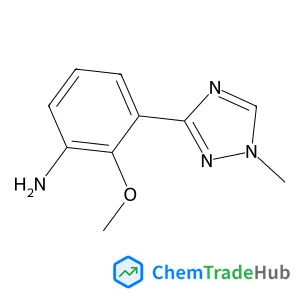
2-Methoxy-3-(1-methyl-1H-1,2,4-triazol-3-yl)aniline
CAS Number:
1609394-10-6
Molecular Formula:
C10H12N4O
Jie Wu, Shui-Xing Wu, Yong Wu, Yu-He Kan, Yun Geng, Zhong-Min Su
We studied the electronic structures of a series of fluorene derivatives (p/mPODPFs and p/mPOAPFs) using density functional theory calculations and investigated their performances as host materials in organic light-emitting diodes from three aspects, i.e. triplet energy, ability of charge injection from neighboring organic layer or electrode, and match of the hosts and the reference guests (FIrpic and FCNIr) for efficient energy transfer (EF). Especially for the last aspect, the singlet/triplet (S1/T1) energies as well as the simulated host emission and guest absorption spectra are investigated to predict the possible emission mechanisms in the host–guest system and therefore to pursue the most suitable host for (deep) blue guest. From the investigated results, we deduced that pPODPF and pPOAPF are suitable for sky-blue FIrpic due to feasible Förster/Dexter energy transfers from pPODPF/pPOAPF to FIrpic, which agrees well with the experimental results. Furthermore, the higher external quantum efficiency (20.6%) of the pPOAPF-based device than that of the pPODPF-based device (13.2%) in experiments was inferred to be attributed to the matching S1 energies between pPOAPF and FIrpic as well as good hole/electron injection abilities of pPOAPF in spite of a smaller overlap between the pPOAPF emission and FIrpic absorption spectra. By contrast, mPOAPF and mPODPF, designed in the work, may match with deep-blue FCNIr. In particular, mPOAPF may exhibit good performance as a host material for deep blue FCNIr as a consequence of its own balanced hole/electron injection ability and the matching S1/T1 energies between mPOAPF and FCNIr.

Environmental Toxicology and Pharmacology

Faraday Discussions

Photochemical & Photobiological Sciences

Advanced Engineering Materials

Foundations of Chemistry

Nature Reviews Drug Discovery

Contact Lens & Anterior Eye

Lab on a Chip

Journal of Enzyme inhibition and Medicinal Chemistry

Mini-Reviews in Medicinal Chemistry
Gabriele Raabe, Juergen Koehler
DOI: 10.1039/B108641N
Waldemar Adam, Manfred Diedering
DOI: 10.1039/B110562K
Thorsten M. Bernhardt, Bernhard Kaiser, Klaus Rademann
DOI: 10.1039/B110194C
Guohua Zhao, Barara Groß, Herbert Dilger, Emil Roduner
DOI: 10.1039/B110158G
M. Bardas, N. Dahmen, T. Kraska, K.-D. Wagner, L. Yelash
DOI: 10.1039/B109059C
Anan Tongraar, Kritsana Sagarik, Bernd Michael Rode
DOI: 10.1039/B107786D
Osvaldo H. Scalise, Moises Silbert
DOI: 10.1039/B107990P
Christoph Janzen, Petra Imhof, Karl Kleinermanns, Mattanjah S. de Vries
DOI: 10.1039/B110360C
DOI: 10.1039/B106788E
6-Bromo-2-methylimidazo[1,2-a]pyrimidine (CAS: 1111638-05-1) falls under various...
While there are no direct alternatives, similar compounds like 1-Pyrrolidineetha...
4-Methyl-2,6-bis(2-methyl-2-propanyl)phenyl methylcarbamate (CAS: 1918-11-2) is ...
2-(3-Bromo-4-fluorophenyl)-1,3-dioxolane (CAS: 77771-04-1) should be stored in a...
4,5,6,7-Tetrahydro-1H-indazole hydrochloride is a white crystalline solid with a...
(2R)-1-Methoxy-3-phenyl-2-propanamine is a chiral organic compound with the CAS ...
Ethyl 1-(1-phenylethyl)-1H-imidazole-5-carboxylate is used in various industries...
4-[(1E,3S)-1-(4-Hydroxyphenyl)-1,4-pentadien-3-yl]phenol (CAS: 17676-24-3) falls...
(S)-3-Amino-5-phenylpentanoic acid hydrochloride is primarily used in the pharma...
7-Methoxy-1-benzothiophene-2-carboxylic acid is typically synthesized by reactin...

Physical Chemistry Chemical Physics (PCCP) is an international journal co-owned by 19 physical chemistry and physics societies from around the world. This journal publishes original, cutting-edge research in physical chemistry, chemical physics and biophysical chemistry. To be suitable for publication in PCCP, articles must include significant innovation and/or insight into physical chemistry; this is the most important criterion that reviewers and Editors will judge against when evaluating submissions. The journal has a broad scope and welcomes contributions spanning experiment, theory, computation and data science. Topical coverage includes spectroscopy, dynamics, kinetics, statistical mechanics, thermodynamics, electrochemistry, catalysis, surface science, quantum mechanics, quantum computing and machine learning. Interdisciplinary research areas such as polymers and soft matter, materials, nanoscience, energy, surfaces/interfaces, and biophysical chemistry are welcomed if they demonstrate significant innovation and/or insight into physical chemistry. Joined experimental/theoretical studies are particularly appreciated when complementary and based on up-to-date approaches.