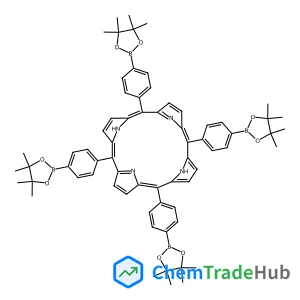
5,10,15,20-tetrakis(4-boronic acid pinacol ester phenyl) porphyrin
CAS Number:
1332748-00-1
Molecular Formula:
C68H74B4N4O8
Katrin Amann-Winkel, Florian Löw, Philip H. Handle, Burkhard Geil, Franz Fujara, Thomas Loerting
Recently, it became clear that relaxation effects in amorphous ices play a very important role that has previously been overlooked. The thermodynamic history of amorphous samples strongly affects their transition behavior. In particular, well-relaxed samples show higher thermal stability, thereby providing a larger window to investigate their glass transitions. We here present neutron scattering experiments using fixed elastic window scans on relaxed forms of amorphous ice, namely expanded high density amorphous ice (eHDA), a variant of low density amorphous ice (LDA-II) and hyperquenched glassy water (HGW). These amorphous ices are expected to be true glassy counterparts of deeply supercooled liquid water, therefore fast precursor dynamics of structural relaxation are expected to appear below the calorimetric glass transition temperature. The Debye–Waller factor shows a very weak sub-Tg anomaly in some of the samples, which might be the signature of such fast precursor dynamics. However, we cannot find this behavior consistently in all samples at all reciprocal length scales of momentum transfer.
Rundong Hu, Mingzhen Zhang, Hong Chen, Yan Sun, Lingyun Jia, Jie Zheng
DOI: 10.1039/C6CP03582E
Sonja Grubišić
DOI: 10.1039/C6CP01120A
Sherdil Khan, Maximiliano J. M. Zapata, Marcelo B. Pereira, Renato V. Gonçalves, Lukas Strizik, Jairton Dupont, Marcos J. L. Santos, Sérgio R. Teixeira
DOI: 10.1039/C5CP03645C
Shahin Sowlati-Hashjin, Stacey D. Wetmore
DOI: 10.1039/C5CP04250J
Congcong Xu, Yan Su, Dajun Liu, Xingquan He
DOI: 10.1039/C5CP04211A
Pedro Augusto Franco Pinheiro Moreira, Maurice de Koning
DOI: 10.1039/C5CP03346B
J. H. K. Pfisterer, P. S. Deimel, R. G. Acres, M. Fritton, P. Feulner, J. V. Barth, F. Allegretti
DOI: 10.1039/C6CP02541B
M. Mihaylov, S. Andonova, K. Chakarova, A. Vimont, E. Ivanova, N. Drenchev, K. Hadjiivanov
DOI: 10.1039/C5CP04139B
Alejandro Gallegos, Diannan Lu, Zheng Liu, Jianzhong Wu
DOI: 10.1039/C5CP03514G
Mohan Zhang
DOI: 10.1039/C6CP03435G
When handling 4-Methyl-6-(trifluoromethyl)quinoline (CAS: 40716-16-3), safety go...
4-(3,5-Difluorophenyl)aniline is an aromatic organic compound with the CAS numbe...
5-{[4-(Trifluoromethyl)phenyl]sulfanyl}-1,2,3-thiadiazole-4-carboxylic acid can ...
The market for 4-Benzylaniline hydrochloride (CAS: 6317-57-3) is steadily growin...
[3-(Diethylsulfamoyl)phenyl]boronic acid is generally considered safe when handl...
3-Bromo-2,5-dimethoxyaniline is mainly used in the pharmaceutical and chemical i...
N-Methyl-1-(5-methyl-1H-indol-3-yl)methanamine (CAS: 915922-67-7) is subject to ...
This compound is primarily used in the pharmaceutical industry for the synthesis...
2-Methyl-2-propanyl [(1S,3R)-3-aminocyclohexyl]carbamate (CAS: 1298101-47-9) sho...
Ethyl 2-bromo-4,4,4-trifluorobutanoate (CAS: 367-33-9) is utilized in the pharma...

Physical Chemistry Chemical Physics (PCCP) is an international journal co-owned by 19 physical chemistry and physics societies from around the world. This journal publishes original, cutting-edge research in physical chemistry, chemical physics and biophysical chemistry. To be suitable for publication in PCCP, articles must include significant innovation and/or insight into physical chemistry; this is the most important criterion that reviewers and Editors will judge against when evaluating submissions. The journal has a broad scope and welcomes contributions spanning experiment, theory, computation and data science. Topical coverage includes spectroscopy, dynamics, kinetics, statistical mechanics, thermodynamics, electrochemistry, catalysis, surface science, quantum mechanics, quantum computing and machine learning. Interdisciplinary research areas such as polymers and soft matter, materials, nanoscience, energy, surfaces/interfaces, and biophysical chemistry are welcomed if they demonstrate significant innovation and/or insight into physical chemistry. Joined experimental/theoretical studies are particularly appreciated when complementary and based on up-to-date approaches.
![2,4-Dichloro-6-isopropyl-5H-pyrrolo[3,4-d]pyrimidin-7(6H)-one structure](https://static.chemtradehub.com/structs/107/1079649-94-7-ad4a.webp "2,4-Dichloro-6-isopropyl-5H-pyrrolo[3,4-d]pyrimidin-7(6H)-one structure")
![(4aR,5S,6R,8aS)-5-[2-(3-Furyl)ethyl]-8a-(hydroxymethyl)-5,6-dimethyl-3,4,4a,5,6,7,8,8a-octahydro-1-naphthalenecarboxylic acid structure](https://static.chemtradehub.com/structs/184/18411-75-1-d4cd.webp "(4aR,5S,6R,8aS)-5-[2-(3-Furyl)ethyl]-8a-(hydroxymethyl)-5,6-dimethyl-3,4,4a,5,6,7,8,8a-octahydro-1-naphthalenecarboxylic acid structure")