













Electrochemical reduction of graphene oxide and its in situ spectroelectrochemical characterization
Literature Information
Publication Date
2012-08-20
DOI
10.1039/C2CP42253K
Impact Factor
3.676
Authors
Antti Viinikanoja, Zhijuan Wang, Carita Kvarnström
View Original
Abstract
The electrochemical properties of self-assembled films of graphene oxide (GO) on mercaptoethylamine (MEA) modified rough Au-surfaces were studied. The film deposition process on MEA primed gold was followed by surface plasmon resonance measurements and the film morphology on 3-aminopropyltriethoxysilane primed Si(100)-surface was studied by atomic force microscopy. The deposited few layer thick GO films on gold were electrochemically reduced by cyclic voltammetry simultaneously as the structural changes in the film were recorded by in situ vibrational spectroscopies. In situ surface enhanced infrared spectroscopy results indicate that the effect of the applied potential on the GO structure could be divided into two parts where the changes occurring at moderate negative potentials are mainly related to changes in the double layer at the film–electrolyte interface and to hydrogen bonding of intercalated water between the GO sheets. At potentials more negative than −0.8 V vs. Ag/AgCl the reduction of GO starts to take place with concomitant conversion of the different functional groups of the film.
Recommended Journals
Related Literature
Effects of poly(vinyl pivalate)-based stabiliser architecture on CO2-solubility and stabilising ability in dispersion polymerisation of N-vinyl pyrrolidone
Natasha A. Birkin, Oliver J. Wildig, Steven M. Howdle
2013-05-16
Paper
DOI: 10.1039/C3PY00275F
Nanoscale polymeric penetration enhancers in topical drug delivery
Yang Yang, Jason Bugno, Seungpyo Hong
2013-01-29
Minireview
DOI: 10.1039/C3PY00049D
A modular construction kit for supramolecular polymer gels
Torsten Rossow, Sebastian Hackelbusch, Peter van Assenbergh
2013-02-07
Paper
DOI: 10.1039/C3PY00104K
Outstanding Reviewers for Reaction Chemistry & Engineering in 2020
2021-05-17
Editorial
DOI: 10.1039/D1RE90017J
Reactive crystallization: a review
Matthew A. McDonald, Hossein Salami, Patrick R. Harris, Colton E. Lagerman, Xiaochuan Yang, Andreas S. Bommarius, Martha A. Grover, Ronald W. Rousseau
2020-11-16
Review Article
DOI: 10.1039/D0RE00272K
Thinking continuously: a microreactor for the production and scale-up of biodegradable, self-assembled nanoparticles
Christina Petschacher, Andreas Eitzlmayr, Julian Wagner, Jan Barthelmes, Andreas Bernkop-Schnürch, Andreas Zimmer
2013-01-21
Paper
DOI: 10.1039/C3PY20939C
Zeolite membrane reactors: from preparation to application in heterogeneous catalytic reactions
W. Rahmah, Z. Wang, S. Kawi
2020-12-11
Review Article
DOI: 10.1039/D0RE00388C
Quaternized amino poly(glycerol-methacrylate)s for enhanced pDNA delivery
Zhixiang Liang, Xinshi Wu, Ying-Wei Yang, Cui Li, Guolin Wu, Hui Gao
2013-04-03
Paper
DOI: 10.1039/C3PY00210A
Immobilization of MacMillan catalyst via controlled radical polymerization: catalytic activity and reuse
Beth L. Moore, Annhelen Lu, Deborah A. Longbottom, Rachel K. O'Reilly
2013-02-06
Paper
DOI: 10.1039/C3PY21125H
You might also like
Compound Q&A
What are the main uses of 4-Nitrophenyl phosphate disodium salt hexahydrate (CAS: 333338-18-4)?
4-Nitrophenyl phosphate disodium salt hexahydrate is primarily used as a substra...
333338-18-44-Nitrophenyl phosph...
Compound Q&A
What are the main uses of 2-(Trifluoromethyl)-1,3-oxazole-4-carboxylic Acid (CAS: 1060816-01-4)?
2-(Trifluoromethyl)-1,3-oxazole-4-carboxylic Acid (CAS: 1060816-01-4) is widely ...
1060816-01-42-(Trifluoromethyl)-...
Compound Q&A
How should 2-Fluoro-4-biphenylcarboxylic acid (CAS: 137045-30-8) be stored?
2-Fluoro-4-biphenylcarboxylic acid should be stored in a cool, dry place at room...
137045-30-82-Fluoro-4-biphenylc...
Compound Q&A
What industries use Prednisolone-21-Carboxylic Acid (CAS: 61549-70-0)?
Prednisolone-21-Carboxylic Acid is primarily used in the pharmaceutical industry...
61549-70-0Prednisolone-21-Carb...
Compound Q&A
How should 4-(Hydrazinomethyl)-1,2,3-benzenetriol (CAS: 3614-72-0) be stored?
4-(Hydrazinomethyl)-1,2,3-benzenetriol (CAS: 3614-72-0) should be stored in a co...
3614-72-04-(Hydrazinomethyl)-...
Compound Q&A
What industries use 4-Amino-1-methyl-1H-pyrazole-5-carboxylic acid hydrochloride (CAS: 92534-70-8)?
4-Amino-1-methyl-1H-pyrazole-5-carboxylic acid hydrochloride (CAS: 92534-70-8) i...
92534-70-84-Amino-1-methyl-1H-...
Compound Q&A
What regulatory guidelines apply to dehydropachymic acid (CAS: 77012-31-8)?
Dehydropachymic acid (CAS: 77012-31-8) is regulated by various agencies. It fall...
77012-31-8Dehydropachymic acid
Compound Q&A
What is the market or research trend for 6-[(2,2-Dimethylpropanoyl)amino]nicotinic acid (CAS: 898561-66-5)?
The market and research trends for 6-[(2,2-Dimethylpropanoyl)amino]nicotinic aci...
898561-66-56-[(2,2-Dimethylprop...
Compound Q&A
How should 1,10-Phenanthroline-2,9-dicarbaldehyde (CAS: 57709-62-3) be stored?
1,10-Phenanthroline-2,9-dicarbaldehyde should be stored in a cool, dry place awa...
57709-62-31,10-Phenanthroline-...
Compound Q&A
How is 5-Carbamoyl-11-oxo-10,11-dihydro-5H-dibenzo[b,f]azepin-10-yl acetate (CAS: 113952-21-9) typically synthesized?
5-Carbamoyl-11-oxo-10,11-dihydro-5H-dibenzo[b,f]azepin-10-yl acetate can be synt...
113952-21-95-Carbamoyl-11-oxo-1...
Source Journal
Physical Chemistry Chemical Physics

CiteScore:
5.5
Self-citation Rate:
10.3%
Articles per Year:
3036
Physical Chemistry Chemical Physics (PCCP) is an international journal co-owned by 19 physical chemistry and physics societies from around the world. This journal publishes original, cutting-edge research in physical chemistry, chemical physics and biophysical chemistry. To be suitable for publication in PCCP, articles must include significant innovation and/or insight into physical chemistry; this is the most important criterion that reviewers and Editors will judge against when evaluating submissions. The journal has a broad scope and welcomes contributions spanning experiment, theory, computation and data science. Topical coverage includes spectroscopy, dynamics, kinetics, statistical mechanics, thermodynamics, electrochemistry, catalysis, surface science, quantum mechanics, quantum computing and machine learning. Interdisciplinary research areas such as polymers and soft matter, materials, nanoscience, energy, surfaces/interfaces, and biophysical chemistry are welcomed if they demonstrate significant innovation and/or insight into physical chemistry. Joined experimental/theoretical studies are particularly appreciated when complementary and based on up-to-date approaches.
Recommended Compounds
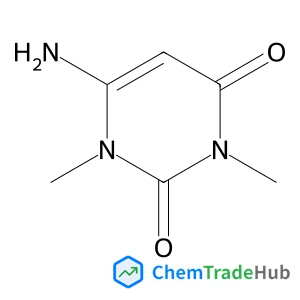
6-amino-1,3-dimethyl-1,2,3,4-tetrahydropyrimidine-2,4-dione
CAS Number:
6642-31-5
Molecular Formula:
C6H9N3O2
Recommended Suppliers




Disclaimer
This page provides academic journal information for reference and research purposes only. We are not affiliated with any journal publishers and do not handle publication submissions. For publication-related inquiries, please contact the respective journal publishers directly.
If you notice any inaccuracies in the information displayed, please contact us at support@chemtradehub.com. We will promptly review and address your concerns.