












![[4-(Heptyloxy)phenyl]boronic acid structure](https://static.chemtradehub.com/structs/136/136370-19-9-ad33.webp "[4-(Heptyloxy)phenyl]boronic acid structure")
Free volume and phase transitions of 1-butyl-3-methylimidazolium based ionic liquids from positron lifetime spectroscopy
Literature Information
Publication Date
2012-03-12
DOI
10.1039/C2CP40486A
Impact Factor
3.676
Authors
Yang Yu, Witali Beichel, Günter Dlubek, Reinhard Krause-Rehberg, Marian Paluch, Jürgen Pionteck, Dirk Pfefferkorn, Safak Bulut, Christian Friedrich, Natalia Pogodina, Ingo Krossing
View Original
Abstract
Positron annihilation lifetime spectroscopy (PALS) was used to study a series of ionic liquids (ILs) with the 1-butyl-3-methylimidazolium cation ([C4MIM]+) but different anions [Cl]−, [BF4]−, [PF6]−, [OTf]−, [NTf2]−, and [B(hfip)4]− with increasing anion volumes. Changes of the ortho-positronium (o-Ps) lifetime parameters with temperature were observed for crystalline and amorphous (glass, supercooled, and normal liquid) states. Evidence for distinct phase transitions, e.g. melting, crystallization and solid–solid transitions, was observed in several PALS experiments. The o-Ps mean lifetime 〈τ3〉 showed smaller values in the crystalline phase due to dense packing of the material compared to the amorphous phase. The o-Ps lifetime intensity I3 in the liquid state is clearly smaller than in the crystallized state. This behaviour can be attributed to a solvation of e+ by the anions, which reduces the Ps formation probability in the normal and supercooled liquid. These phenomena were observed for the first time when applying the PALS technique to ionic liquids by us in one preliminary and in this work. Four of the ionic liquids investigated in this work ([BF4]−, [NTf2]−, [PF6]− and [Cl]− ILs) exhibit supercooled phases. The specific hole densities and occupied volumes of those ILs were obtained by comparing the local free volume with the specific volume from pressure–volume–temperature (PVT) experiments. From the o-Ps lifetime, the mean size 〈vh〉 of free volume holes of the four samples was calculated and compared with that calculated according to Fürth's hole theory. The hole volumes from both methods agree well. From the Cohen–Turnbull fitting of viscosity and conductivity against PALS/PVT results, the influence of the free volume on molecular transport properties was investigated.
Related Literature
Quantification of drug loading in polymeric nanoparticles using AFM-IR technique: a novel method to map and evaluate drug distribution in drug nanocarriers
M. Seray Ural, Emmanuel Dartois, Jérémie Mathurin, Didier Desmaële, Philippe Collery, Alexandre Dazzi, Ariane Deniset-Besseau, Ruxandra Gref
2022-10-31
Paper
DOI: 10.1039/D2AN01079H
A bioluminescent probe for NQO1 overexpressing cancer cell imaging in vitro and in vivo
Yuhong Luo, Wentao Wang, Yi Zeng, Shuangqing Wang, Xudong Guo, Rui Hu, Guoqiang Yang
2022-10-28
Communication
DOI: 10.1039/D2AN01435A
Copper nanoclusters on specific-primer PCR fragments with magnetic capture for the label-free fluorescent sensing of the T315I single nucleotide variant in the BCR–ABL1 gene
Ke-Peng Lai, Yu-Chen Su, Bo-Siang Fu, Kung-Hung Lin, Hwang-Shang Kou
2022-11-17
Paper
DOI: 10.1039/D2AN01433E
UV-PEDD photometry dedicated for bioanalytical uses
Łukasz Tymecki, Luiza Brodacka, Beata Rozum, Robert Koncki
2009-03-13
Paper
DOI: 10.1039/B822025E
Ultra-thin silica shell-guarded nanoflares for high-fidelity live cell miRNA-21 imaging by fully avoiding the interference of biothiols
Yuze Luo, Zefeng Wang, Junqin Li, Wenhua Yi, Ke Yang, Chunlei Ou, Le Deng, Dinggeng He
2022-11-07
Communication
DOI: 10.1039/D2AN01441F
Characterization of glycerophospholipids at multiple isomer levels via Mn(ii)-catalyzed epoxidation
Xi Chen, Shuli Tang, Dallas Freitas, Erin Hirtzel, Heyong Cheng, Xin Yan
2022-09-13
Paper
DOI: 10.1039/D2AN01174C
Nanoparticle-induced potentiometric biosensing of NADH at copper ion-selective electrodes
Karin Y. Chumbimuni-Torres, Joseph Wang
2009-05-15
Paper
DOI: 10.1039/B902171J
Raman spectroscopy – a potential platform for the rapid measurement of carbon nanotube-induced cytotoxicity
Peter Knief, Colin Clarke, Eva Herzog, Maria Davoren, Fiona M. Lyng, Aidan D. Meade, Hugh J. Byrne
2009-03-03
Paper
DOI: 10.1039/B821393C
You might also like
Compound Q&A
What precautions should be taken when handling 4-(2-Furylmethyl)thiomorpholine 1,1-dioxide (CAS: 79206-94-3)?
When handling 4-(2-Furylmethyl)thiomorpholine 1,1-dioxide (CAS: 79206-94-3), it ...
79206-94-34-(2-Furylmethyl)thi...
Compound Q&A
What precautions should be taken when handling 4-Chloro-N-[2-(4-morpholinyl)ethyl]benzamide (CAS: 71320-77-9)?
When handling 4-Chloro-N-[2-(4-morpholinyl)ethyl]benzamide (CAS: 71320-77-9), it...
71320-77-94-Chloro-N-[2-(4-mor...
Compound Q&A
How should waste containing 2-[2-(2-Methoxyethoxy)ethoxy]ethyl 4-methylbenzenesulfonate (CAS: 62921-74-8) be handled?
Waste containing this compound (CAS: 62921-74-8) should be handled according to ...
62921-74-82-[2-(2-Methoxyethox...
Compound Q&A
How should waste containing (S)-Methyl 2-amino-3-cyclohexylpropanoate be handled?
Waste containing (S)-Methyl 2-amino-3-cyclohexylpropanoate should be collected i...
40056-18-6(S)-Methyl 2-amino-3...
Compound Q&A
How is 5-({4-[(2S,4R)-4-Hydroxy-2-methyltetrahydro-2H-pyran-4-yl]-2-thienyl}sulfanyl)-1-methyl-1,3-dihydro-2H-indol-2-one (CAS: 166882-70-8) typically synthesized?
This compound can be synthesized using a multi-step process involving the conjug...
166882-70-85-({4-[(2S,4R)-4-Hyd...
Compound Q&A
Are there alternatives to (2E)-3-(3,4-Dichlorophenyl)acrylic acid (CAS: 7312-27-8) in synthesis?
There are several alternatives to (2E)-3-(3,4-Dichlorophenyl)acrylic acid in syn...
7312-27-8(2E)-3-(3,4-Dichloro...
Compound Q&A
How should Ethyl 6-(2-nitrophenyl)imidazo[2,1-b][1,3]thiazole-3-carboxylate (CAS: 925437-84-9) be stored?
Ethyl 6-(2-nitrophenyl)imidazo[2,1-b][1,3]thiazole-3-carboxylate (CAS: 925437-84...
925437-84-9Ethyl 6-(2-nitrophen...
Compound Q&A
How should waste containing 2-(1,3-Thiazol-2-yl)ethanamine (CAS: 18453-07-1) be handled?
Waste containing 2-(1,3-Thiazol-2-yl)ethanamine (CAS: 18453-07-1) should be coll...
18453-07-12-(1,3-Thiazol-2-yl)...
Compound Q&A
How is Methyl 5-iodo-2-methylbenzoate (CAS: 103440-54-6) typically synthesized?
Methyl 5-iodo-2-methylbenzoate can be synthesized through the iodination of meth...
103440-54-6Methyl 5-iodo-2-meth...
Compound Q&A
How is 5-Chloro[1,2,4]triazolo[1,5-a]pyridine (CAS: 1427399-34-5) typically synthesized?
5-Chloro[1,2,4]triazolo[1,5-a]pyridine is commonly synthesized via the condensat...
1427399-34-55-Chloro[1,2,4]triaz...
Source Journal
Physical Chemistry Chemical Physics

CiteScore:
5.5
Self-citation Rate:
10.3%
Articles per Year:
3036
Physical Chemistry Chemical Physics (PCCP) is an international journal co-owned by 19 physical chemistry and physics societies from around the world. This journal publishes original, cutting-edge research in physical chemistry, chemical physics and biophysical chemistry. To be suitable for publication in PCCP, articles must include significant innovation and/or insight into physical chemistry; this is the most important criterion that reviewers and Editors will judge against when evaluating submissions. The journal has a broad scope and welcomes contributions spanning experiment, theory, computation and data science. Topical coverage includes spectroscopy, dynamics, kinetics, statistical mechanics, thermodynamics, electrochemistry, catalysis, surface science, quantum mechanics, quantum computing and machine learning. Interdisciplinary research areas such as polymers and soft matter, materials, nanoscience, energy, surfaces/interfaces, and biophysical chemistry are welcomed if they demonstrate significant innovation and/or insight into physical chemistry. Joined experimental/theoretical studies are particularly appreciated when complementary and based on up-to-date approaches.
Recommended Compounds


![1-Naphthalenesulfonic acid, 2-[(2-hydroxy-1-naphthalenyl)azo]-, bariumsalt (2:1) structure](https://static.chemtradehub.com/structs/110/1103-38-4-0b33.webp "1-Naphthalenesulfonic acid, 2-[(2-hydroxy-1-naphthalenyl)azo]-, bariumsalt (2:1) structure")
1-Naphthalenesulfonic acid, 2-[(2-hydroxy-1-naphthalenyl)azo]-, bariumsalt (2:1)
CAS Number:
1103-38-4
Molecular Formula:
C20H14BaN2O4S
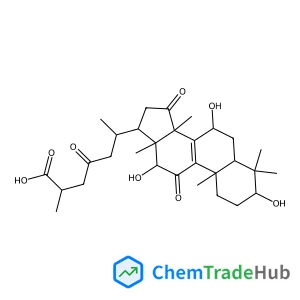
(3beta,7beta,12beta)-3,7,12-Trihydroxy-11,15,23-trioxolanost-8-en-26-oic acid
CAS Number:
98665-22-6
Molecular Formula:
C30H44O8
Recommended Suppliers



Disclaimer
This page provides academic journal information for reference and research purposes only. We are not affiliated with any journal publishers and do not handle publication submissions. For publication-related inquiries, please contact the respective journal publishers directly.
If you notice any inaccuracies in the information displayed, please contact us at support@chemtradehub.com. We will promptly review and address your concerns.