












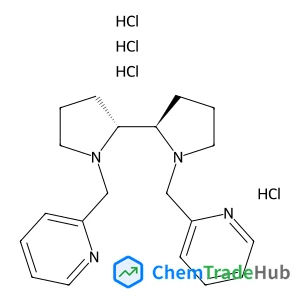
(2R,2'R)-1,1'-Bis(2-pyridinylmethyl)-2,2'-bipyrrolidine tetrahydrochloride
CAS Number:
1228077-88-0
Molecular Formula:
C20H30Cl4N4
Simon Petrie, Phillip Gatt, Robert Stranger, Ron J. Pace
The most recent XRD studies of Photosystem II (PS II) reveal that the His337 residue is sufficiently close to the Mn4Ca core of the Water Oxidising Complex (WOC) to engage in H-bonding interactions with the μ3-oxo bridge connecting Mn(1), Mn(2) and Mn(3). Such interactions may account for the lengthening of the Mn–Mn distances observed in the most recent and highest resolution (1.9 Å) crystal structure of PS II compared to earlier, lower-resolution (2.9 Å or greater) XRD structures and EXAFS studies on functional PS II. Density functional theory is used to examine the influence on Mn–Mn distances of H-bonding interactions, mediated by the proximate His337 residue, which may lead to either partial or complete protonation of the μ3-oxo bridge on models of the WOC. Calculations were performed on a set of minimal-complexity models (in which WOC-ligating amino acid residues are represented as formate and imidazole ligands), and also on extended models in which a 13-peptide sequence (from His332 to Ala344) is treated explicitly. These calculations demonstrate that while the 2.9 Å structure is best described by models in which the μ3-oxo bridge is neither protonated nor involved in significant H-bonding, the 1.9 Å XRD structure is better reproduced by models in which the μ3-oxo bridge undergoes H-bonding interactions with the His337 residue leading to expansion of the ‘close’ Mn–Mn distances well known from EXAFS studies at ∼ 2.7 Å. Furthermore, full μ3-oxo-bridge protonation remains a distinct possibility during the process of water oxidation, as evidenced by the lengthening of the Mn–Mn vectors observed in EXAFS studies of the higher oxidation states of PS II. In this context, the Mn–Mn distances calculated in the protonated μ3-oxo bridge structures, particularly for the peptide extended models, are in close agreement with the EXAFS data.
Jing Zhang, Qingzhong Zhang, Shuaifeng Zhou, Yuping Liu, Wei Huang
DOI: 10.1039/C7PY01476G
Shu Wang, Grant A. Knappe, Norman J. Wagner
DOI: 10.1039/C7PY01431G
Bo Zhao, Mahalia A. C. Serrano, Jingjing Gao, Jiaming Zhuang
DOI: 10.1039/C7PY01947E
Hiroaki Imoto, Ryoichi Katoh, Kensuke Naka
DOI: 10.1039/C8PY00758F
DOI: 10.1039/C7PY01969F
Seishi Ohashi, Daniela Iguchi, Tyler R. Heyl, Hatsuo Ishida
DOI: 10.1039/C8PY00760H
Rongzong Zheng, Jiaqiang Zhang, Chunyang Jia, Zhongquan Wan, Yaru Fan, Xiaolong Weng, Jianliang Xie, Longjiang Deng
DOI: 10.1039/C7PY01434A
(3.beta.)-3-Hydroxy-N,N-dimethyl-chol-5-en-24-amide (CAS: 79066-03-8) is primari...
5-(Aminomethyl)-2-methoxyphenol (CAS: 89702-89-6) is classified under GHS as a s...
Thieno[2,3-c]pyridin-7(6H)-one (CAS: 28981-13-7) is a heterocyclic organic compo...
1-[(6-Methoxy-3-pyridinyl)methyl]-4-piperidinamine dihydrochloride is generally ...
[(2E)-3-Phenyl-2-propen-1-yl]phosphonic acid (CAS: 146404-58-2) is regulated und...
6-Bromo-7-methoxyquinoline (CAS: 1620515-86-7) falls under the scope of the Glob...
This compound is primarily used in the pharmaceutical industry for the developme...
1-Ethyl-7-[2-methyl-6-(4H-1,2,4-triazol-3-yl)-3-pyridinyl]-3,5-dihydropyrazino[2...
Alternative reagents such as 2-[(dimethylamino)methyl]phenylboronic acid or rela...
3-(Piperidin-4-yloxy)pyridine (CAS: 310881-48-2) is an organic compound with the...

Physical Chemistry Chemical Physics (PCCP) is an international journal co-owned by 19 physical chemistry and physics societies from around the world. This journal publishes original, cutting-edge research in physical chemistry, chemical physics and biophysical chemistry. To be suitable for publication in PCCP, articles must include significant innovation and/or insight into physical chemistry; this is the most important criterion that reviewers and Editors will judge against when evaluating submissions. The journal has a broad scope and welcomes contributions spanning experiment, theory, computation and data science. Topical coverage includes spectroscopy, dynamics, kinetics, statistical mechanics, thermodynamics, electrochemistry, catalysis, surface science, quantum mechanics, quantum computing and machine learning. Interdisciplinary research areas such as polymers and soft matter, materials, nanoscience, energy, surfaces/interfaces, and biophysical chemistry are welcomed if they demonstrate significant innovation and/or insight into physical chemistry. Joined experimental/theoretical studies are particularly appreciated when complementary and based on up-to-date approaches.
![5,7-Dihydroxy-3-(4-hydroxyphenyl)-6-[(1R,6R)-3-methyl-6-prop-1-en-2-ylcyclohex-2-en-1-yl]chromen-4-one structure](https://static.chemtradehub.com/structs/191/1914963-20-4-2b05.webp "5,7-Dihydroxy-3-(4-hydroxyphenyl)-6-[(1R,6R)-3-methyl-6-prop-1-en-2-ylcyclohex-2-en-1-yl]chromen-4-one structure")





