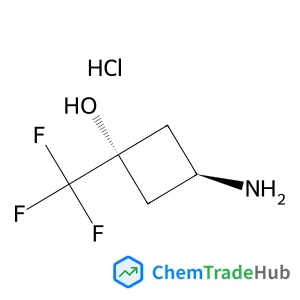
cis-3-Amino-1-(trifluoromethyl)cyclobutanol hydrochloride (1:1)
CAS Number:
1408075-16-0
Molecular Formula:
C5H9ClF3NO
Chao Bian, Yin-Ning Zhou, Jun-Kang Guo, Zheng-Hong Luo
Photoinduced atom transfer radical polymerization with an Fe catalyst was successfully performed in aqueous media for the first time. Three water-soluble ligands [i.e., tetrabutylammonium bromide (TBABr), tris[2-(2-methoxyethoxy)ethyl]amine (TDA), and triphenylphosphine-3,3′,3′′-trisulfonic acid trisodium (TPPSA)] were screened for polymerization in aqueous media. Linear semilogarithmic plots, increasing molecular weights (Mn) with conversion, and low dispersity (Đ < 1.40) were achieved by using a new water-soluble phosphine ligand TPPSA, indicating a well-controlled polymerization. Subsequently, the polymerization kinetics of different catalyst concentrations and the targeted degree of polymerizations were investigated. The applicability of this system to the polymerization of different water-soluble monomers was examined. Furthermore, the polymerization can be regulated by switching the light on and off, which further confirmed its controlled and “living” nature. A successful experiment of chain extension suggested the retention of chain-end functionality. A study of the mechanism showed that the activator (FeIIX2/L) and the additional initiator were generated by the photochemical reduction of FeIIIX3/L in the presence of a monomer. This work provides an environmentally benign ATRP to synthesize well-defined water-soluble materials.
Martina Banchelli, Sara Tombelli, Marella de Angelis, Cristiano D'Andrea, Cosimo Trono, Francesco Baldini, Ambra Giannetti, Paolo Matteini
DOI: 10.1039/D3AY01661G
Fengjiao Hao, Yuanyuan Luo, Fengshou Dong, Xinglu Pan, Xiaohu Wu, Yongquan Zheng, Jun Xu
DOI: 10.1039/D3AY01473H
Jiahao Shen, Junli Liu, Xiuyi Fan, Hui Liu, Yan Bao, AiPing Hui, Hafiz Akif Munir
DOI: 10.1039/D3BM01030A
Daiki Asakawa, Ryoma Yamamoto, Nobuyasu Hanari, Kazumi Saikusa
DOI: 10.1039/D3AY01450A
DOI: 10.1039/D3AY01627G
Qiuyan Zhao, Mingyue Ding, Dangshuai Pei, Xiuhua Qi, Yexuan Mao, Xianqing Huang, Lianjun Song, Jingnan Zuo, Huijuan Yang, Xiya Zhang
DOI: 10.1039/D3AY01403G
DOI: 10.1039/D3AY01817B
Clément Praud, Victor Ribay, Arnab Dey, Benoît Charrier, Joris Mandral, Jonathan Farjon, Jean-Nicolas Dumez, Patrick Giraudeau
DOI: 10.1039/D3AY01681A
4-Nitrophenyl phosphate disodium salt hexahydrate is primarily used as a substra...
2-(Trifluoromethyl)-1,3-oxazole-4-carboxylic Acid (CAS: 1060816-01-4) is widely ...
2-Fluoro-4-biphenylcarboxylic acid should be stored in a cool, dry place at room...
Prednisolone-21-Carboxylic Acid is primarily used in the pharmaceutical industry...
4-(Hydrazinomethyl)-1,2,3-benzenetriol (CAS: 3614-72-0) should be stored in a co...
4-Amino-1-methyl-1H-pyrazole-5-carboxylic acid hydrochloride (CAS: 92534-70-8) i...
Dehydropachymic acid (CAS: 77012-31-8) is regulated by various agencies. It fall...
The market and research trends for 6-[(2,2-Dimethylpropanoyl)amino]nicotinic aci...
1,10-Phenanthroline-2,9-dicarbaldehyde should be stored in a cool, dry place awa...
5-Carbamoyl-11-oxo-10,11-dihydro-5H-dibenzo[b,f]azepin-10-yl acetate can be synt...

Polymer Chemistry welcomes submissions in all areas of polymer science that have a strong focus on macromolecular chemistry. Manuscripts may cover a broad range of fields, yet no direct application focus is required.
![(2E)-3-(3-Chlorophenyl)-N-{2-[4-(methylsulfonyl)-1-piperazinyl]-2-oxoethyl}acrylamide structure](https://static.chemtradehub.com/structs/250/2505001-54-5-c1e9.webp "(2E)-3-(3-Chlorophenyl)-N-{2-[4-(methylsulfonyl)-1-piperazinyl]-2-oxoethyl}acrylamide structure")