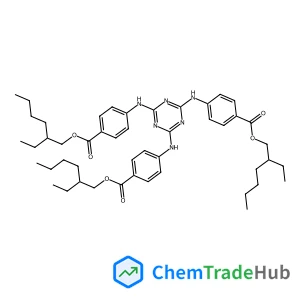
Tris(2-ethylhexyl) 4,4',4''-(1,3,5-triazine-2,4,6-triyltriimino)tribenzoate
CAS Number:
88122-99-0
Molecular Formula:
C48H66N6O6
Sung-Seen Choi, Hye-Seung Chung
Co-matrix systems composed of a UV absorber and a UV stabilizer applied to the analysis of polystyrene (PS) using a matrix-assisted laser desorption/ionization-mass spectrometer (MALDI-MS) equipped with a N2 laser (337 nm) as the light source were investigated. Various UV absorbers such as Tinuvin 234, Tinuvin 326, Tinuvin 327, Tinuvin 328, Tinuvin 329, and Tinuvin 1577 and a UV stabilizer of Tinuvin 770 were used. Analytical results using the co-matrix systems were compared with those using anthracene-1,8,9-triol (DIT) as the most common matrix for PS analysis. The MALDI mass spectrum of PS obtained using single DIT showed higher ionization efficiency than that using a mixture of DIT and Tinuvin 770 as the matrix. In contrast to this, for the UV absorbers, the ionization efficiencies were notably enhanced by using the co-matrix systems of the UV absorber and Tinuvin 770. The analytical results were explained with the enhanced compatibility with PS by the formation of a complex between the UV absorber and Tinuvin 770 and with the capability of transferring silver cations. Prices of Tinuvin 770 and the UV absorbers are much cheaper than those of the common matrices. The co-matrix systems are recommendable for the MALDI-MS analysis of PS, especially the co-matrix system composed of Tinuvin 234 and Tinuvin 770.
Anmin Chen, Xun Gao
DOI: 10.1039/D3JA00345K
Guanqun Cai, Lei Tan, He Lin, Anthony E. Phillips, Isaac Abrahams, David A. Keen, Dean S. Keeble, Andy Fiedler, Xiang Yang Kong
DOI: 10.1039/D3TA90219F
Ao Zhen, Guanyu Zhang, Ao Wang, Feng Luo, Jiehua Li, Hong Tan, Zhen Li
DOI: 10.1039/D3TA06813G
Jianqiang Xiao, Zhichao Liu, Alexey·Nikolaevich Yakovlev, Tingting Hu, Tatiana Grigorievna Cherkasova, Canjun Wang, Xuhui Xu
DOI: 10.1039/D3TA06257K
Constance Lecourt, Raquel Utrera Melero, Florent Moutier, Vincent Dorcet, Guillaume Calvez, Corentin Poidevin, Karine Costuas, Manfred Scheer, Christophe Lescop
DOI: 10.1039/D3QI01544K
Marek Szafrański
DOI: 10.1039/D3TA06849H
Na Xu, Fu-Li Wang, Jun-Qi Han, Wen-Li Yu, Wen-Jing Li, Yi-Chuan Li, Yu-Lu Zhou, Yong-Ming Chai, Bin Dong
DOI: 10.1039/D3QI01975F
Zhi-hui Dai, Shan-ling Fu, Yue-fu Liu, Yu-miao Meng, Zhi-an Bao, Ke-jun Hou, Ting-guang Lan
DOI: 10.1039/D3JA00308F
When handling lithium chloride hydrate (1:1:1) (CAS: 16712-20-2), it is importan...
4-(4H-1,2,4-Triazol-4-yl)piperidine is generally considered safe for use in phar...
Waste containing 1,3-Thiazole-2-carboxamide (CAS: 16733-85-0) should be collecte...
5-(Difluoromethyl)-2-fluorobenzonitrile (CAS: 934175-58-3) is subject to regulat...
Methyl 3-acetamido-2-thiophenecarboxylate can be synthesized by the reaction of ...
4-Isoquinolinecarbonitrile is a chemical compound with the CAS number 34846-65-6...
Store Methyl 1H-1,2,3-triazole-4-carboxylate (CAS: 877309-59-6) in a cool, dry p...
6-Bromo[1,3]thiazolo[5,4-b]pyridin-2-amine (CAS: 1160791-13-8) is subject to the...
(2S,3S)-2-Ammonio-3-(3,4-dihydroxyphenyl)-3-hydroxypropanoate (CAS: 23651-95-8) ...
7-Bromo-3-methyl-3,4-dihydroquinazolin-4-one is a solid with a crystalline form....

Analyst publishes analytical and bioanalytical research that reports premier fundamental discoveries and inventions, and the applications of those discoveries, unconfined by traditional discipline barriers.