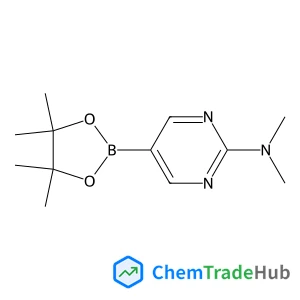
N,N-Dimethyl-5-(4,4,5,5-tetramethyl-1,3,2-dioxaborolan-2-yl)-2-pyrimidinamine
CAS Number:
1032759-30-0
Molecular Formula:
C12H20BN3O2
Eisuke Baba, Satoshi Honda, Takuya Yamamoto, Yasuyuki Tezuka
A novel amphiphilic block copolymer, i.e., cyclic polystyrene-b-poly(ethylene oxide) (cyclic PS-b-PEO 2), was synthesized through atom-transfer radical polymerization (ATRP), followed by ring-closing metathesis (RCM). Thus, a bromobenzyl-terminated PS-b-PEO-b-PS (6) was first prepared by ATRP of styrene using a PEO macroinitiator having 2-bromoisobutyryl groups (5). The subsequent end-group conversion into allyl groups was performed quantitatively with allyltrimethylsilane (ATMS) in the presence of TiCl4. The allyl-telechelic triblock copolymer PS-b-PEO-b-PS (7) thus obtained was subjected to metathesis polymer cyclization with a Grubbs' 2nd generation catalyst to produce amphiphilic cyclic PS-b-PEO (2).
Marco Albuszis, Peter J. Roth, Werner Pauer, Hans-Ulrich Moritz
DOI: 10.1039/C4PY00709C
Siddharth Chanpuriya, Marc A. Hillmyer, Frank S. Bates
DOI: 10.1039/C4PY00614C
Mariolino Carta, Matthew Croad, Johannes C. Jansen, Paola Bernardo, Gabriele Clarizia, Neil B. McKeown
DOI: 10.1039/C4PY00607K
Yilin Zhang, Liguo Xu, Rongrong Hu, Kam Sing Wong, William A. Goddard, III
DOI: 10.1039/C7PY00154A
Stephanie M. Barbon, Joe B. Gilroy
DOI: 10.1039/C6PY00441E
Shaojian Lin, Anindita Das, Patrick Theato
DOI: 10.1039/C6PY01996J
Matthew D. Green, Abbygail A. Foster, Chad T. Greco, Raghunath Roy, Rachel M. Lehr, Thomas H. Epps, III, Millicent O. Sullivan
DOI: 10.1039/C4PY00638K
Khama Rani Ghosh, Sukanta Kumar Saha
DOI: 10.1039/C4PY00673A
Chao Yin, Wenli Song, Rongcui Jiang, Wenbo Hu, Qingming Shen, Xiang Li, Jie Li, Quli Fan
DOI: 10.1039/C4PY00376D
Yangqing Tao, Fengkai He, Kaikai Jin, Jiajia Wang, Yuanqiang Wang, Junfeng Zhou, Jing Sun, Qiang Fang
DOI: 10.1039/C7PY00047B
When considering alternatives to 1-(4-Chlorophenyl)-N-hydroxymethanimine (CAS: 3...
This compound should be stored in a cool, dry place away from direct sunlight. I...
3-(4-Bromophenyl)-5-(2-fluorophenyl)-1,2,4-oxadiazole is synthesized through a m...
5-Chloro-2-(4-chlorophenyl)-4-methyl-6-[3-(1-piperidinyl)propoxy]pyrimidine (CAS...
2-Chloro-4-(difluoromethoxy)pyridine is used in the pharmaceutical industry for ...
3-Chloro-6-methylpyridazine (CAS: 1121-79-5) is classified under the Globally Ha...
Several alternatives can be used in the synthesis of Methyl 4,5-dimethyl-2-nitro...
Alternatives to (2E,2'E)-3,3'-(1,4-Phenylene)bisacrylaldehyde include other acry...
3-Amino-5-chloropyridin-2-ol hydrochloride is an organic compound with the CAS n...
When handling 6,7-Difluoro-2,3-dihydro-4H-chromen-4-one, it is essential to wear...

Polymer Chemistry welcomes submissions in all areas of polymer science that have a strong focus on macromolecular chemistry. Manuscripts may cover a broad range of fields, yet no direct application focus is required.
![6-Bromo-2,3-dihydro-1H-pyrido[2,3-b][1,4]oxazine structure](https://static.chemtradehub.com/structs/120/1203499-17-5-b4d1.webp "6-Bromo-2,3-dihydro-1H-pyrido[2,3-b][1,4]oxazine structure")