












Low absorption vitreous carbon reactors for operandoXAS: a case study on Cu/Zeolites for selective catalytic reduction of NOx by NH3
Literature Information
Publication Date
2011-12-09
DOI
10.1039/C1CP22992C
Impact Factor
3.676
Authors
Vincent F. Kispersky, A. Jeremy Kropf, Fabio H. Ribeiro, Jeffrey T. Miller
View Original
Abstract
We describe the use of vitreous carbon as an improved reactor material for an operandoX-ray absorption spectroscopy (XAS) plug-flow reactor. These tubes significantly broaden the operating range for operando experiments. Using selective catalytic reduction (SCR) of NOx by NH3 on Cu/Zeolites (SSZ-13, SAPO-34 and ZSM-5) as an example reaction, we illustrate the high-quality XAS data achievable with these reactors. The operando experiments showed that in Standard SCR conditions of 300 ppm NO, 300 ppm NH3, 5% O2, 5% H2O, 5% CO2 and balance He at 200 °C, the Cu was a mixture of Cu(I) and Cu(II) oxidation states. XANES and EXAFS fitting found the percent of Cu(I) to be 15%, 45% and 65% for SSZ-13, SAPO-34 and ZSM-5, respectively. For Standard SCR, the catalytic rates per mole of Cu for Cu/SSZ-13 and Cu/SAPO-34 were about one third of the rate per mole of Cu on Cu/ZSM-5. Based on the apparent lack of correlation of rate with the presence of Cu(I), we propose that the reaction occurs via a redox cycle of Cu(I) and Cu(II). Cu(I) was not found in in situSCR experiments on Cu/Zeolites under the same conditions, demonstrating a possible pitfall of in situ measurements. A Cu/SiO2 catalyst, reduced in H2 at 300 °C, was also used to demonstrate the reactor's operando capabilities using a bending magnet beamline. Analysis of the EXAFS data showed the Cu/SiO2 catalyst to be in a partially reduced Cu metal–Cu(I) state. In addition to improvements in data quality, the reactors are superior in temperature, stability, strength and ease of use compared to previously proposed borosilicate glass, polyimide tubing, beryllium and capillary reactors. The solid carbon tubes are non-porous, machinable, can be operated at high pressure (tested at 25 bar), are inert, have high material purity and high X-ray transmittance.
Related Literature
Activation of weak IR fundamentals of two species of astrochemical interest in the Td point group – the importance of amorphous ices
R. L. Hudson, P. A. Gerakines, M. J. Loeffler
2015-04-16
Paper
DOI: 10.1039/C5CP00975H
Two-dimensional electronic-vibrational spectra: modeling correlated electronic and nuclear motion
F. Terenziani, A. Painelli
2015-04-20
Paper
DOI: 10.1039/C5CP01485A
Towards multielectron photocatalysis: a porphyrin array for lateral hole transfer and capture on a metal oxide surface
Bradley J. Brennan, Alec C. Durrell, Matthieu Koepf, Robert H. Crabtree, Gary W. Brudvig
2015-04-16
Paper
DOI: 10.1039/C5CP01683E
A QCM study of ORR-OER and an in situ study of a redox mediator in DMSO for Li–O2 batteries
Stijn Schaltin, Gijs Vanhoutte, Minxian Wu, Fanny Bardé, Jan Fransaer
2015-04-13
Paper
DOI: 10.1039/C5CP00386E
Tunable electronic properties in the van der Waals heterostructure of germanene/germanane
Run-wu Zhang, Chang-wen Zhang, Wei-xiao Ji, Feng Li, Miao-juan Ren, Ping Li, Min Yuan, Pei-ji Wang
2015-03-31
Paper
DOI: 10.1039/C5CP00875A
Radical anions of hypervalent silicon compounds: 1-substituted silatranes
Elena F. Belogolova, Tamara I. Vakul'skaya, Valery F. Sidorkin
2015-04-23
Paper
DOI: 10.1039/C4CP06046F
Single-step preparation of two-dimensionally organized gold particles via ionic liquid/metal sputter deposition
Daisuke Sugioka, Tatsuya Kameyama, Susumu Kuwabata, Tsukasa Torimoto
2015-04-16
Paper
DOI: 10.1039/C5CP01602A
Effect of cationic molecules on the oxygen reduction reaction on fuel cell grade Pt/C (20 wt%) catalyst in potassium hydroxide (aq, 1 mol dm−3)
Ai Lien Ong, Kenneth K. Inglis, Daniel K. Whelligan, Sam Murphy, John R. Varcoe
2015-03-31
Paper
DOI: 10.1039/C4CP04973J
Coherent resonance of quantum plasmons in the graphene–gold cluster hybrid system
Chikang Li
2015-04-15
Paper
DOI: 10.1039/C4CP05049E
Physical chemistry and membrane properties of two phosphatidylinositol bisphosphate isomers
Yu-Hsiu Wang
2015-04-09
Paper
DOI: 10.1039/C5CP00862J
You might also like
Compound Q&A
How should waste containing N-Methoxy-N-methyl-1,3-thiazole-5-carboxamide (CAS: 898825-89-3) be handled?
Waste containing N-Methoxy-N-methyl-1,3-thiazole-5-carboxamide (CAS: 898825-89-3...
898825-89-3N-Methoxy-N-methyl-1...
Compound Q&A
How should N-(4-Biphenylyl)dibenzo[b,d]furan-4-amine (CAS: 1318338-47-4) be stored?
N-(4-Biphenylyl)dibenzo[b,d]furan-4-amine should be stored in a tightly sealed c...
1318338-47-4N-(4-Biphenylyl)dibe...
Compound Q&A
What is the market or research trend for 3-Acetamido-5-amino-2,4,6-triiodobenzoic acid (CAS: 1713-07-1)?
The market for 3-Acetamido-5-amino-2,4,6-triiodobenzoic acid (CAS: 1713-07-1) is...
1713-07-13-Acetamido-5-amino-...
Compound Q&A
How should Benzyl 2-O-acetyl-3,4,6-tri-O-benzyl-beta-D-galactopyranoside (CAS: 61820-03-9) be stored?
Benzyl 2-O-acetyl-3,4,6-tri-O-benzyl-beta-D-galactopyranoside (CAS: 61820-03-9) ...
61820-03-9Benzyl 2-O-acetyl-3,...
Compound Q&A
What regulatory guidelines apply to 2-Ethylpiperazine dihydrochloride (CAS: 438050-52-3)?
2-Ethylpiperazine dihydrochloride (CAS: 438050-52-3) is regulated under the Glob...
438050-52-32-Ethylpiperazine di...
Compound Q&A
What regulatory guidelines apply to 1,1'-[1,3-Phenylenebis(methylene)]bis(3-methyl-1H-pyrrole-2,5-dione) (CAS: 119462-56-5)?
1,1'-[1,3-Phenylenebis(methylene)]bis(3-methyl-1H-pyrrole-2,5-dione) (CAS: 11946...
119462-56-51,1'-[1,3-Phenyleneb...
Compound Q&A
Are there alternatives to 5-Fluoro-2-(1-pyrrolidinyl)pyridine (CAS: 1287217-79-1) in synthesis?
Several alternatives can be used in the synthesis of 5-Fluoro-2-(1-pyrrolidinyl)...
1287217-79-15-Fluoro-2-(1-pyrrol...
Compound Q&A
What precautions should be taken when handling 1-((2R,3R,4R,5R)-5-((bis(4-methoxyphenyl)(phenyl)methoxy)methyl)-4-hydroxy-3-methoxytetrahydrofuran-2-yl)-5-methylpyrimidine-2,4(1H,3H)-dione (CAS: 153631-19-7)?
Proper personal protective equipment (PPE) must be worn when handling this compo...
153631-19-71-((2R,3R,4R,5R)-5-(...
Compound Q&A
What precautions should be taken when handling 6-Bromoimidazo[1,2-a]pyridin-8-amine (CAS: 676371-00-9)?
When handling 6-Bromoimidazo[1,2-a]pyridin-8-amine, it is important to wear appr...
676371-00-96-Bromoimidazo[1,2-a...
Compound Q&A
Are there alternatives to (2S,4R)-4-(4-Nitrobenzyl)pyrrolidine-2-carboxylic acid hydrochloride (CAS: 1049740-22-8) in synthesis?
Alternatives to (2S,4R)-4-(4-Nitrobenzyl)pyrrolidine-2-carboxylic acid hydrochlo...
1049740-22-8(2S,4R)-4-(4-Nitrobe...
Source Journal
Physical Chemistry Chemical Physics

CiteScore:
5.5
Self-citation Rate:
10.3%
Articles per Year:
3036
Physical Chemistry Chemical Physics (PCCP) is an international journal co-owned by 19 physical chemistry and physics societies from around the world. This journal publishes original, cutting-edge research in physical chemistry, chemical physics and biophysical chemistry. To be suitable for publication in PCCP, articles must include significant innovation and/or insight into physical chemistry; this is the most important criterion that reviewers and Editors will judge against when evaluating submissions. The journal has a broad scope and welcomes contributions spanning experiment, theory, computation and data science. Topical coverage includes spectroscopy, dynamics, kinetics, statistical mechanics, thermodynamics, electrochemistry, catalysis, surface science, quantum mechanics, quantum computing and machine learning. Interdisciplinary research areas such as polymers and soft matter, materials, nanoscience, energy, surfaces/interfaces, and biophysical chemistry are welcomed if they demonstrate significant innovation and/or insight into physical chemistry. Joined experimental/theoretical studies are particularly appreciated when complementary and based on up-to-date approaches.
Recommended Compounds
![4-Chloro-2-{[(2-chlorophenoxy)acetyl]amino}benzoic acid structure](https://static.chemtradehub.com/structs/351/351424-20-9-9467.webp "4-Chloro-2-{[(2-chlorophenoxy)acetyl]amino}benzoic acid structure")
4-Chloro-2-{[(2-chlorophenoxy)acetyl]amino}benzoic acid
CAS Number:
351424-20-9
Molecular Formula:
C15H11Cl2NO4
![2-Methyl-2-propanyl {3-[4-(4,4,5,5-tetramethyl-1,3,2-dioxaborolan-2-yl)phenyl]-3-oxetanyl}carbamate structure](https://static.chemtradehub.com/structs/127/1279090-25-3-1b84.webp "2-Methyl-2-propanyl {3-[4-(4,4,5,5-tetramethyl-1,3,2-dioxaborolan-2-yl)phenyl]-3-oxetanyl}carbamate structure")
2-Methyl-2-propanyl {3-[4-(4,4,5,5-tetramethyl-1,3,2-dioxaborolan-2-yl)phenyl]-3-oxetanyl}carbamate
CAS Number:
1279090-25-3
Molecular Formula:
C20H30BNO5

N-(5-Fluoro-2-oxo-2,3-dihydro-4-pyrimidinyl)benzamide
CAS Number:
10357-07-0
Molecular Formula:
C11H8FN3O2
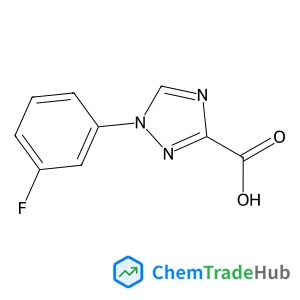
1-(3-Fluorophenyl)-1H-1,2,4-triazole-3-carboxylic acid
CAS Number:
1292369-51-7
Molecular Formula:
C9H6FN3O2
Recommended Suppliers






Disclaimer
This page provides academic journal information for reference and research purposes only. We are not affiliated with any journal publishers and do not handle publication submissions. For publication-related inquiries, please contact the respective journal publishers directly.
If you notice any inaccuracies in the information displayed, please contact us at support@chemtradehub.com. We will promptly review and address your concerns.