












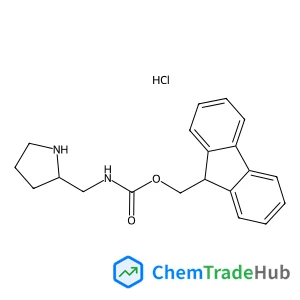
(S)-(9H-Fluoren-9-yl)methyl (pyrrolidin-2-ylmethyl)carbamate hydrochloride
CAS Number:
1217813-15-4
Molecular Formula:
C20H23ClN2O2
Todor Hikov, Christian A. Schröder, Janosch Cravillon, Michael Wiebcke, Klaus Huber
The kinetics and mechanism of crystallization of the dense zinc imidazolate framework with zni topology, from comparatively dilute methanol solutions containing Zn(NO3)·6H2O and imidazole with variation of the zinc-to-imidazole ratio, were followed in situ by time-resolved static and dynamic light scattering. The light scattering data revealed that metastable primary particles of about 100 nm in diameter form rapidly upon mixing the component solutions. After a lag time that is dependent on the imidazole concentration, the primary particles aggregate into secondary particles by a monomer addition mechanism with the primary particles as the monomers. Complementary scanning electron microscopy revealed that further evolution of the secondary particles is a complex process involving polycrystalline intermediates, the non-spherical morphologies of which depend on the initial zinc-to-imidazole ratio. Time and location of the first appearance of crystalline order could so far not be established. The pure-phase ZIF-zni crystals obtained after 240 min are twins. The aspect ratio of the tetragonal crystals can be controlled via the zinc-to-imidazole ratio.
Agata Arendt, Marek Samoc, Sławomir Szafert
DOI: 10.1039/C5CP01661D
DOI: 10.1039/C4CP03714F
Arpan Kool, Biswajoy Bagchi, Nur Amin Hoque, Sukhen Das, Papiya Nandy
DOI: 10.1039/C5CP01207D
Elena F. Belogolova, Tamara I. Vakul'skaya, Valery F. Sidorkin
DOI: 10.1039/C4CP06046F
Shaobing Lin, Jun Xu, Ling Xu, Kunji Chen
DOI: 10.1039/C5CP00246J
Sergey Ostanin
DOI: 10.1039/C4CP05831C
Masaki Hiratsuka, Ryo Ohmura, Amadeu K. Sum, Saman Alavi, Kenji Yasuoka
DOI: 10.1039/C4CP05732E
Chao-Feng Wu, Tian-Ran Wei, Jing-Feng Li
DOI: 10.1039/C4CP06021K
Yi Bao, Richard L. Martin, Maciej Haranczyk
DOI: 10.1039/C5CP00002E
Changzeng Fan, Jian Li
DOI: 10.1039/C5CP00001G
Waste containing N-Methoxy-N-methyl-1,3-thiazole-5-carboxamide (CAS: 898825-89-3...
N-(4-Biphenylyl)dibenzo[b,d]furan-4-amine should be stored in a tightly sealed c...
The market for 3-Acetamido-5-amino-2,4,6-triiodobenzoic acid (CAS: 1713-07-1) is...
Benzyl 2-O-acetyl-3,4,6-tri-O-benzyl-beta-D-galactopyranoside (CAS: 61820-03-9) ...
2-Ethylpiperazine dihydrochloride (CAS: 438050-52-3) is regulated under the Glob...
1,1'-[1,3-Phenylenebis(methylene)]bis(3-methyl-1H-pyrrole-2,5-dione) (CAS: 11946...
Several alternatives can be used in the synthesis of 5-Fluoro-2-(1-pyrrolidinyl)...
Proper personal protective equipment (PPE) must be worn when handling this compo...
When handling 6-Bromoimidazo[1,2-a]pyridin-8-amine, it is important to wear appr...
Alternatives to (2S,4R)-4-(4-Nitrobenzyl)pyrrolidine-2-carboxylic acid hydrochlo...

Physical Chemistry Chemical Physics (PCCP) is an international journal co-owned by 19 physical chemistry and physics societies from around the world. This journal publishes original, cutting-edge research in physical chemistry, chemical physics and biophysical chemistry. To be suitable for publication in PCCP, articles must include significant innovation and/or insight into physical chemistry; this is the most important criterion that reviewers and Editors will judge against when evaluating submissions. The journal has a broad scope and welcomes contributions spanning experiment, theory, computation and data science. Topical coverage includes spectroscopy, dynamics, kinetics, statistical mechanics, thermodynamics, electrochemistry, catalysis, surface science, quantum mechanics, quantum computing and machine learning. Interdisciplinary research areas such as polymers and soft matter, materials, nanoscience, energy, surfaces/interfaces, and biophysical chemistry are welcomed if they demonstrate significant innovation and/or insight into physical chemistry. Joined experimental/theoretical studies are particularly appreciated when complementary and based on up-to-date approaches.


![4-Chloro-2-{[(2-chlorophenoxy)acetyl]amino}benzoic acid structure](https://static.chemtradehub.com/structs/351/351424-20-9-9467.webp "4-Chloro-2-{[(2-chlorophenoxy)acetyl]amino}benzoic acid structure")






