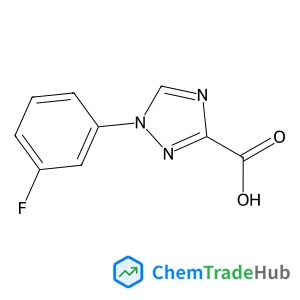
1-(3-Fluorophenyl)-1H-1,2,4-triazole-3-carboxylic acid
CAS Number:
1292369-51-7
Molecular Formula:
C9H6FN3O2
Shaobing Lin, Jun Xu, Ling Xu, Kunji Chen
Er3+ ions and SnO2 nanocrystals co-doped silica thin films are prepared by an improved sol–gel spin-coating method. With increase in annealing temperature, the related 1.54 μm characteristic emission intensity from Er3+ ions is obviously enhanced by more than two orders of magnitude via SnO2 nanocrystals size control to boost the sensitization efficiency. Quantitative studies of steady-state spectroscopic data and fluorescence decay curves demonstrate that the related sensitization efficiency via size-tunable nanocrystals is increased from 0.14% to 1.3%. This improved sensitization efficiency is achieved by doping some of the Er3+ ions into the SnO2 inner sites at a high annealing temperature, as revealed by high-resolution TEM, X-ray diffraction patterns and elemental mapping technique. Different sensitization mechanisms are also discussed separately according to the selective photoluminescence excitation measurements. All these results have not only explained the greatly improved sensitization efficiency resulting from SnO2 nanocrystals but also indicated that the development of Er3+ ions and SnO2 nanocrystals co-doped silica thin films could result in promising high-performance near-infrared luminous materials using broadband UV pumping.
DOI: 10.1039/B502849N
Mårten Ahlquist, Giancarlo Fabrizi, Sandro Cacchi, Per-Ola Norrby
DOI: 10.1039/B507784B
Gareth O. Lloyd, Martin W. Bredenkamp, Leonard J. Barbour
DOI: 10.1039/B507726E
Charng-Sheng Tsai, Ting-Bin Yu, Chao-Tsen Chen
DOI: 10.1039/B507237A
Jyongsik Jang, Byungkwon Lim, Moonjung Choi
DOI: 10.1039/B506265A
Makeba B. Murphy-Jolly, Lesley C. Lewis, Andrew J. M. Caffyn
DOI: 10.1039/B507752D
Shaofeng Yang, Roel Prins
DOI: 10.1039/B507940C
Steven Dickson, Darrell Dean, Robert. D. Singer
DOI: 10.1039/B508400H
Olalla Nieto Faza, Carlos Silva López, Rosana Álvarez, Ángel R. de Lera
DOI: 10.1039/B506601H
Guo-Ping Wang, Er-Qun Song, Hai-Yan Xie, Zhi-Ling Zhang, Zhi-Quan Tian, Chao Zuo, Dai-Wen Pang, Dao-Cheng Wu, Yun-Bo Shi
DOI: 10.1039/B508075D
Waste containing N-Methoxy-N-methyl-1,3-thiazole-5-carboxamide (CAS: 898825-89-3...
N-(4-Biphenylyl)dibenzo[b,d]furan-4-amine should be stored in a tightly sealed c...
The market for 3-Acetamido-5-amino-2,4,6-triiodobenzoic acid (CAS: 1713-07-1) is...
Benzyl 2-O-acetyl-3,4,6-tri-O-benzyl-beta-D-galactopyranoside (CAS: 61820-03-9) ...
2-Ethylpiperazine dihydrochloride (CAS: 438050-52-3) is regulated under the Glob...
1,1'-[1,3-Phenylenebis(methylene)]bis(3-methyl-1H-pyrrole-2,5-dione) (CAS: 11946...
Several alternatives can be used in the synthesis of 5-Fluoro-2-(1-pyrrolidinyl)...
Proper personal protective equipment (PPE) must be worn when handling this compo...
When handling 6-Bromoimidazo[1,2-a]pyridin-8-amine, it is important to wear appr...
Alternatives to (2S,4R)-4-(4-Nitrobenzyl)pyrrolidine-2-carboxylic acid hydrochlo...

Physical Chemistry Chemical Physics (PCCP) is an international journal co-owned by 19 physical chemistry and physics societies from around the world. This journal publishes original, cutting-edge research in physical chemistry, chemical physics and biophysical chemistry. To be suitable for publication in PCCP, articles must include significant innovation and/or insight into physical chemistry; this is the most important criterion that reviewers and Editors will judge against when evaluating submissions. The journal has a broad scope and welcomes contributions spanning experiment, theory, computation and data science. Topical coverage includes spectroscopy, dynamics, kinetics, statistical mechanics, thermodynamics, electrochemistry, catalysis, surface science, quantum mechanics, quantum computing and machine learning. Interdisciplinary research areas such as polymers and soft matter, materials, nanoscience, energy, surfaces/interfaces, and biophysical chemistry are welcomed if they demonstrate significant innovation and/or insight into physical chemistry. Joined experimental/theoretical studies are particularly appreciated when complementary and based on up-to-date approaches.