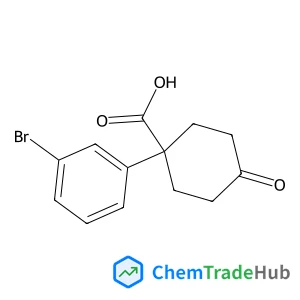
1-(3-Bromophenyl)-4-oxocyclohexanecarboxylic acid
CAS Number:
1385694-53-0
Molecular Formula:
C13H13BrO3
Martin C. R. Cockett, Mitsuhiko Miyazaki, Kohei Tanabe, Masaaki Fujii
The 4-fluorotoluene-ammonia van der Waals complex has been studied using IR-UV depletion and hole-burning spectroscopies with assignments supported by ab initio and DFT calculations of ground state binding energies and intramolecular vibrational frequencies. The experimental IR-UV depletion and hole-burning spectra presented here provide unequivocal empirical evidence that the 4FT-NH3 complex exists in two almost equally stable conformational forms. Both isomers contribute intensity to the experimental R2PI spectrum with one responsible for bands appearing to the red of the 4FT band origin position, and the other for those appearing immediately to the blue. On the basis of comparison of computed NH stretching frequencies with those obtained from the IR-UV spectra, the red-shifted bands are assigned to a π-proton-acceptor complex featuring an NH⋯π-hydrogen bond, and the blue-shifted bands are assigned to an in-plane σ-complex in which the ammonia binds in the plane of the ring forming a double-hydrogen-bonded six-membered ring with the fluorine atom. Ground state interaction energies computed at the M06-2X/cc-pVTZ level were found to compare favourably with those obtained at the CCSD(T) CBS level, although the former resulted in overbinding of the π-complex compared with the in-plane conformer, a characteristic shared with MP2 level calculations. The observation of a π-complex in addition to a σ-complex is consistent with the conclusion that the electron-donating power of the methyl group is sufficiently large to counter-balance the electron-withdrawing power of the fluorine atom.
K. Garg, E. Ganapathi, P. Rajakannu, M. Ravikanth
DOI: 10.1039/C5CP02400E
Liang Han, Jie Lian, Sheng Liu, Zhongfang Chen, Nikhil Koratkar, Suvranu De
DOI: 10.1039/C5CP02986D
Qiang Li, Qingzhong Xue, Chunyong Liang, Mingdong Dong
DOI: 10.1039/C6CP02580C
Marcileia Zanatta, Anne-Lise Girard, Graciane Marin, Gunter Ebeling, Francisco P. dos Santos, Chiara Valsecchi, Hubert Stassen, Paolo R. Livotto, William Lewis
DOI: 10.1039/C6CP03112A
Matthew E. Potter, Sivan V. Aswegen, Emma K. Gibson, Robert Raja
DOI: 10.1039/C6CP01209D
I. Goikoetxea
DOI: 10.1039/C5CP02051D
Liwen F. Wan, Joshua Wright, Brian R. Perdue, Timothy T. Fister, Soojeong Kim, Christopher A. Apblett, David Prendergast
DOI: 10.1039/C6CP02412B
Benjamin Bardet, Domingos De Sousa Meneses, Thomas Defforge, Jérôme Billoué, Gaël Gautier
DOI: 10.1039/C6CP02086K
4-Amino-3-bromophenol (CAS: 74440-80-5) falls under the classification of a haza...
(17beta)-3-Oxoestr-4-en-17-yl acetate should be stored in a cool, dry place away...
2-[(2,2-Diethoxyethyl)disulfanyl]-1,1-diethoxyethane (CAS: 76505-71-0) is a colo...
The market and research for 1-(β-D-ribofuranosyl)-1H-imidazo[4,5-c]pyridin-4-ami...
Waste containing Conjugated Estrogen (CAS: 12126-59-9) should be collected and d...
The market for Bis(2,2,2-trifluoroethyl) (methoxycarbonylmethyl)phosphonate (CAS...
There are several alternatives to 3,4'-Di-O-methylellagic acid (CAS: 57499-59-9)...
2-Chloro-N,N-dimethylpyridin-4-amine (CAS: 59047-70-0) is regulated under the Gl...
Cerium(3+);oxygen(2-);vanadium(5+) (CAS: 13597-19-8) is a complex inorganic comp...
7-Chloro-1-iodoisoquinoline (CAS: 1203579-27-4) is generally considered safe whe...

Physical Chemistry Chemical Physics (PCCP) is an international journal co-owned by 19 physical chemistry and physics societies from around the world. This journal publishes original, cutting-edge research in physical chemistry, chemical physics and biophysical chemistry. To be suitable for publication in PCCP, articles must include significant innovation and/or insight into physical chemistry; this is the most important criterion that reviewers and Editors will judge against when evaluating submissions. The journal has a broad scope and welcomes contributions spanning experiment, theory, computation and data science. Topical coverage includes spectroscopy, dynamics, kinetics, statistical mechanics, thermodynamics, electrochemistry, catalysis, surface science, quantum mechanics, quantum computing and machine learning. Interdisciplinary research areas such as polymers and soft matter, materials, nanoscience, energy, surfaces/interfaces, and biophysical chemistry are welcomed if they demonstrate significant innovation and/or insight into physical chemistry. Joined experimental/theoretical studies are particularly appreciated when complementary and based on up-to-date approaches.
![N-[(1R,2R)-2-Amino-1,2-diphenylethyl]-1,1,1-trifluoromethanesulfonamide structure](https://static.chemtradehub.com/structs/852/852212-89-6-5ef9.webp "N-[(1R,2R)-2-Amino-1,2-diphenylethyl]-1,1,1-trifluoromethanesulfonamide structure")