


Polyoxometalate grafting onto silica: stability diagrams of H3PMo12O40 on {001}, {101}, and {111} β-cristobalite surfaces analyzed by DFT
Literature Information
Publication Date
2011-08-09
DOI
10.1039/C1CP21171D
Impact Factor
3.676
Authors
Xavier Rozanska, Philippe Sautet, Françoise Delbecq, Frédéric Lefebvre, Sergei Borshch, Henri Chermette, Jean-Marie Basset, Eva Grinenval
View Original
Abstract
The process of grafting H3PMo12O40 onto silica surfaces is studied using periodic density functional theory methods. For surfaces with a high hydroxyl coverage, the hydroxyl groups are consumed by the polyoxometalate protons, resulting in water formation and the creation of a covalent bond between the polyoxometalate and the surface, and mostly no remaining acidic proton on the polyoxometalate. When the surfaces are partially dehydroxylated and more hydrophobic, after temperature pretreatment, less covalent and hydrogen bonds are formed and the polyoxometalate tends to retain surface hydroxyl groups, while at least one acidic proton remains. Hence the hydroxylation of the surface has a great impact on the chemical properties of the grafted polyoxometalate. In return, the polyoxometalate species affects the compared stability of the partially hydroxylated silica surfaces in comparison with the bare silica case.
Recommended Journals

Foundations of Chemistry

Physical Chemistry Chemical Physics

European Journal of Organic Chemistry

Advanced Engineering Materials

CrystEngComm

Mini-Reviews in Medicinal Chemistry

Current Pharmaceutical Biotechnology

Journal of Enzyme inhibition and Medicinal Chemistry

Environmental Toxicology and Pharmacology

Journal of Medical Biochemistry
Related Literature
The dynamics of adsorption and dissociation of N2 in a monolayer of iron on W(110)
I. Goikoetxea
2015-06-12
Paper
DOI: 10.1039/C5CP02051D
Ab initio calculation of pentacene–PbSe hybrid interface for photovoltaic applications
P. Roy, Thao P. Nguyen
2016-06-10
Paper
DOI: 10.1039/C6CP01563H
Secondary brown carbon formation via the dicarbonyl imine pathway: nitrogen heterocycle formation and synergistic effects
C. Zuth, T. Hoffmann, T. Opatz
2016-06-13
Paper
DOI: 10.1039/C6CP03029G
Electronic structure engineering of various structural phases of phosphorene
Sumandeep Kaur, Ashok Kumar, Sunita Srivastava, K. Tankeshwar
2016-06-09
Paper
DOI: 10.1039/C6CP01252C
Preparation of superhydrophobic films based on the diblock copolymer P(TFEMA-r-Sty)-b-PCEMA
2015-06-23
Paper
DOI: 10.1039/C5CP02751A
Determination of toluene hydrogenation kinetics with neutron diffraction
Sarayute Chansai, Haresh G. Manyar, Lynn F. Gladden, Daniel T. Bowron, Tristan G. A. Youngs, Christopher Hardacre
2016-03-29
Paper
DOI: 10.1039/C6CP01494A
Methanol diffusion in zeolite HY: a combined quasielastic neutron scattering and molecular dynamics simulation study
Victoria García Sakai, Ian P. Silverwood, Nikolaos Dimitratos
2016-05-16
Paper
DOI: 10.1039/C6CP01151A
Two-photon-absorption DNA sensitization via solvated electron production: unraveling photochemical pathways by molecular modeling and simulation
Elise Dumont
2016-06-13
Paper
DOI: 10.1039/C6CP02592G
Structure and bonding in crystalline cesium uranyl tetrachloride under pressure
Pilar Pertierra, Miguel A. Salvadó, F. Izquierdo-Ruiz, J. M. Recio
2016-06-10
Paper
DOI: 10.1039/C6CP03876J
Structural phase transition in perovskite metal–formate frameworks: a Potts-type model with dipolar interactions
Mantas Šimėnas, Sergejus Balčiūnas, Mirosław Maçzka, Jūras Banys, Evaldas E. Tornau
2016-06-13
Paper
DOI: 10.1039/C6CP03414D
You might also like
Compound Q&A
What regulatory guidelines apply to 4-Amino-3-bromophenol (CAS: 74440-80-5)?
4-Amino-3-bromophenol (CAS: 74440-80-5) falls under the classification of a haza...
74440-80-54-Amino-3-bromopheno...
Compound Q&A
How should (17beta)-3-Oxoestr-4-en-17-yl acetate (CAS: 1425-10-1) be stored?
(17beta)-3-Oxoestr-4-en-17-yl acetate should be stored in a cool, dry place away...
1425-10-1(17beta)-3-Oxoestr-4...
Compound Q&A
What are the physical and chemical properties of 2-[(2,2-Diethoxyethyl)disulfanyl]-1,1-diethoxyethane (CAS: 76505-71-0)?
2-[(2,2-Diethoxyethyl)disulfanyl]-1,1-diethoxyethane (CAS: 76505-71-0) is a colo...
76505-71-02-[(2,2-Diethoxyethy...
Compound Q&A
What is the market or research trend for 1-(β-D-ribofuranosyl)-1H-imidazo[4,5-c]pyridin-4-amine?
The market and research for 1-(β-D-ribofuranosyl)-1H-imidazo[4,5-c]pyridin-4-ami...
6736-58-91-(beta-D-Ribofurano...
Compound Q&A
How should waste containing Conjugated Estrogen (CAS: 12126-59-9) be handled?
Waste containing Conjugated Estrogen (CAS: 12126-59-9) should be collected and d...
12126-59-9Conjugated Estrogen
Compound Q&A
What is the market or research trend for Bis(2,2,2-trifluoroethyl) (methoxycarbonylmethyl)phosphonate?
The market for Bis(2,2,2-trifluoroethyl) (methoxycarbonylmethyl)phosphonate (CAS...
88738-78-7Bis(2,2,2-trifluoroe...
Compound Q&A
Are there alternatives to 3,4'-Di-O-methylellagic acid (CAS: 57499-59-9) in synthesis?
There are several alternatives to 3,4'-Di-O-methylellagic acid (CAS: 57499-59-9)...
57499-59-93,4'-Di-O-methylella...
Compound Q&A
What regulatory guidelines apply to 2-Chloro-N,N-dimethylpyridin-4-amine (CAS: 59047-70-0)?
2-Chloro-N,N-dimethylpyridin-4-amine (CAS: 59047-70-0) is regulated under the Gl...
59047-70-02-Chloro-N,N-dimethy...
Compound Q&A
What is cerium(3+);oxygen(2-);vanadium(5+) (CAS: 13597-19-8)?
Cerium(3+);oxygen(2-);vanadium(5+) (CAS: 13597-19-8) is a complex inorganic comp...
13597-19-8cerium(3+);oxygen(2-...
Compound Q&A
Is 7-Chloro-1-iodoisoquinoline (CAS: 1203579-27-4) safe?
7-Chloro-1-iodoisoquinoline (CAS: 1203579-27-4) is generally considered safe whe...
1203579-27-47-Chloro-1-iodoisoqu...
Source Journal
Physical Chemistry Chemical Physics
CiteScore:
5.5
Self-citation Rate:
10.3%
Articles per Year:
3036
Physical Chemistry Chemical Physics (PCCP) is an international journal co-owned by 19 physical chemistry and physics societies from around the world. This journal publishes original, cutting-edge research in physical chemistry, chemical physics and biophysical chemistry. To be suitable for publication in PCCP, articles must include significant innovation and/or insight into physical chemistry; this is the most important criterion that reviewers and Editors will judge against when evaluating submissions. The journal has a broad scope and welcomes contributions spanning experiment, theory, computation and data science. Topical coverage includes spectroscopy, dynamics, kinetics, statistical mechanics, thermodynamics, electrochemistry, catalysis, surface science, quantum mechanics, quantum computing and machine learning. Interdisciplinary research areas such as polymers and soft matter, materials, nanoscience, energy, surfaces/interfaces, and biophysical chemistry are welcomed if they demonstrate significant innovation and/or insight into physical chemistry. Joined experimental/theoretical studies are particularly appreciated when complementary and based on up-to-date approaches.
Recommended Compounds
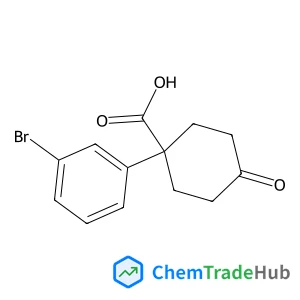
1-(3-Bromophenyl)-4-oxocyclohexanecarboxylic acid
CAS Number:
1385694-53-0
Molecular Formula:
C13H13BrO3
Recommended Suppliers







Disclaimer
This page provides academic journal information for reference and research purposes only. We are not affiliated with any journal publishers and do not handle publication submissions. For publication-related inquiries, please contact the respective journal publishers directly.
If you notice any inaccuracies in the information displayed, please contact us at support@chemtradehub.com. We will promptly review and address your concerns.