












Complex kinetics and significant influences of bromine removal in ferroin–bromate–metol reaction
Literature Information
Publication Date
2011-08-02
DOI
10.1039/C1CP21028A
Impact Factor
3.676
Authors
Jun Li, Jichang Wang
View Original
Abstract
This study presents a new bromate-based chemical oscillator that employs metol as the organic substrate. Complex reaction behaviors were observed when the system was subjected to bromine removal and oxygen exposure. Transitions from simple to sequential oscillations took place as a function of the age of the metol stock solution. MS spectroscopy measurements and parallel kinetic experiments with a mixture of metol and hydroquinone suggest that the decomposition of metol to hydroquinone was responsible for the observed influence of oxygen and the age of the metol solution. GS/MS and NMR measurements revealed that 1,4-benzoquinone and bromobenzoquinones were the major final products, regardless of the presence of oxygen and bromine removal. Preliminary exploration in a capillary tube showed some interesting propagating pulse behavior.
Related Literature
Structure and bonding in crystalline cesium uranyl tetrachloride under pressure
Pilar Pertierra, Miguel A. Salvadó, F. Izquierdo-Ruiz, J. M. Recio
2016-06-10
Paper
DOI: 10.1039/C6CP03876J
Fabrication of bilayer tetrathiafulvalene integrated surface covalent organic frameworks
Cheng Wang, Dong Wang, Li-Jun Wan
2016-06-06
Communication
DOI: 10.1039/C6CP01804A
Surface adsorption of sulfonated poly(phenylene sulfone)/C14TAB mixtures and its correlation with foam film stability
Martin Uhlig, Reinhard Miller, Regine von Klitzing
2016-06-17
Paper
DOI: 10.1039/C6CP02256A
Dissolved chloride markedly changes the nanostructure of the protic ionic liquids propylammonium and ethanolammonium nitrate
Thomas Murphy, Samantha K. Callear, Gregory G. Warr, Rob Atkin
2016-02-08
Paper
DOI: 10.1039/C5CP06947E
Nano-size scaling of alloy intra-particle vs. inter-particle separation transitions: prediction of distinctly interface-affected critical behaviour
M. Polak, L. Rubinovich
2016-06-10
Paper
DOI: 10.1039/C6CP02444K
How surface reparation prevents catalytic oxidation of carbon monoxide on atomic gold at defective magnesium oxide surfaces
Kai Töpfer, Jean Christophe Tremblay
2016-06-09
Paper
DOI: 10.1039/C6CP02339H
Two-photon-absorption DNA sensitization via solvated electron production: unraveling photochemical pathways by molecular modeling and simulation
Elise Dumont
2016-06-13
Paper
DOI: 10.1039/C6CP02592G
Dynamics of H2 adsorbed in porous materials as revealed by computational analysis of inelastic neutron scattering spectra
Tony Pham, Katherine A. Forrest, Brian Space, Juergen Eckert
2016-04-27
Perspective
DOI: 10.1039/C6CP01863G
You might also like
Compound Q&A
What regulatory guidelines apply to 4-Amino-3-bromophenol (CAS: 74440-80-5)?
4-Amino-3-bromophenol (CAS: 74440-80-5) falls under the classification of a haza...
74440-80-54-Amino-3-bromopheno...
Compound Q&A
How should (17beta)-3-Oxoestr-4-en-17-yl acetate (CAS: 1425-10-1) be stored?
(17beta)-3-Oxoestr-4-en-17-yl acetate should be stored in a cool, dry place away...
1425-10-1(17beta)-3-Oxoestr-4...
Compound Q&A
What are the physical and chemical properties of 2-[(2,2-Diethoxyethyl)disulfanyl]-1,1-diethoxyethane (CAS: 76505-71-0)?
2-[(2,2-Diethoxyethyl)disulfanyl]-1,1-diethoxyethane (CAS: 76505-71-0) is a colo...
76505-71-02-[(2,2-Diethoxyethy...
Compound Q&A
What is the market or research trend for 1-(β-D-ribofuranosyl)-1H-imidazo[4,5-c]pyridin-4-amine?
The market and research for 1-(β-D-ribofuranosyl)-1H-imidazo[4,5-c]pyridin-4-ami...
6736-58-91-(beta-D-Ribofurano...
Compound Q&A
How should waste containing Conjugated Estrogen (CAS: 12126-59-9) be handled?
Waste containing Conjugated Estrogen (CAS: 12126-59-9) should be collected and d...
12126-59-9Conjugated Estrogen
Compound Q&A
What is the market or research trend for Bis(2,2,2-trifluoroethyl) (methoxycarbonylmethyl)phosphonate?
The market for Bis(2,2,2-trifluoroethyl) (methoxycarbonylmethyl)phosphonate (CAS...
88738-78-7Bis(2,2,2-trifluoroe...
Compound Q&A
Are there alternatives to 3,4'-Di-O-methylellagic acid (CAS: 57499-59-9) in synthesis?
There are several alternatives to 3,4'-Di-O-methylellagic acid (CAS: 57499-59-9)...
57499-59-93,4'-Di-O-methylella...
Compound Q&A
What regulatory guidelines apply to 2-Chloro-N,N-dimethylpyridin-4-amine (CAS: 59047-70-0)?
2-Chloro-N,N-dimethylpyridin-4-amine (CAS: 59047-70-0) is regulated under the Gl...
59047-70-02-Chloro-N,N-dimethy...
Compound Q&A
What is cerium(3+);oxygen(2-);vanadium(5+) (CAS: 13597-19-8)?
Cerium(3+);oxygen(2-);vanadium(5+) (CAS: 13597-19-8) is a complex inorganic comp...
13597-19-8cerium(3+);oxygen(2-...
Compound Q&A
Is 7-Chloro-1-iodoisoquinoline (CAS: 1203579-27-4) safe?
7-Chloro-1-iodoisoquinoline (CAS: 1203579-27-4) is generally considered safe whe...
1203579-27-47-Chloro-1-iodoisoqu...
Source Journal
Physical Chemistry Chemical Physics

CiteScore:
5.5
Self-citation Rate:
10.3%
Articles per Year:
3036
Physical Chemistry Chemical Physics (PCCP) is an international journal co-owned by 19 physical chemistry and physics societies from around the world. This journal publishes original, cutting-edge research in physical chemistry, chemical physics and biophysical chemistry. To be suitable for publication in PCCP, articles must include significant innovation and/or insight into physical chemistry; this is the most important criterion that reviewers and Editors will judge against when evaluating submissions. The journal has a broad scope and welcomes contributions spanning experiment, theory, computation and data science. Topical coverage includes spectroscopy, dynamics, kinetics, statistical mechanics, thermodynamics, electrochemistry, catalysis, surface science, quantum mechanics, quantum computing and machine learning. Interdisciplinary research areas such as polymers and soft matter, materials, nanoscience, energy, surfaces/interfaces, and biophysical chemistry are welcomed if they demonstrate significant innovation and/or insight into physical chemistry. Joined experimental/theoretical studies are particularly appreciated when complementary and based on up-to-date approaches.
Recommended Compounds
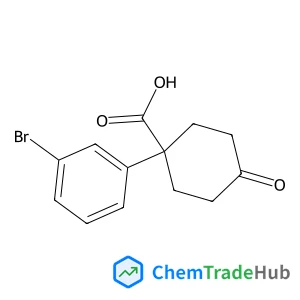
1-(3-Bromophenyl)-4-oxocyclohexanecarboxylic acid
CAS Number:
1385694-53-0
Molecular Formula:
C13H13BrO3
Recommended Suppliers





Disclaimer
This page provides academic journal information for reference and research purposes only. We are not affiliated with any journal publishers and do not handle publication submissions. For publication-related inquiries, please contact the respective journal publishers directly.
If you notice any inaccuracies in the information displayed, please contact us at support@chemtradehub.com. We will promptly review and address your concerns.