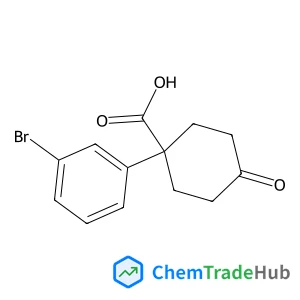
1-(3-Bromophenyl)-4-oxocyclohexanecarboxylic acid
CAS Number:
1385694-53-0
Molecular Formula:
C13H13BrO3
Yasuhiro Oba, Naoki Watanabe, Akira Kouchi, Tetsuya Hama, Valerio Pirronello
We investigated the OH-related formation routes of two astrophysically important molecules, H2O and CO2, under relatively warm astrophysical conditions. OH radicals, together with other neutral species such as H, O, H2, and O2, were produced in H2O microwave-discharge plasma and cooled to 100 K before being deposited on an Al substrate at 40–60 K. H2O formed at 40 and 50 K, but not at 60 K. Taking the experimental conditions into account, a possible route of H2O formation is via reactions involving OH + OH, which yield H2O2 as the main reaction product. The present study is the first to show experimentally that surface reactions of two OH radicals can yield H2O at low temperatures. The products' branching ratio was 0.2 and 0.8 for H2O and H2O2, respectively. When CO was co-deposited with neutral species that formed in the H2O plasma, CO2 was formed at 40–60 K. H2CO3 formed at 40 and 50 K. The present results may suggest that chemical reactions related to OH radicals are effective at yielding various molecules in relatively warm astrophysical environments, such as protostars.

Physical Chemistry Chemical Physics

Mini-Reviews in Medicinal Chemistry

Journal of Enzyme inhibition and Medicinal Chemistry

Current Pharmaceutical Biotechnology

Photochemical & Photobiological Sciences

CrystEngComm

Journal of Medical Biochemistry

Faraday Discussions

Advanced Engineering Materials

Foundations of Chemistry
Jianguo Wang
DOI: 10.1039/C5CP02486B
Daniel P. Zaleski, Susanna L. Stephens, David P. Tew, Dror M. Bittner, Nicholas R. Walker, Anthony C. Legon
DOI: 10.1039/C5CP02248G
Lei Zhang, Ludovic Favereau, Yoann Farré, Edgar Mijangos, Yann Pellegrin, Errol Blart, Fabrice Odobel, Leif Hammarström
DOI: 10.1039/C6CP01762B
Robert G. Northcutt, Christian Heinemann, Vishnu Baba Sundaresan
DOI: 10.1039/C6CP03071H
Richard K. Heenan
DOI: 10.1039/C6CP01694D
L. Cheng, H. J. Liu, J. Zhang, J. Wei, J. H. Liang, P. H. Jiang, D. D. Fan, L. Sun, J. Shi
DOI: 10.1039/C6CP01958G
M. Horch, P. Hildebrandt, I. Zebger
DOI: 10.1039/C5CP02447A
Chathurangi S. Kumarasinghe, Malin Premaratne, Sarath D. Gunapala, Govind P. Agrawal
DOI: 10.1039/C6CP03043B
Xiaoli Zheng, Yang Bai, Zilong Wang
DOI: 10.1039/C5CP01534K
4-Amino-3-bromophenol (CAS: 74440-80-5) falls under the classification of a haza...
(17beta)-3-Oxoestr-4-en-17-yl acetate should be stored in a cool, dry place away...
2-[(2,2-Diethoxyethyl)disulfanyl]-1,1-diethoxyethane (CAS: 76505-71-0) is a colo...
The market and research for 1-(β-D-ribofuranosyl)-1H-imidazo[4,5-c]pyridin-4-ami...
Waste containing Conjugated Estrogen (CAS: 12126-59-9) should be collected and d...
The market for Bis(2,2,2-trifluoroethyl) (methoxycarbonylmethyl)phosphonate (CAS...
There are several alternatives to 3,4'-Di-O-methylellagic acid (CAS: 57499-59-9)...
2-Chloro-N,N-dimethylpyridin-4-amine (CAS: 59047-70-0) is regulated under the Gl...
Cerium(3+);oxygen(2-);vanadium(5+) (CAS: 13597-19-8) is a complex inorganic comp...
7-Chloro-1-iodoisoquinoline (CAS: 1203579-27-4) is generally considered safe whe...
Physical Chemistry Chemical Physics (PCCP) is an international journal co-owned by 19 physical chemistry and physics societies from around the world. This journal publishes original, cutting-edge research in physical chemistry, chemical physics and biophysical chemistry. To be suitable for publication in PCCP, articles must include significant innovation and/or insight into physical chemistry; this is the most important criterion that reviewers and Editors will judge against when evaluating submissions. The journal has a broad scope and welcomes contributions spanning experiment, theory, computation and data science. Topical coverage includes spectroscopy, dynamics, kinetics, statistical mechanics, thermodynamics, electrochemistry, catalysis, surface science, quantum mechanics, quantum computing and machine learning. Interdisciplinary research areas such as polymers and soft matter, materials, nanoscience, energy, surfaces/interfaces, and biophysical chemistry are welcomed if they demonstrate significant innovation and/or insight into physical chemistry. Joined experimental/theoretical studies are particularly appreciated when complementary and based on up-to-date approaches.
![Ethyl 5-[({[(2-methyl-2-propanyl)oxy]carbonyl}amino)methyl]-1,2-oxazole-3-carboxylate structure](https://static.chemtradehub.com/structs/253/253196-37-1-8450.webp "Ethyl 5-[({[(2-methyl-2-propanyl)oxy]carbonyl}amino)methyl]-1,2-oxazole-3-carboxylate structure")