











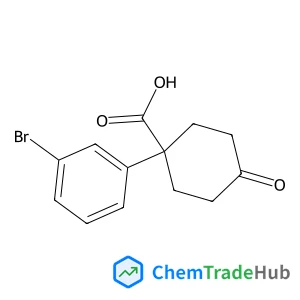
1-(3-Bromophenyl)-4-oxocyclohexanecarboxylic acid
CAS Number:
1385694-53-0
Molecular Formula:
C13H13BrO3
Sergio Pilling, Eduardo Seperuelo Duarte, Alicja Domaracka, Hermann Rothard, Philippe Boduch, Enio F. da Silveira
An experimental study of the interaction of highly charged, energetic ions (52 MeV 58Ni13+ and 15.7 MeV 16O5+) with mixed H2O : C18O2 astrophysical ice analogs at two different temperatures is presented. This analysis aims to simulate the chemical and the physicochemical interactions induced by cosmic rays inside dense, cold astrophysical environments, such as molecular clouds or protostellar clouds as well at the surface of outer solar system bodies. The measurements were performed at the heavy ion accelerator GANIL (Grand Accelerateur National d'Ions Lourds) in Caen, France. The gas samples were deposited onto a CsI substrate at 13 K and 80 K. In situ analysis was performed by a Fourier transform infrared (FTIR) spectrometer at different fluences. Radiolysis yields of the produced species were quantified. The dissociation cross section at 13 K of both H2O and CO2 is about 3–4 times smaller when O ions are employed. The ice temperature seems to affect differently each species when the same projectile was employed. The formation cross section at 13 K of molecules such as C18O, CO (with oxygen from water), and H2O2 increases when Ni ions are employed. The formation of organic compounds seems to be enhanced by the oxygen projectiles and at lower temperatures. In addition, because the organic production at 13 K is at least 4 times higher than the value at 80 K, we also expect that interstellar ices are more organic-rich than the surfaces of outer solar system bodies.
Mihaela Florea, Daniel Avram, Bogdan Cojocaru, Ion Tiseanu, Vasile Parvulescu, Carmen Tiseanu
DOI: 10.1039/C6CP02754G
M. Polak, L. Rubinovich
DOI: 10.1039/C6CP02444K
Alexey O. Ivanov, Vladimir S. Zverev, Ekaterina A. Elfimova, Alexander V. Lebedev, Alexander F. Pshenichnikov
DOI: 10.1039/C6CP02793H
Mingzhen Zhang, Huipeng Gao, Jie Zheng, Lingyun Jia
DOI: 10.1039/C6CP02790C
Liwen F. Wan, Joshua Wright, Brian R. Perdue, Timothy T. Fister, Soojeong Kim, Christopher A. Apblett, David Prendergast
DOI: 10.1039/C6CP02412B
Paweł Tecmer, Sung W. Hong, Katharina Boguslawski
DOI: 10.1039/C6CP03542F
Tatsuya Miyatou, Ryutaro Ohashi, Tomonori Ida, Shigeharu Kittaka, Motohiro Mizuno
DOI: 10.1039/C6CP03111K
Zhiqi He, Paschalis Alexandridis
DOI: 10.1039/C5CP01620G
Min Zeng, Xiange Peng, Jianjun Liao, Guizhen Wang, Yanfang Li, Jianbao Li, Yong Qin, Joshua Wilson, Aimin Song
DOI: 10.1039/C6CP01299J
4-Amino-3-bromophenol (CAS: 74440-80-5) falls under the classification of a haza...
(17beta)-3-Oxoestr-4-en-17-yl acetate should be stored in a cool, dry place away...
2-[(2,2-Diethoxyethyl)disulfanyl]-1,1-diethoxyethane (CAS: 76505-71-0) is a colo...
The market and research for 1-(β-D-ribofuranosyl)-1H-imidazo[4,5-c]pyridin-4-ami...
Waste containing Conjugated Estrogen (CAS: 12126-59-9) should be collected and d...
The market for Bis(2,2,2-trifluoroethyl) (methoxycarbonylmethyl)phosphonate (CAS...
There are several alternatives to 3,4'-Di-O-methylellagic acid (CAS: 57499-59-9)...
2-Chloro-N,N-dimethylpyridin-4-amine (CAS: 59047-70-0) is regulated under the Gl...
Cerium(3+);oxygen(2-);vanadium(5+) (CAS: 13597-19-8) is a complex inorganic comp...
7-Chloro-1-iodoisoquinoline (CAS: 1203579-27-4) is generally considered safe whe...

Physical Chemistry Chemical Physics (PCCP) is an international journal co-owned by 19 physical chemistry and physics societies from around the world. This journal publishes original, cutting-edge research in physical chemistry, chemical physics and biophysical chemistry. To be suitable for publication in PCCP, articles must include significant innovation and/or insight into physical chemistry; this is the most important criterion that reviewers and Editors will judge against when evaluating submissions. The journal has a broad scope and welcomes contributions spanning experiment, theory, computation and data science. Topical coverage includes spectroscopy, dynamics, kinetics, statistical mechanics, thermodynamics, electrochemistry, catalysis, surface science, quantum mechanics, quantum computing and machine learning. Interdisciplinary research areas such as polymers and soft matter, materials, nanoscience, energy, surfaces/interfaces, and biophysical chemistry are welcomed if they demonstrate significant innovation and/or insight into physical chemistry. Joined experimental/theoretical studies are particularly appreciated when complementary and based on up-to-date approaches.
![9-Ethyl-3-{(E)-[ethyl(2-methylphenyl)hydrazono]methyl}-9H-carbazole structure](https://static.chemtradehub.com/structs/127/1274948-12-7-301f.webp "9-Ethyl-3-{(E)-[ethyl(2-methylphenyl)hydrazono]methyl}-9H-carbazole structure")
![[3-Formyl-5-(trifluoromethoxy)phenyl]boronic acid structure](https://static.chemtradehub.com/structs/145/1451393-39-7-aebb.webp "[3-Formyl-5-(trifluoromethoxy)phenyl]boronic acid structure")





