












Electrochemical and spectroscopic studies of ethanoloxidation on Pt stepped surfaces modified by tin adatoms
Literature Information
Publication Date
2011-06-03
DOI
10.1039/C1CP20546C
Impact Factor
3.676
Authors
Vinicius Del Colle, Germano Tremiliosi-Filho, Enrique Herrero, Juan M. Feliu
View Original
Abstract
Ethanol oxidation on platinum stepped surfaces vicinal to the (111) pole modified by tin has been studied to determine the role of this adatom in the oxidation mechanism. Tin has been slowly deposited so that the initial stages of the deposition take place on the step, and deposition on the terrace only occurs when the step has been completely decorated. Voltammetric and chronoamperometric experiments demonstrate that tin on the step catalyzes the oxidation. The maximum enhancement is found when the step is completely decorated by tin. FTIR experiments using normal and isotopically labeled ethanol have been used to elucidate the effect of the tin adatoms in the mechanism. The obtained results indicate that the role of tin is double: (i) when the surface has sites capable of breaking the C–C bond of the molecule, that is, when the step sites are not completely covered by tin, it promotes the oxidation of CO formed from the molecular fragments to CO2 through a bifunctional mechanism and (ii) it catalyzes the oxidation of ethanol to acetic acid.
Related Literature
Recent advances in synthesis and applications of clay-based photocatalysts: a review
Jin Liu
2014-02-27
Perspective
DOI: 10.1039/C3CP54146K
Controlling the window size in mesoporous SBA-16
L. Qin, Y. Sakamoto, M. W. Anderson
2014-05-19
Paper
DOI: 10.1039/C4CP00343H
Density functional tight binding: values of semi-empirical methods in an ab initio era
Qiang Cui, Marcus Elstner
2014-05-13
Perspective
DOI: 10.1039/C4CP00908H
XAS of tetrakis(phenyl)- and tetrakis(pentafluorophenyl)-porphyrin: an experimental and theoretical study
Roberto Verucchi, Luca Pasquali, Angelo Giglia, Giovanna Fronzoni, Mauro Sambi, Giulia Mangione
2014-11-27
Paper
DOI: 10.1039/C4CP03958K
DPT tautomerisation of the G·Asyn and A*·G*syn DNA mismatches: a QM/QTAIM combined atomistic investigation
2014-03-06
Paper
DOI: 10.1039/C4CP00488D
In-depth exploration of the photophysics of a trinuclear palladium complex
Y. Schmitt, K. Chevalier, F. Rupp, M. Becherer, A. Grün, A. M. Rijs, F. Walz, F. Breher, R. Diller, M. Gerhards, W. Klopper
2014-03-04
Paper
DOI: 10.1039/C4CP00175C
Plasmon resonance analysis with configuration interaction
Emilie B. Guidez, Christine M. Aikens
2014-06-17
Paper
DOI: 10.1039/C4CP01365D
Water-mediated interactions between trimethylamine-N-oxide and urea
Johannes Hunger, Niklas Ottosson, Kamila Mazur, Mischa Bonn, Huib J. Bakker
2014-08-12
Paper
DOI: 10.1039/C4CP02709D
You might also like
Compound Q&A
What are the main uses of 1H-Indazole-6-carbonitrile (CAS: 141290-59-7)?
1H-Indazole-6-carbonitrile finds applications in pharmaceuticals, where it serve...
141290-59-71H-Indazole-6-carbon...
Compound Q&A
How should waste containing Dioctyl (2E)-2-butenedioate (CAS: 2997-85-5) be handled?
Waste containing Dioctyl (2E)-2-butenedioate (CAS: 2997-85-5) should be collecte...
2997-85-5Dioctyl (2E)-2-buten...
Compound Q&A
What industries use Sodium [(1,2-benzoxazol-3-ylmethyl)sulfonyl]azanide (CAS: 68291-98-5)?
Sodium [(1,2-benzoxazol-3-ylmethyl)sulfonyl]azanide is primarily used in pharmac...
68291-98-5Sodium [(1,2-benzoxa...
Compound Q&A
Are there alternatives to Dimethyl 4-(4,4,5,5-tetramethyl-1,3,2-dioxaborolan-2-yl)-2,6-pyridinedicarboxylate (CAS: 741709-66-0) in synthesis?
Dimethyl 4-(4,4,5,5-tetramethyl-1,3,2-dioxaborolan-2-yl)-2,6-pyridinedicarboxyla...
741709-66-0Dimethyl 4-(4,4,5,5-...
Compound Q&A
How should waste containing 2-Fluoro-6-hydrazinopyridine (CAS: 80714-39-2) be handled?
Waste containing 2-Fluoro-6-hydrazinopyridine (CAS: 80714-39-2) should be manage...
80714-39-22-Fluoro-6-hydrazino...
Compound Q&A
What is 6-Formyl-2-pyridinecarboxylic acid (CAS: 499214-11-8)?
6-Formyl-2-pyridinecarboxylic acid is an organic compound with the molecular for...
499214-11-86-Formyl-2-pyridinec...
Compound Q&A
What is the market or research trend for 3-(3,4-dimethoxyphenyl)-2,5-dimethyl-N-(2-morpholin-4-ylethyl)pyrazolo[1,5-a]pyrimidin-7-amine (CAS: 900874-91-1)?
Research trends for this compound indicate a focus on its potential applications...
900874-91-13-(3,4-dimethoxyphen...
Compound Q&A
How is 9H-Tribenzo[b,d,f]azepine (CAS: 29875-73-8) typically synthesized?
9H-Tribenzo[b,d,f]azepine is typically synthesized via a multi-step process invo...
29875-73-89H-Tribenzo[b,d,f]az...
Compound Q&A
How is 1-Cyclopropyl-7-ethoxy-6-fluoro-8-methoxy-4-oxo-1,4-dihydro-3-quinolinecarboxylic acid (CAS: 1797982-51-4) typically synthesized?
1-Cyclopropyl-7-ethoxy-6-fluoro-8-methoxy-4-oxo-1,4-dihydro-3-quinolinecarboxyli...
1797982-51-41-Cyclopropyl-7-etho...
Compound Q&A
How should waste containing Methyl 3-oxo-1,2,3,4-tetrahydro-6-quinoxalinecarboxylate (CAS: 671820-52-3) be handled?
Waste containing Methyl 3-oxo-1,2,3,4-tetrahydro-6-quinoxalinecarboxylate (CAS: ...
671820-52-3Methyl 3-oxo-1,2,3,4...
Source Journal
Physical Chemistry Chemical Physics

CiteScore:
5.5
Self-citation Rate:
10.3%
Articles per Year:
3036
Physical Chemistry Chemical Physics (PCCP) is an international journal co-owned by 19 physical chemistry and physics societies from around the world. This journal publishes original, cutting-edge research in physical chemistry, chemical physics and biophysical chemistry. To be suitable for publication in PCCP, articles must include significant innovation and/or insight into physical chemistry; this is the most important criterion that reviewers and Editors will judge against when evaluating submissions. The journal has a broad scope and welcomes contributions spanning experiment, theory, computation and data science. Topical coverage includes spectroscopy, dynamics, kinetics, statistical mechanics, thermodynamics, electrochemistry, catalysis, surface science, quantum mechanics, quantum computing and machine learning. Interdisciplinary research areas such as polymers and soft matter, materials, nanoscience, energy, surfaces/interfaces, and biophysical chemistry are welcomed if they demonstrate significant innovation and/or insight into physical chemistry. Joined experimental/theoretical studies are particularly appreciated when complementary and based on up-to-date approaches.
Recommended Compounds

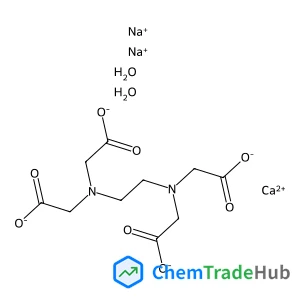
EthylenediaminetetraaceticacidcalciumDisodiumsalthydrate
CAS Number:
23411-34-9
Molecular Formula:
C10H16CaN2Na2O10
Recommended Suppliers





Disclaimer
This page provides academic journal information for reference and research purposes only. We are not affiliated with any journal publishers and do not handle publication submissions. For publication-related inquiries, please contact the respective journal publishers directly.
If you notice any inaccuracies in the information displayed, please contact us at support@chemtradehub.com. We will promptly review and address your concerns.