












Synthesis of thermoresponsive phenyl- and naphthyl-terminated poly(NIPAM) derivatives using RAFT and their complexation with cyclobis(paraquat-p-phenylene) derivatives in water
Literature Information
Publication Date
2010-05-21
DOI
10.1039/C0PY00085J
Impact Factor
5.582
Authors
Graeme Cooke
View Original
Abstract
A series of poly(N-isopropylacrylamide)s (poly(NIPAM)s) have been synthesized via reversible addition-fragmentation chain transfer (RAFT) polymerization from a functionalized chain transfer agent (CTA) bearing either dialkoxynaphthalene or dialkoxyphenylene moieties. After demonstrating the controlled character of the RAFT polymerization in the presence of these CTAs, well-defined functionalized poly(NIPAM)s with low PDIs and similar molecular weights were selected and subjected to lower critical solution temperature (LCST) measurements using UV-vis spectroscopy. We have investigated the complexation of the polymers with the tetracationic cyclophane cyclobis(paraquat-p-phenylene) (CBPQT4+) and specifically the role the counter anion (Cl−, Br−, I−) of the cyclophane has on the LCST. Moreover, we have shown that the addition of a competing end-functionalized naphthalene poly(NIPAM) guest to a (CBPQT4+)–end-functionalized phenylene poly(NIPAM) complex results in the dethreading of the original architecture.
Recommended Journals
Related Literature
Fluctuation correlations as major determinants of structure- and dynamics-driven allosteric effects
Miao Yu, Yixin Chen, Zi-Le Wang
2019-02-09
Paper
DOI: 10.1039/C8CP07859A
Laser and electron beam-induced formation of Ag/Cr structures on Ag2CrO4
Lemos P. S., Silva G. S., Roca R. A., Assis M., Torres-Mendieta R., Beltrán-Mir H., Mínguez-Vega G., Cordoncillo E., Andrés J., Longo E.
2019-02-07
Paper
DOI: 10.1039/C8CP07263A
Electron localization in niobium doped CaMnO3 due to the energy difference of electronic states of Mn and Nb
Yi Li, Jian Liu, Ji-Chao Li, Yu-Fei Chen, Xin-Miao Zhang, Xue-Jin Wang, Fu-Ning Wang, Wen-Bin Su, Lan-Ling Zhao, Chun-Lei Wang
2018-07-23
Paper
DOI: 10.1039/C8CP02783H
Neural network force fields for simple metals and semiconductors: construction and application to the calculation of phonons and melting temperatures
Mário R. G. Marques, Jakob Wolff, Conrad Steigemann, Miguel A. L. Marques
2019-03-07
Paper
DOI: 10.1039/C8CP05771K
Experimental and theoretical investigation of long-wavelength fluorescence emission in push–pull benzazoles: intramolecular proton transfer or charge transfer in the excited state?
Guilherme Wiethaus, Josene Maria Toldo, Fabiano da Silveira Santos, Rodrigo da Costa Duarte, Paulo Fernando Bruno Gonçalves, Fabiano Severo Rodembusch
2019-01-28
Paper
DOI: 10.1039/C8CP05186K
Tuning the magnetic properties of beryllium chains
Noelia Faginas-Lago, Thierry Leininger, Stefano Evangelisti
2019-02-27
Paper
DOI: 10.1039/C8CP07159D
Using nanotubes to study the phonon spectrum of two-dimensional materials
Jesús Carrete, Vu Ngoc Tuoc, Georg K. H. Madsen
2019-02-06
Paper
DOI: 10.1039/C9CP00052F
Transition metal-containing molecular devices: controllable single-spin negative differential thermoelectric resistance effects under gate voltages
Xifeng Yang, Fangxin Tan, Yaojun Dong, Hailin Yu, Yushen Liu
2019-02-07
Paper
DOI: 10.1039/C8CP07049K
You might also like
Compound Q&A
Is 6-(3-Fluorophenyl)picolinic acid (CAS: 887982-40-3) safe?
6-(3-Fluorophenyl)picolinic acid is generally considered safe for laboratory use...
887982-40-36-(3-Fluorophenyl)pi...
Compound Q&A
What industries use (3R)-3-Pyrrolidinol (CAS: 2799-21-5)?
(3R)-3-Pyrrolidinol is used in the pharmaceutical industry as a precursor for dr...
2799-21-5(3R)-3-Pyrrolidinol
Compound Q&A
What precautions should be taken when handling (4R,5R)-4,5-Diethoxycarbonyl-2,2-dimethyldioxolane (CAS: 59779-75-8)?
When handling (4R,5R)-4,5-Diethoxycarbonyl-2,2-dimethyldioxolane (CAS: 59779-75-...
59779-75-8(4R,5R)-4,5-Diethoxy...
Compound Q&A
How is 1-(6-Chloroimidazo[1,2-b]pyridazin-3-yl)ethanone (CAS: 90734-71-7) typically synthesized?
1-(6-Chloroimidazo[1,2-b]pyridazin-3-yl)ethanone is often synthesized via a mult...
90734-71-71-(6-Chloroimidazo[1...
Compound Q&A
What is the market or research trend for N-Ethyl-3,4-dimethylbenzylamine (CAS: 39180-83-1)?
The market for N-Ethyl-3,4-dimethylbenzylamine (CAS: 39180-83-1) remains steady,...
39180-83-1N-Ethyl-3,4-dimethyl...
Compound Q&A
What is Tert-butyl 3-(pyrrolidin-1-yl)azetidine-1-carboxylate (CAS: 1019008-21-9)?
Tert-butyl 3-(pyrrolidin-1-yl)azetidine-1-carboxylate is a chemical compound wit...
1019008-21-9Tert-butyl 3-(pyrrol...
Compound Q&A
What regulatory guidelines apply to 1-Bromo-3-chloro-2,4-dimethoxybenzene (CAS: 1228956-93-1)?
1-Bromo-3-chloro-2,4-dimethoxybenzene (CAS: 1228956-93-1) falls under the classi...
1228956-93-11-Bromo-3-chloro-2,4...
Compound Q&A
Is 8-Bromo-2-methyl-3,4-dihydroisoquinolin-1(2H)-one (CAS: 1368622-07-4) safe?
The safety of 8-Bromo-2-methyl-3,4-dihydroisoquinolin-1(2H)-one (CAS: 1368622-07...
1368622-07-48-Bromo-2-methyl-3,4...
Compound Q&A
Is Benzyl [(3S)-2,6-dioxo-3-piperidinyl]carbamate (CAS: 22785-43-9) safe?
Benzyl [(3S)-2,6-dioxo-3-piperidinyl]carbamate is generally safe when handled wi...
22785-43-9Benzyl [(3S)-2,6-dio...
Compound Q&A
How should 1-{[4-(4,4,5,5-Tetramethyl-1,3,2-dioxaborolan-2-yl)phenyl]sulfonyl}pyrrolidine (CAS: 928657-21-0) be stored?
1-{[4-(4,4,5,5-Tetramethyl-1,3,2-dioxaborolan-2-yl)phenyl]sulfonyl}pyrrolidine s...
928657-21-01-{[4-(4,4,5,5-Tetra...
Source Journal
Polymer Chemistry

CiteScore:
8.6
Self-citation Rate:
7.3%
Articles per Year:
457
Polymer Chemistry welcomes submissions in all areas of polymer science that have a strong focus on macromolecular chemistry. Manuscripts may cover a broad range of fields, yet no direct application focus is required.
Recommended Compounds
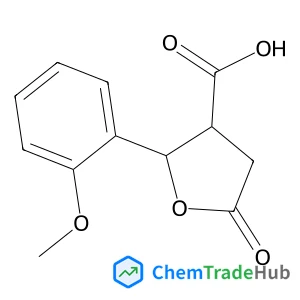
trans-2-(2-Methoxyphenyl)-5-oxotetrahydrofuran-3-carboxylic acid
CAS Number:
99226-02-5
Molecular Formula:
C12H12O5

Recommended Suppliers







Disclaimer
This page provides academic journal information for reference and research purposes only. We are not affiliated with any journal publishers and do not handle publication submissions. For publication-related inquiries, please contact the respective journal publishers directly.
If you notice any inaccuracies in the information displayed, please contact us at support@chemtradehub.com. We will promptly review and address your concerns.