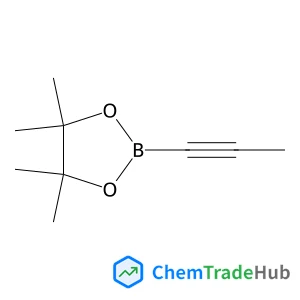
4,4,5,5-Tetramethyl-2-(1-propyn-1-YL)-1,3,2-dioxaborolane
CAS Number:
347389-75-7
Molecular Formula:
C9H15BO2
Shao-Yong Lu, Yong-Jun Jiang, Jian-Wei Zou, Tian-Xing Wu
Glycogen synthase kinase 3β (GSK3β) is a serine/threonine kinase that requires two cofactor Mg2+ ions for catalysis in regulating many important cellular signals. Experimentally, Li+ is a competitive inhibitor of GSK3β relative to Mg2+, while this mechanism is not experienced with other group I metal ions. Herein, we use native Mg22+–Mg12+ GSK3β and its Mg22+–M1+ (M = Li, Na, K, and Rb) derivatives to investigate the effect of metal ion substitution on the mechanism of inhibition through two-layer ONIOM-based quantum mechanics/molecular mechanics (QM/MM) calculations and molecular dynamics (MD) simulations. The results of ONIOM calculations elucidate that the interaction of Na+, K+, and Rb+ with ATP is weaker compared to that of Mg2+ and Li+ with ATP, and the critical triphosphate moiety of ATP undergoes a large conformational change in the Na+, K+, and Rb+ substituted systems. As a result, the three metal ions (Na+, K+, and Rb+) are not stable and depart from the active site, while Mg2+ and Li+ can stabilize in the active site, evident in MD simulations. Comparisons of Mg22+–Mg12+ and Mg22+–Li1+ systems reveal that the inline phosphor-transfer of ATP and the two conserved hydrogen bonds between Lys85 and ATP, together with the electrostatic potential at the Li1+ site, are disrupted in the Mg22+–Li1+ system. These computational results highlight the possible mechanism why Li+ inhibits GSK3β.
D. Durgalakshmi, S. Balakumar
DOI: 10.1039/C5CP01738F
Wallace D. Derricotte, Francesco A. Evangelista
DOI: 10.1039/C4CP05509H
Eun Soo Cho, Myung Jong Kang, Young Soo Kang
DOI: 10.1039/C5CP01823D
N. Komiha, M. Taleb, M. Mogren Al-Mogren, M. Hochlaf
DOI: 10.1039/C4CP06108J
E. Scoppola, E. Watkins, G. Li Destri, L. Porcar, R. A. Campbell, O. Konovalov, G. Fragneto, O. Diat
DOI: 10.1039/C5CP01809A
Zhenzhen Feng, Yuli Yan, Guangbiao Zhang, Jueming Yang, Chao Wang
DOI: 10.1039/C5CP00972C
Régis Stephan, Marie-Christine Hanf, Philippe Sonnet
DOI: 10.1039/C5CP00613A
H. Li, R. Atkin, A. J. Page
DOI: 10.1039/C5CP01952D
DOI: 10.1039/C5CP00329F
Tianyu Zhu, Peng Chen, Hongfeng Li, Wenbin Sun, Ting Gao, Pengfei Yan
DOI: 10.1039/C5CP01392E
2-Methylbenzene-1,4-diamine dihydrochloride (CAS: 615-45-2) should be stored in ...
(1S,4S)-2,5-Diazabicyclo[2.2.1]heptane dihydrobromide is generally considered sa...
(6-Chloropyridazin-3-YL)methanamine finds applications in the pharmaceutical ind...
2-Fluoro-3-methylphenol is primarily used in the synthesis of pharmaceuticals, p...
When handling 3-Methoxy-4-nitrobenzonitrile, it is important to wear appropriate...
When handling 1,3-Oxazolo[4,5-b]pyridine-2(3H)-thione (CAS: 211949-57-4), it is ...
4-Ethynylbenzamide (CAS: 90347-86-7) falls under various regulatory guidelines i...
3-(2-Ethylphenyl)-2-thioxo-4-imidazolidinone is primarily used as an intermediat...
(2-Fluoro-6-methoxyphenyl)acetic acid, also known as 4-fluoro-3-methoxybenzoic a...
Market trends for 2-[4-(Hydroxymethyl)phenoxy]ethanol (CAS: 102196-18-9) indicat...

Physical Chemistry Chemical Physics (PCCP) is an international journal co-owned by 19 physical chemistry and physics societies from around the world. This journal publishes original, cutting-edge research in physical chemistry, chemical physics and biophysical chemistry. To be suitable for publication in PCCP, articles must include significant innovation and/or insight into physical chemistry; this is the most important criterion that reviewers and Editors will judge against when evaluating submissions. The journal has a broad scope and welcomes contributions spanning experiment, theory, computation and data science. Topical coverage includes spectroscopy, dynamics, kinetics, statistical mechanics, thermodynamics, electrochemistry, catalysis, surface science, quantum mechanics, quantum computing and machine learning. Interdisciplinary research areas such as polymers and soft matter, materials, nanoscience, energy, surfaces/interfaces, and biophysical chemistry are welcomed if they demonstrate significant innovation and/or insight into physical chemistry. Joined experimental/theoretical studies are particularly appreciated when complementary and based on up-to-date approaches.
![(3R,4aR,7aS,9aR,10S,11R,13aR,13bS,15aS,15bR)-3,11-Dihydroxy-10-(hydroxymethyl)-4,4,7a,10,13a,15b-hexamethyl-1,2,3,4,4a,7,7a,8,9,9a,10,11,12,13,13a,13b,14,15,15a,15b-icosahydro-5H-naphtho[2',1':4,5]cyc
lohepta[1,2-a]naphthalen-5-one structure](https://static.chemtradehub.com/structs/538/53800-21-8-9f18.webp "(3R,4aR,7aS,9aR,10S,11R,13aR,13bS,15aS,15bR)-3,11-Dihydroxy-10-(hydroxymethyl)-4,4,7a,10,13a,15b-hexamethyl-1,2,3,4,4a,7,7a,8,9,9a,10,11,12,13,13a,13b,14,15,15a,15b-icosahydro-5H-naphtho[2',1':4,5]cyc
lohepta[1,2-a]naphthalen-5-one structure")
![3-[(3R,4R)-3-[(6-aminopyrimidin-4-yl)-methyl-amino]-4-methyl-1-piperidyl]-3-oxo-propanenitrile structure](https://static.chemtradehub.com/structs/164/1640971-60-3-83a4.webp "3-[(3R,4R)-3-[(6-aminopyrimidin-4-yl)-methyl-amino]-4-methyl-1-piperidyl]-3-oxo-propanenitrile structure")