











Circular dichroism in ion yields employing femtosecond laser ionization—the role of laser pulse duration
Literature Information
Publication Date
2010-11-30
DOI
10.1039/C0CP01903H
Impact Factor
3.676
Authors
Philipp Horsch, Gunter Urbasch, Karl-Michael Weitzel, Dominik Kröner
View Original
Abstract
The circular dichroism (CD) induced by femtosecond laser pulse excitation of 3-methyl-cyclopentanone has been investigated by means of experiment and theory as a function of the laser pulse duration. In the experiment the CD in ion yields is measured by femtosecond laser ionization via a one-photon resonant excited state. In the theoretical part the CD is calculated by solving laser driven quantum electron dynamics for the same resonant excitation based on ab initio electronic structure calculations employing a complete description of the electric field–electric dipole and magnetic field–magnetic dipole interactions. Both the experimentally measured CD in ion yields and the calculated CD in excited state populations exhibit a marked increase of the CD for pulse duration increasing from 50 fs to about 200 fs. Beyond 200 fs pulse duration the CD levels off. The combination of experimental and theoretical evidences indicates that the CD decreases with increasing laser intensity connected to the increased coupling between the excited states.
Recommended Journals
Related Literature
Synthesis of a BaO thin film supported on MgO(001) using a shell-model amorphisation and recrystallisation strategy
Dean C. Sayle, S. Andrada Maicaneanu, Graeme W. Watson
2002-09-17
Paper
DOI: 10.1039/B205725P
Photochromism and solvatochromism of push–pull or pull–push spiroindolinenaphthoxazines
A. V. Metelitsa, V. Lokshin, J. C. Micheau, A. Samat, R. Guglielmetti, V. I. Minkin
2002-08-09
Paper
DOI: 10.1039/B204603B
Phase transition in swollen gels Part 32. Temperature transition in charged poly(N-isopropylmethacrylamide) hydrogels in water and aqueous NaCl solutions
A. Fomenko, H. Pospíšil, Z. Sedláková, J. Pleštil
2002-08-09
Paper
DOI: 10.1039/B203378J
Investigations on the stability of thiol stabilized semiconductor nanoparticles
Herwig Döllefeld, Kathrin Hoppe, Joanna Kolny, Kristian Schilling, Horst Weller, Alexander Eychmüller
2002-09-02
Paper
DOI: 10.1039/B202101C
Second virial coefficients of fluorinated methanes CH4−xFx (x = 0–4) and their binary mixtures
Joachim A. Lamp, Bernhard F. Schramm, Shokry M. Saad, Samia A. El-Geubeily
2002-08-12
Paper
DOI: 10.1039/B204839F
Analytical derivatives, π bonding and d–s mixing in the ligand field molecular mechanics method
Robert J. Deeth, David L. Foulis
2002-08-12
Paper
DOI: 10.1039/B203815C
FTIR study of low-temperature CO adsorption on high surface area tin(iv) oxide: Probing Lewis and Brønsted acidity
Patrick Gélin, Laurent Périer-Camby, Hélène Praliaud, Gérard Thomas
2002-08-28
Paper
DOI: 10.1039/B206336K
Reaction and dissociation mechanism control: the H2 + H2 system
Ernesto Garcia, Antonio Laganà
2002-08-30
Paper
DOI: 10.1039/B205377B
Effects of critical fluctuations to stochastic thermodynamic behavior of chemical reaction systems at steady state far from equilibrium
Nanrong Zhao
2002-07-29
Paper
DOI: 10.1039/B201564C
A disjoining pressure study of n-dodecyl-β-D-maltoside foam films
Cosima Stubenrauch, Judith Schlarmann, Reinhard Strey
2002-08-19
Paper
DOI: 10.1039/B205728J
You might also like
Compound Q&A
How should waste containing 2-Ethyl-4-Methyl-1H-Imidazole-5-Carbaldehyde (CAS: 88634-80-4) be handled?
Waste containing 2-Ethyl-4-Methyl-1H-Imidazole-5-Carbaldehyde (CAS: 88634-80-4) ...
88634-80-42-Ethyl-4-Methyl-1H-...
Compound Q&A
What industries use Triethoxy(octyl)silane (CAS: 1385031-14-0)?
Triethoxy(octyl)silane (CAS: 1385031-14-0) is widely used in the pharmaceuticals...
1385031-14-0Triethoxy(octyl)sila...
Compound Q&A
Are there alternatives to 3-iodo-7-nitro-1H-indazole (CAS: 864724-64-1) in synthesis?
Several alternatives to 3-iodo-7-nitro-1H-indazole (CAS: 864724-64-1) exist in t...
864724-64-13-iodo-7-nitro-1H-in...
Compound Q&A
Are there alternatives to Benzene, bis[(trimethoxysilyl)ethyl] (CAS: 266317-71-9) in synthesis?
Yes, there are alternatives to Benzene, bis[(trimethoxysilyl)ethyl] (CAS: 266317...
266317-71-9Benzene, bis[(trimet...
Compound Q&A
Is Isothiazole-3-carbonitrile (CAS: 1452-17-1) safe?
Isothiazole-3-carbonitrile (CAS: 1452-17-1) is generally considered safe when us...
1452-17-1Isothiazole-3-carbon...
Compound Q&A
Is (3-Chlorophenyl)methanol (CAS: 873-63-2) safe?
(3-Chlorophenyl)methanol (CAS: 873-63-2) is considered low to moderately toxic. ...
873-63-2(3-Chlorophenyl)meth...
Compound Q&A
How is (2S,3S)-2-Hydroxy-3-({[(2-methyl-2-propanyl)oxy]carbonyl}amino)-3-(2-naphthyl)propanoic acid (CAS: 959583-98-3) typically synthesized?
(2S,3S)-2-Hydroxy-3-({[(2-methyl-2-propanyl)oxy]carbonyl}amino)-3-(2-naphthyl)pr...
959583-98-3(2S,3S)-2-Hydroxy-3-...
Compound Q&A
What precautions should be taken when handling Methyl 2-(bromomethyl)-5-methoxybenzoate (CAS: 788081-99-2)?
Proper handling of methyl 2-(bromomethyl)-5-methoxybenzoate requires the use of ...
788081-99-2Methyl 2-(bromomethy...
Compound Q&A
What is 6,8-Dibromoimidazo[1,2-a]pyridine-2-carboxylic acid (CAS: 904805-36-3)?
6,8-Dibromoimidazo[1,2-a]pyridine-2-carboxylic acid (CAS: 904805-36-3) is an aro...
904805-36-36,8-Dibromoimidazo[1...
Compound Q&A
Is 3-Amino-5-bromo-2-pyridinecarbonitrile (CAS: 573675-27-1) safe?
3-Amino-5-bromo-2-pyridinecarbonitrile is considered safe when handled under pro...
573675-27-13-Amino-5-bromo-2-py...
Source Journal
Physical Chemistry Chemical Physics

CiteScore:
5.5
Self-citation Rate:
10.3%
Articles per Year:
3036
Physical Chemistry Chemical Physics (PCCP) is an international journal co-owned by 19 physical chemistry and physics societies from around the world. This journal publishes original, cutting-edge research in physical chemistry, chemical physics and biophysical chemistry. To be suitable for publication in PCCP, articles must include significant innovation and/or insight into physical chemistry; this is the most important criterion that reviewers and Editors will judge against when evaluating submissions. The journal has a broad scope and welcomes contributions spanning experiment, theory, computation and data science. Topical coverage includes spectroscopy, dynamics, kinetics, statistical mechanics, thermodynamics, electrochemistry, catalysis, surface science, quantum mechanics, quantum computing and machine learning. Interdisciplinary research areas such as polymers and soft matter, materials, nanoscience, energy, surfaces/interfaces, and biophysical chemistry are welcomed if they demonstrate significant innovation and/or insight into physical chemistry. Joined experimental/theoretical studies are particularly appreciated when complementary and based on up-to-date approaches.
Recommended Compounds
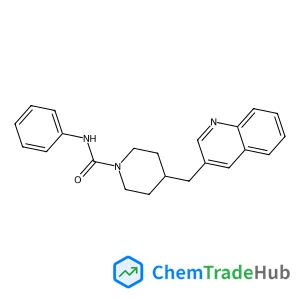
N-phenyl-4-(quinolin-3-ylmethyl)piperidine-1-carboxamide
CAS Number:
959151-50-9
Molecular Formula:
C22H23N3O
Recommended Suppliers






Disclaimer
This page provides academic journal information for reference and research purposes only. We are not affiliated with any journal publishers and do not handle publication submissions. For publication-related inquiries, please contact the respective journal publishers directly.
If you notice any inaccuracies in the information displayed, please contact us at support@chemtradehub.com. We will promptly review and address your concerns.