












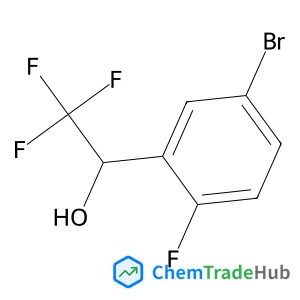
1-(5-Bromo-2-fluorophenyl)-2,2,2-trifluoroethanol
CAS Number:
1039827-16-1
Molecular Formula:
C8H5BrF4O
Marcin Ziółek, Ignacio Tacchini, M. Teresa Martínez, Xichuan Yang, Licheng Sun, Abderrazzak Douhal
We report on femtosecond–nanosecond (fs–ns) studies of the triphenylamine organic dye (TPC1) interacting with titania nanoparticles of different sizes, nanotubes and nanorods. We used time-resolved emission and absorption spectroscopy to measure the photoinduced dynamics of forward and back electron transfer processes taking place in TPC1–titania complexes in acetonitrile (ACN) and dichloromethane (DCM) solutions. We observed that the electron injection from the dye to titania occurs in a multi-exponential way with the main contribution of 100 fs from the hot excited charge-transfer state of anchored TPC1. This process competes with the relaxation of the excited state, mainly governed by solvation, that takes place with average time constants of 400 fs in ACN and 1.3 ps in DCM solutions. A minor contribution to the electron injection process takes place with longer time constants of about 1–10 ps from the relaxed excited state of TPC1. The latter times and their contribution do not depend on the size of the nanoparticles, but are substantially smaller in the case of nanotubes (1–3 ps), probably due to the caging effect. The contribution is also smaller in DCM than in ACN. The efficient back recombination takes place also in a multi-exponential way with times of 1 ps, 15 ps and 1 ns, and only 20–30% of the initial injected electrons in the conduction band are left within the first 1 ns after excitation. The faster recombination rates are suggested due to those originating from the free electrons in the conduction band of titania or the electrons in the shallow trap states, while the slower recombination is due to the electrons in the deep trap states. The results reported here should be relevant to a better understanding of the photobehaviour of an organic dye with promising potential for use in solar cells. They should also help to determine the important factors that limit the efficiency of solar cells based on the triphenylamine-based dyes for solar energy conversion.
Bruno Martínez-Haya, Juan Ramón Avilés-Moreno, Said Hamad, José Elguero
DOI: 10.1039/C6CP05324F
Yoan M. Delavoux, Mark Gilmore, Martin P. Atkins, Małgorzata Swadźba-Kwaśny, John D. Holbrey
DOI: 10.1039/C6CP07790K
C. Ennis, R. Auchettl, M. Ruzi, E. G. Robertson
DOI: 10.1039/C6CP08110J
Sven Oesterling, Oliver Schalk, Ting Geng, Richard D. Thomas, Tony Hansson, Regina de Vivie-Riedle
DOI: 10.1039/C6CP06240G
Qiang Sun
DOI: 10.1039/C6CP07589D
Jianzhong Chen, Jinan Wang, Weiliang Zhu
DOI: 10.1039/C6CP08105C
João P. Prates Ramalho, Francesc Illas, José R. B. Gomes
DOI: 10.1039/C6CP06971A
Otoniel Denis-Alpizar, Raymond J. Bemish
DOI: 10.1039/C6CP07142B
A. García-Fuente, J. Carrete, A. Vega, L. J. Gallego
DOI: 10.1039/C6CP07432D
2-(2-Chloroacetamido)-3-phenylpropanoic acid (CAS: 7765-11-9) is generally consi...
2-(Benzyloxy)-5-bromobenzoic acid can be handled safely if appropriate precautio...
(4-Methyl-1,2,5-oxadiazol-3-yl)methanamine hydrochloride is a chemical compound ...
2-(5-Hexylthiophen-2-yl)-4,4,5,5-tetramethyl-1,3,2-dioxaborolane (CAS: 917985-54...
While 4-(8-Methyl-9H-1,3-dioxolo[4,5-h][2,3]benzodiazepin-5-yl)benzenamine (CAS:...
The market for tert-butyl 3-hydroxy-4,5,7,8-tetrahydro-2H-pyrazolo[3,4-d]azepine...
Waste containing 3,5-Diamino-1H-pyrazole-4-carbonitrile (CAS: 6844-58-2) should ...
(6-Fluoro-3-pyridinyl)boronic acid can be synthesized through the reaction of 6-...
Dibenzyl carbonimidoylbiscarbamate (CAS: 10065-79-9) finds applications in vario...
The market for (beta,beta,2,3,4,5,6-~2~H_7_)Phenylalanine (CAS: 74228-83-4) is g...

Physical Chemistry Chemical Physics (PCCP) is an international journal co-owned by 19 physical chemistry and physics societies from around the world. This journal publishes original, cutting-edge research in physical chemistry, chemical physics and biophysical chemistry. To be suitable for publication in PCCP, articles must include significant innovation and/or insight into physical chemistry; this is the most important criterion that reviewers and Editors will judge against when evaluating submissions. The journal has a broad scope and welcomes contributions spanning experiment, theory, computation and data science. Topical coverage includes spectroscopy, dynamics, kinetics, statistical mechanics, thermodynamics, electrochemistry, catalysis, surface science, quantum mechanics, quantum computing and machine learning. Interdisciplinary research areas such as polymers and soft matter, materials, nanoscience, energy, surfaces/interfaces, and biophysical chemistry are welcomed if they demonstrate significant innovation and/or insight into physical chemistry. Joined experimental/theoretical studies are particularly appreciated when complementary and based on up-to-date approaches.
![3-[4-(difluoromethoxy)phenyl]-2-({[(9H-fluoren-9-yl)methoxy]carbonyl}amino)propanoic acid structure](https://static.chemtradehub.com/structs/149/1496564-27-2-952e.webp "3-[4-(difluoromethoxy)phenyl]-2-({[(9H-fluoren-9-yl)methoxy]carbonyl}amino)propanoic acid structure")
![Ethyl thieno[3,2-f]quinoline-2-carboxylate structure](https://static.chemtradehub.com/structs/299/29948-26-3-f62b.webp "Ethyl thieno[3,2-f]quinoline-2-carboxylate structure")
![(1S)-1,5-Anhydro-2-O-alpha-L-arabinopyranosyl-1-[5-hydroxy-7-({6-O-[3-(4-hydroxy-3-methoxyphenyl)propanoyl]-beta-D-glucopyranosyl}oxy)-2-(4-hydroxyphenyl)-4-oxo-4H-chromen-6-yl]-D-glucitol structure](https://static.chemtradehub.com/structs/225/2252345-81-4-bcff.webp "(1S)-1,5-Anhydro-2-O-alpha-L-arabinopyranosyl-1-[5-hydroxy-7-({6-O-[3-(4-hydroxy-3-methoxyphenyl)propanoyl]-beta-D-glucopyranosyl}oxy)-2-(4-hydroxyphenyl)-4-oxo-4H-chromen-6-yl]-D-glucitol structure")





