












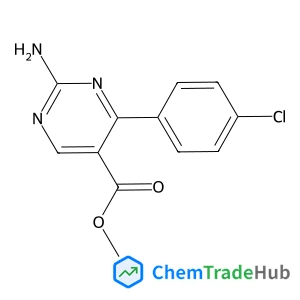
Methyl 2-amino-4-(4-chlorophenyl)-5-pyrimidinecarboxylate
CAS Number:
1133115-56-6
Molecular Formula:
C12H10ClN3O2
Zohra Guennoun, Christian Aupetit, Joëlle Mascetti
UV photochemistry of a polycyclic aromatic hydrocarbon model, coronene (C24H12), has been investigated when it is in interaction with water in argon cryogenic matrices, adsorbed on amorphous water ice films, and embedded in solid water. Photoprocessing, carried out at 10 K and λ > 235 nm by means of a high-pressure Hg arc lamp, results in the oxidation and reduction of coronene. These species have been tentatively identified as being the 1,10-dihydroxycoronene and the 1,10-coroquinone by FTIR spectroscopy with the support of isotopic experiments and DFT calculations. These photochemical products most likely form, after hydrogen bonding between C24H12 and H2O, through ionization of the PAH and subsequent reactivity with water upon irradiation. Cations, thus generated, react subsequently with water yielding the production of oxygen containing coronene compounds. Such species are of particular interest as they may form in interstellar and early Solar System ices, and are also of astrobiological significance as they could play an important role in processes taking place in most of the living organisms.
Jiashu Fan, Qinglong Zhang, Jiachun Feng
DOI: 10.1039/C5CP00548E
Sandeep Kumar Mishra, N. Suryaprakash
DOI: 10.1039/C5CP01505G
Thomas Spura, Hossam Elgabarty
DOI: 10.1039/C4CP05192K
Paweł Tecmer, Katharina Boguslawski, Paul W. Ayers
DOI: 10.1039/C4CP05293E
Manh-Thuong Nguyen, Nicola Seriani, Ralph Gebauer
DOI: 10.1039/C4CP04308A
N. Komiha, M. Taleb, M. Mogren Al-Mogren, M. Hochlaf
DOI: 10.1039/C4CP06108J
Jun Liu, Huawei Deng, Zhanyun Huang, Yueli Zhang, Dihu Chen, Yuanzhi Shao
DOI: 10.1039/C5CP01632K
Mohammad Reza Gharib-Zahedi, Mohsen Tafazzoli, Michael C. Böhm, Mohammad Alaghemandi
DOI: 10.1039/C5CP00752F
Wei Zhang, Wei Tao Zheng
DOI: 10.1039/C5CP01705J
2-Methylbenzene-1,4-diamine dihydrochloride (CAS: 615-45-2) should be stored in ...
(1S,4S)-2,5-Diazabicyclo[2.2.1]heptane dihydrobromide is generally considered sa...
(6-Chloropyridazin-3-YL)methanamine finds applications in the pharmaceutical ind...
2-Fluoro-3-methylphenol is primarily used in the synthesis of pharmaceuticals, p...
When handling 3-Methoxy-4-nitrobenzonitrile, it is important to wear appropriate...
When handling 1,3-Oxazolo[4,5-b]pyridine-2(3H)-thione (CAS: 211949-57-4), it is ...
4-Ethynylbenzamide (CAS: 90347-86-7) falls under various regulatory guidelines i...
3-(2-Ethylphenyl)-2-thioxo-4-imidazolidinone is primarily used as an intermediat...
(2-Fluoro-6-methoxyphenyl)acetic acid, also known as 4-fluoro-3-methoxybenzoic a...
Market trends for 2-[4-(Hydroxymethyl)phenoxy]ethanol (CAS: 102196-18-9) indicat...

Physical Chemistry Chemical Physics (PCCP) is an international journal co-owned by 19 physical chemistry and physics societies from around the world. This journal publishes original, cutting-edge research in physical chemistry, chemical physics and biophysical chemistry. To be suitable for publication in PCCP, articles must include significant innovation and/or insight into physical chemistry; this is the most important criterion that reviewers and Editors will judge against when evaluating submissions. The journal has a broad scope and welcomes contributions spanning experiment, theory, computation and data science. Topical coverage includes spectroscopy, dynamics, kinetics, statistical mechanics, thermodynamics, electrochemistry, catalysis, surface science, quantum mechanics, quantum computing and machine learning. Interdisciplinary research areas such as polymers and soft matter, materials, nanoscience, energy, surfaces/interfaces, and biophysical chemistry are welcomed if they demonstrate significant innovation and/or insight into physical chemistry. Joined experimental/theoretical studies are particularly appreciated when complementary and based on up-to-date approaches.
![Methyl 2-[5-(3-Phenoxyphenyl)-2H-tetrazol-2-yl]acetate structure](https://static.chemtradehub.com/structs/130/1305320-60-8-84b4.webp "Methyl 2-[5-(3-Phenoxyphenyl)-2H-tetrazol-2-yl]acetate structure")
![(1R,6R)-6-({[(2-Methyl-2-propanyl)oxy]carbonyl}amino)-3-cyclohexene-1-carboxylic acid structure](https://static.chemtradehub.com/structs/865/865689-24-3-5fef.webp "(1R,6R)-6-({[(2-Methyl-2-propanyl)oxy]carbonyl}amino)-3-cyclohexene-1-carboxylic acid structure")




