












Molecular organization and effective energy transfer in iridium metallosurfactant–porphyrin assemblies embedded in Langmuir–Schaefer films
Literature Information
Publication Date
2010-12-14
DOI
10.1039/C0CP01683G
Impact Factor
3.676
Authors
Cristina Roldán-Carmona, Antonio M. González-Delgado, Andrés Guerrero-Martínez, Luisa De Cola, Marta Pérez-Morales, María T. Martín-Romero, Luis Camacho
View Original
Abstract
Mixed Langmuir monolayers and Langmuir–Schaefer (LS) films containing the cationic metallosurfactant bis(2-phenylpyridine)(4,4′-diheptadecyl-2,2′-bipyridine)-iridium(III) chloride (Ir-complex) and the anionic tetrakis(4-sulfonatophenyl)porphyrin (TSPP) in 4 ∶ 1 molar ratio have been successfully prepared by the co-spreading method at the air–water interface. The presence of both luminescent species at the interface, as well as the organization of the TSPP underneath the Ir-complex matrix in Langmuir and LS films, is inferred by surface techniques such as π–A isotherms, reflection spectroscopy, Brewster angle microscopy (BAM) and UV–visible absorption spectroscopy. A red-shift in the absorption band of the porphyrin under the compression of the mixed monolayer suggests the J-aggregation of the TSPP under the Ir-complex matrix. To date, this is the first report of Langmuir and/or LS films containing these two types of species together. Furthermore, the intermolecular energy transfer between Ir-complex and TSPP molecules in solution and in transferred mixed films is investigated through steady-state fluorescence and lifetime measurements. These results indicate that effective intermolecular energy transfer occurs from the Ir-complex to the TSPP molecules in LS films. The influence of the spatial proximity of donor and acceptor molecules has been studied by the insertion of lipid interlayers among them.
Related Literature
A covalent triazine-based framework from tetraphenylthiophene and 2,4,6-trichloro-1,3,5-triazine motifs for sensing o-nitrophenol and effective I2 uptake
Tongmou Geng, Weiyong Zhang, Zongming Zhu, Guofeng Chen, Lanzhen Ma, Sainan Ye, Qingyuan Niu
2018-01-03
Paper
DOI: 10.1039/C7PY01834G
Surface-attached poly(phosphoester)-hydrogels with benzophenone groups
Zhuoling Deng, Maria Zober, Manfred Wagner, Karen Lienkamp, Frederik R. Wurm
2017-12-19
Paper
DOI: 10.1039/C7PY01777D
Luminescent solar concentrators based on PMMA films obtained from a red-emitting ATRP initiator
Riccardo Mori, Giuseppe Iasilli, Marco Lessi, Ana Belén Muñoz-García, Michele Pavone, Fabio Bellina, Andrea Pucci
2018-01-15
Paper
DOI: 10.1039/C7PY01933E
Correction: Synthesis of well-defined α,ω-telechelic multiblock copolymers in aqueous medium: in situ generation of α,ω-diols
Alexandre Simula, Vasiliki Nikolaou, Athina Anastasaki, Fehaid Alsubaie, Gabit Nurumbetov
2017-11-28
Correction
DOI: 10.1039/C7PY90189E
Nano-porous structures via self-assembly of amphiphilic triblock copolymers: influence of solvent and molecular weight
S. Nehache, M. Semsarilar, A. Deratani, M. In, P. Dieudonné-George, J. Lai Kee Him, P. Bron, D. Quémener
2017-12-01
Paper
DOI: 10.1039/C7PY01853C
Synthesis, characterization and the paramagnetic properties of bottle-brush copolymers with shielding TEMPO radicals
Zhigang Wu, Hongying Shen, Guowei Wang
2017-11-02
Paper
DOI: 10.1039/C7PY01683B
A novel radical polymerization system initiated by a redox reaction with NHPI and xanthone
2017-09-19
Communication
DOI: 10.1039/C7PY01329A
A red-emitting cationic hyperbranched polymer: facile synthesis, aggregation-enhanced emission, large Stokes shift, polarity-insensitive fluorescence and application in cell imaging
Rui Chen, Xiaoying Gao, Xiao Cheng, Anjun Qin, Jing Zhi Sun
2017-09-18
Paper
DOI: 10.1039/C7PY01378G
Tailored emulsion-templated porous polymer scaffolds for iPSC-derived human neural precursor cell culture
Ashley R. Murphy
2017-10-06
Paper
DOI: 10.1039/C7PY01375B
You might also like
Compound Q&A
What precautions should be taken when handling lithium chloride hydrate (1:1:1) (CAS: 16712-20-2)?
When handling lithium chloride hydrate (1:1:1) (CAS: 16712-20-2), it is importan...
16712-20-2Lithium chloride hyd...
Compound Q&A
Is 4-(4H-1,2,4-Triazol-4-yl)piperidine (CAS: 690261-92-8) safe?
4-(4H-1,2,4-Triazol-4-yl)piperidine is generally considered safe for use in phar...
690261-92-84-(4H-1,2,4-Triazol-...
Compound Q&A
How should waste containing 1,3-Thiazole-2-carboxamide (CAS: 16733-85-0) be handled?
Waste containing 1,3-Thiazole-2-carboxamide (CAS: 16733-85-0) should be collecte...
16733-85-01,3-Thiazole-2-carbo...
Compound Q&A
What regulatory guidelines apply to 5-(Difluoromethyl)-2-fluorobenzonitrile (CAS: 934175-58-3)?
5-(Difluoromethyl)-2-fluorobenzonitrile (CAS: 934175-58-3) is subject to regulat...
934175-58-35-(Difluoromethyl)-2...
Compound Q&A
How is Methyl 3-acetamido-2-thiophenecarboxylate (CAS: 22288-79-5) typically synthesized?
Methyl 3-acetamido-2-thiophenecarboxylate can be synthesized by the reaction of ...
22288-79-5Methyl 3-acetamido-2...
Compound Q&A
What is 4-Isoquinolinecarbonitrile (CAS: 34846-65-6)?
4-Isoquinolinecarbonitrile is a chemical compound with the CAS number 34846-65-6...
34846-65-64-Isoquinolinecarbon...
Compound Q&A
How should Methyl 1H-1,2,3-triazole-4-carboxylate (CAS: 877309-59-6) be stored?
Store Methyl 1H-1,2,3-triazole-4-carboxylate (CAS: 877309-59-6) in a cool, dry p...
877309-59-6Methyl 1H-1,2,3-tria...
Compound Q&A
What regulatory guidelines apply to 6-Bromo[1,3]thiazolo[5,4-b]pyridin-2-amine (CAS: 1160791-13-8)?
6-Bromo[1,3]thiazolo[5,4-b]pyridin-2-amine (CAS: 1160791-13-8) is subject to the...
1160791-13-86-Bromo[1,3]thiazolo...
Compound Q&A
Is (2S,3S)-2-Ammonio-3-(3,4-dihydroxyphenyl)-3-hydroxypropanoate (CAS: 23651-95-8) safe?
(2S,3S)-2-Ammonio-3-(3,4-dihydroxyphenyl)-3-hydroxypropanoate (CAS: 23651-95-8) ...
23651-95-8(2S,3S)-2-Ammonio-3-...
Compound Q&A
What are the physical and chemical properties of 7-bromo-3-methyl-3,4-dihydroquinazolin-4-one (CAS: 1293987-84-4)?
7-Bromo-3-methyl-3,4-dihydroquinazolin-4-one is a solid with a crystalline form....
1293987-84-47-bromo-3-methyl-3,4...
Source Journal
Physical Chemistry Chemical Physics

CiteScore:
5.5
Self-citation Rate:
10.3%
Articles per Year:
3036
Physical Chemistry Chemical Physics (PCCP) is an international journal co-owned by 19 physical chemistry and physics societies from around the world. This journal publishes original, cutting-edge research in physical chemistry, chemical physics and biophysical chemistry. To be suitable for publication in PCCP, articles must include significant innovation and/or insight into physical chemistry; this is the most important criterion that reviewers and Editors will judge against when evaluating submissions. The journal has a broad scope and welcomes contributions spanning experiment, theory, computation and data science. Topical coverage includes spectroscopy, dynamics, kinetics, statistical mechanics, thermodynamics, electrochemistry, catalysis, surface science, quantum mechanics, quantum computing and machine learning. Interdisciplinary research areas such as polymers and soft matter, materials, nanoscience, energy, surfaces/interfaces, and biophysical chemistry are welcomed if they demonstrate significant innovation and/or insight into physical chemistry. Joined experimental/theoretical studies are particularly appreciated when complementary and based on up-to-date approaches.
Recommended Compounds

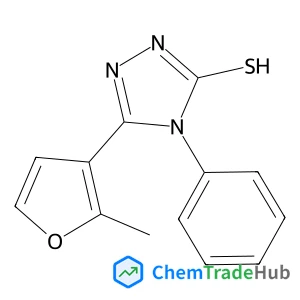
5-(2-Methyl-3-furyl)-4-phenyl-2,4-dihydro-3H-1,2,4-triazole-3-thione
CAS Number:
346464-59-3
Molecular Formula:
C13H11N3OS
![Ethyl 4-[8-chloro(5,5,6,6,7-~2~H_5_)-5,6-dihydro-11H-benzo[5,6]cyclohepta[1,2-b]pyridin-11-ylidene]-1-piperidinecarboxylate structure](https://static.chemtradehub.com/structs/102/1020719-57-6-37e2.webp "Ethyl 4-[8-chloro(5,5,6,6,7-~2~H_5_)-5,6-dihydro-11H-benzo[5,6]cyclohepta[1,2-b]pyridin-11-ylidene]-1-piperidinecarboxylate structure")
Ethyl 4-[8-chloro(5,5,6,6,7-~2~H_5_)-5,6-dihydro-11H-benzo[5,6]cyclohepta[1,2-b]pyridin-11-ylidene]-1-piperidinecarboxylate
CAS Number:
1020719-57-6
Molecular Formula:
C22H18D5ClN2O2
Recommended Suppliers




Disclaimer
This page provides academic journal information for reference and research purposes only. We are not affiliated with any journal publishers and do not handle publication submissions. For publication-related inquiries, please contact the respective journal publishers directly.
If you notice any inaccuracies in the information displayed, please contact us at support@chemtradehub.com. We will promptly review and address your concerns.