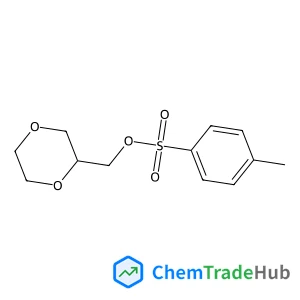
(S)-(1,4-Dioxan-2-yl)methyl 4-methylbenzenesulfonate
CAS Number:
917882-64-5
Molecular Formula:
C12H16O5S
X. Yang, A. W. Jasper, B. R. Giri, J. H. Kiefer, R. S. Tranter
The dissociation of 1, 2 and 4% 1,4-dioxane dilute in krypton was studied in a shock tube using laser schlieren densitometry, LS, for 1550–2100 K with 56 ± 4 and 123 ± 3 Torr. Products were identified by time-of-flight mass spectrometry, TOF-MS. 1,4-dioxane was found to initially dissociate via C–O bond fission followed by nearly equal contributions from pathways involving 2,6 H-atom transfers to either the O or C atom at the scission site. The ‘linear’ species thus formed (ethylene glycol vinyl ether and 2-ethoxyacetaldehyde) then dissociate by central fission at rates too fast to resolve. The radicals produced in this fission break down further to generate H, CH3 and OH, driving a chain decomposition and subsequent exothermic recombination. High-level ab initio calculations were used to develop a potential energy surface for the dissociation. These results were incorporated into an 83 reaction mechanism used to simulate the LS profiles with excellent agreement. Simulations of the TOF-MS experiments were also performed with good agreement for consumption of 1,4-dioxane. Rate coefficients for the overall initial dissociation yielded k123Torr = (1.58 ± 0.50) × 1059 × T−13.63 × exp(−43970/T) s−1 and k58Torr = (3.16 ± 1.10) × 1079 × T−19.13 × exp(−51326/T) s−1 for 1600 < T < 2100 K.
DOI: 10.1039/C6CP07834F
Daniel A. Jacobs, Yiliang Wu, Heping Shen, Chog Barugkin, Fiona J. Beck, Thomas P. White, Klaus Weber, Kylie R. Catchpole
DOI: 10.1039/C6CP06989D
Jingxin Shao, Caixia Wen, Mingjun Xuan, Hongyue Zhang, Johannes Frueh, Mingwei Wan, Lianghui Gao, Qiang He
DOI: 10.1039/C6CP06787E
D. Houdoux, J. Houplin, L. Amiaud, A. Lafosse, C. Dablemont
DOI: 10.1039/C6CP03328H
Dongshan Wei
DOI: 10.1039/C6CP07573H
G. Meneses, C. Widmann, T. Cunha, A. Gil, F. Ferreira da Silva, M. J. Calhorda, P. Limão-Vieira
DOI: 10.1039/C6CP06375F
Daniela Kerlé, Majid Namayandeh Jorabchi, Sebastian Wohlrab, Dietmar Paschek
DOI: 10.1039/C6CP06792A
Bolong Huang, Dengfeng Peng, Caofeng Pan
DOI: 10.1039/C6CP07472C
2-(2-Chloroacetamido)-3-phenylpropanoic acid (CAS: 7765-11-9) is generally consi...
2-(Benzyloxy)-5-bromobenzoic acid can be handled safely if appropriate precautio...
(4-Methyl-1,2,5-oxadiazol-3-yl)methanamine hydrochloride is a chemical compound ...
2-(5-Hexylthiophen-2-yl)-4,4,5,5-tetramethyl-1,3,2-dioxaborolane (CAS: 917985-54...
While 4-(8-Methyl-9H-1,3-dioxolo[4,5-h][2,3]benzodiazepin-5-yl)benzenamine (CAS:...
The market for tert-butyl 3-hydroxy-4,5,7,8-tetrahydro-2H-pyrazolo[3,4-d]azepine...
Waste containing 3,5-Diamino-1H-pyrazole-4-carbonitrile (CAS: 6844-58-2) should ...
(6-Fluoro-3-pyridinyl)boronic acid can be synthesized through the reaction of 6-...
Dibenzyl carbonimidoylbiscarbamate (CAS: 10065-79-9) finds applications in vario...
The market for (beta,beta,2,3,4,5,6-~2~H_7_)Phenylalanine (CAS: 74228-83-4) is g...

Physical Chemistry Chemical Physics (PCCP) is an international journal co-owned by 19 physical chemistry and physics societies from around the world. This journal publishes original, cutting-edge research in physical chemistry, chemical physics and biophysical chemistry. To be suitable for publication in PCCP, articles must include significant innovation and/or insight into physical chemistry; this is the most important criterion that reviewers and Editors will judge against when evaluating submissions. The journal has a broad scope and welcomes contributions spanning experiment, theory, computation and data science. Topical coverage includes spectroscopy, dynamics, kinetics, statistical mechanics, thermodynamics, electrochemistry, catalysis, surface science, quantum mechanics, quantum computing and machine learning. Interdisciplinary research areas such as polymers and soft matter, materials, nanoscience, energy, surfaces/interfaces, and biophysical chemistry are welcomed if they demonstrate significant innovation and/or insight into physical chemistry. Joined experimental/theoretical studies are particularly appreciated when complementary and based on up-to-date approaches.
![{3-[Bis(4-hydroxyphenyl)methyl]-1-[2-(dimethylamino)ethyl]-1H-indol-2-yl}[4-(2-chlorophenyl)-1-piperazinyl]methanone structure](https://static.chemtradehub.com/structs/170/170365-25-0-e4d7.webp "{3-[Bis(4-hydroxyphenyl)methyl]-1-[2-(dimethylamino)ethyl]-1H-indol-2-yl}[4-(2-chlorophenyl)-1-piperazinyl]methanone structure")