












Spin relaxation of a short-lived radical in zero magnetic field
Literature Information
Publication Date
2010-11-15
DOI
10.1039/C0CP01216E
Impact Factor
3.676
Authors
Iain McKenzie
View Original
Abstract
A short-lived radical containing only one I = 1/2 nucleus, the muoniated 1,2-dicarboxyvinyl radical dianion, was produced in an aqueous solution by the reaction of muonium with the dicarboxyacetylene dianion. The identity of the radical was confirmed by measuring the muon hyperfine coupling constant (hfcc) by transverse field muon spin rotation spectroscopy and comparing this value with the hfcc obtained from DFT calculations. The muon spin relaxation rate of this radical was measured as a function of temperature in zero magnetic field by the zero field muon spin relaxation technique. The results have been interpreted using the theoretical model of Fedin et al. (J. Chem. Phys., 2003, 118, 192). The muon spin polarization decreases exponentially with time after muon implantation and the temperature dependence of the spin relaxation rate indicates that the dominant relaxation mechanism is the modulation of the anisotropic hyperfine interaction due to molecular rotation. The effective radius of the radical in solution was determined to be 1.12 ± 0.04 nm from the dependence of the muon spin relaxation rate on the temperature and viscosity of the solution, and is approximately 3.6 times larger than the value obtained from DFT calculations.
Related Literature
Transition metal-free α-Csp3–H oxidative sulfuration of benzyl thiosulfates with anilines to form N-aryl thioamides
Mengjun Qiao, Ling Chen, Fengyi Zhou, Yali Zhang, Lingfei Zhou
2019-03-19
Paper
DOI: 10.1039/C9OB00336C
Aryne insertion into the PO bond: one-pot synthesis of quaternary phosphonium triflates
Babulal Das
2019-06-14
Paper
DOI: 10.1039/C9OB01157A
Antinociceptive activity of thiazole-containing cyclized DAMGO and Leu-(Met) enkephalin analogs
Hannah M. Harris, Shainnel O. Eans, Michelle L. Ganno, Jennifer C. Davis, Colette T. Dooley, Jay P. McLaughlin, Adel Nefzi
2019-05-09
Paper
DOI: 10.1039/C9OB00882A
Allylic azides: synthesis, reactivity, and the Winstein rearrangement
Angela S. Carlson, Joseph J. Topczewski
2019-04-04
Review Article
DOI: 10.1039/C8OB03178A
N-Hydroxyphthalimide/benzoquinone-catalyzed chlorination of hydrocarbon C–H bond using N-chlorosuccinimide
Zi-Hao Li, Biao-Lin Jiang, Jian-Wei Li
2019-02-26
Paper
DOI: 10.1039/C9OB00216B
A gold-catalyzed facile intramolecular rearrangement and cyclization sequence for synthesis of 2,5-dihydrofurans
Komalla Sunil, Sridhar Balasubramanian
2019-05-14
Paper
DOI: 10.1039/C9OB00756C
A novel chemiluminescent probe for hydrazine detection in water and HeLa cells
Jiang Liu, Jianze Jiang, Yandong Dou, Fangfang Zhang, Xin Liu, Jiaojiao Qu, Qing Zhu
2019-07-10
Communication
DOI: 10.1039/C9OB01407A
Two-component boronic acid catalysis for increased reactivity in challenging Friedel–Crafts alkylations with deactivated benzylic alcohols
Hwee Ting Ang, Jason P. G. Rygus, Dennis G. Hall
2019-05-29
Paper
DOI: 10.1039/C9OB01043B
A novel codrug made of the combination of ethionamide and its potentiating booster: synthesis, self-assembly into nanoparticles and antimycobacterial evaluation
Alexandra Pastor, Arnaud Machelart, Xue Li, Nicolas Willand, Alain Baulard, Priscille Brodin, Ruxandra Gref, Didier Desmaële
2019-05-02
Paper
DOI: 10.1039/C9OB00680J
You might also like
Compound Q&A
What is 1-(2,4,6-Trifluorophenyl)ethanol (CAS: 1250113-83-7)?
1-(2,4,6-Trifluorophenyl)ethanol is an organic compound with the CAS number 1250...
1250113-83-71-(2,4,6-Trifluoroph...
Compound Q&A
Is 1-(2,4-Dimethoxybenzyl)-4-(hydroxymethyl)-2-pyrrolidinone (CAS: 919111-34-5) safe?
1-(2,4-Dimethoxybenzyl)-4-(hydroxymethyl)-2-pyrrolidinone (CAS: 919111-34-5) is ...
919111-34-51-(2,4-Dimethoxybenz...
Compound Q&A
What are the physical and chemical properties of (7S,15R)-6β,15-Diacetoxy-7α,20-epoxy-7-hydroxykaura-2,16-dien-1-one (CAS: 51419-51-3)?
(7S,15R)-6β,15-Diacetoxy-7α,20-epoxy-7-hydroxykaura-2,16-dien-1-one is a crystal...
51419-51-3(7S,15R)-6β,15-Diace...
Compound Q&A
What regulatory guidelines apply to rac-ethyl (1r,4r)-4-hydroxycyclohexane-1-carboxylate, trans (CAS: 3618-04-0)?
The compound rac-ethyl (1r,4r)-4-hydroxycyclohexane-1-carboxylate, trans (CAS: 3...
3618-04-0rac-ethyl (1r,4r)-4-...
Compound Q&A
What is the market or research trend for 2-(2,4-Difluorophenoxy)-3-nitropyridine (CAS: 175135-62-3)?
The market for 2-(2,4-Difluorophenoxy)-3-nitropyridine (CAS: 175135-62-3) is cur...
175135-62-32-(2,4-Difluoropheno...
Compound Q&A
What are the main uses of 6-Diazo-5-oxo-L-norleucine (CAS: 157-03-9)?
The main uses of 6-Diazo-5-oxo-L-norleucine (CAS: 157-03-9) include research in ...
157-03-96-Diazo-5-oxo-L-norl...
Compound Q&A
What precautions should be taken when handling 2-Aminoethyl-mono-amide-DOTA-tris(tBu ester) (CAS: 173308-19-5)?
When handling 2-Aminoethyl-mono-amide-DOTA-tris(tBu ester) (CAS: 173308-19-5), i...
173308-19-52-Aminoethyl-mono-am...
Compound Q&A
How is 5-Methylimidazo[1,2-a]pyridine-3-carbaldehyde (CAS: 178488-37-4) typically synthesized?
5-Methylimidazo[1,2-a]pyridine-3-carbaldehyde (CAS: 178488-37-4) can be synthesi...
178488-37-45-Methylimidazo[1,2-...
Compound Q&A
Are there alternatives to 2,4,6-Trihydroxyisophthalaldehyde (CAS: 4396-13-8) in synthesis?
There are alternative reagents that can be used in the synthesis of 2,4,6-Trihyd...
4396-13-82,4,6-Trihydroxyisop...
Compound Q&A
What is (2Z)-3-(5-Fluoro-1H-indol-3-yl)-2-sulfanylacrylic acid (CAS: 179461-52-0)?
(2Z)-3-(5-Fluoro-1H-indol-3-yl)-2-sulfanylacrylic acid is a chemical compound wi...
179461-52-0(2Z)-3-(5-Fluoro-1H-...
Source Journal
Physical Chemistry Chemical Physics

CiteScore:
5.5
Self-citation Rate:
10.3%
Articles per Year:
3036
Physical Chemistry Chemical Physics (PCCP) is an international journal co-owned by 19 physical chemistry and physics societies from around the world. This journal publishes original, cutting-edge research in physical chemistry, chemical physics and biophysical chemistry. To be suitable for publication in PCCP, articles must include significant innovation and/or insight into physical chemistry; this is the most important criterion that reviewers and Editors will judge against when evaluating submissions. The journal has a broad scope and welcomes contributions spanning experiment, theory, computation and data science. Topical coverage includes spectroscopy, dynamics, kinetics, statistical mechanics, thermodynamics, electrochemistry, catalysis, surface science, quantum mechanics, quantum computing and machine learning. Interdisciplinary research areas such as polymers and soft matter, materials, nanoscience, energy, surfaces/interfaces, and biophysical chemistry are welcomed if they demonstrate significant innovation and/or insight into physical chemistry. Joined experimental/theoretical studies are particularly appreciated when complementary and based on up-to-date approaches.
Recommended Compounds
![Sodium 6-amino-3-[(E)-{4-[(E)-(4-aminophenyl)diazenyl]-2-methoxy-5-methylphenyl}diazenyl]-4-hydroxy-2-naphthalenesulfonate structure](https://static.chemtradehub.com/structs/294/2945-96-2-092f.webp "Sodium 6-amino-3-[(E)-{4-[(E)-(4-aminophenyl)diazenyl]-2-methoxy-5-methylphenyl}diazenyl]-4-hydroxy-2-naphthalenesulfonate structure")
Sodium 6-amino-3-[(E)-{4-[(E)-(4-aminophenyl)diazenyl]-2-methoxy-5-methylphenyl}diazenyl]-4-hydroxy-2-naphthalenesulfonate
CAS Number:
2945-96-2
Molecular Formula:
C24H21N6NaO5S
![9H-Fluoren-9-ylmethyl [(2S)-1-hydroxy-3-(1H-indol-3-yl)-2-propanyl]carbamate structure](https://static.chemtradehub.com/structs/153/153815-60-2-a67d.webp "9H-Fluoren-9-ylmethyl [(2S)-1-hydroxy-3-(1H-indol-3-yl)-2-propanyl]carbamate structure")
9H-Fluoren-9-ylmethyl [(2S)-1-hydroxy-3-(1H-indol-3-yl)-2-propanyl]carbamate
CAS Number:
153815-60-2
Molecular Formula:
C26H24N2O3
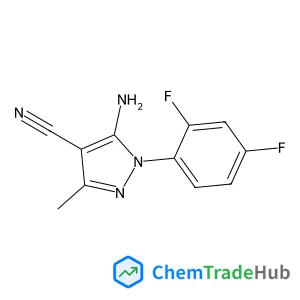
5-Amino-1-(2,4-difluorophenyl)-3-methyl-1H-pyrazole-4-carbonitrile
CAS Number:
1020057-92-4
Molecular Formula:
C11H8F2N4
Recommended Suppliers



Disclaimer
This page provides academic journal information for reference and research purposes only. We are not affiliated with any journal publishers and do not handle publication submissions. For publication-related inquiries, please contact the respective journal publishers directly.
If you notice any inaccuracies in the information displayed, please contact us at support@chemtradehub.com. We will promptly review and address your concerns.