












Photoinduced intra- and intermolecular electron transfer in solutions and in solid organized molecular assemblies
Literature Information
Publication Date
2010-10-29
DOI
10.1039/C0CP01106A
Impact Factor
3.676
Authors
Helge Lemmetyinen, Nikolai V. Tkachenko, Alexander Efimov, Marja Niemi
View Original
Abstract
The present paper highlights results of a systematic study of photoinduced electron transfer, where the fundamental aspects of the photochemistry occurring in solutions and in artificially or self-assembled molecular systems are combined and compared. In photochemical electron transfer (ET) reactions in solutions the electron donor, D, and acceptor, A, have to be or to diffuse to a short distance, which requires a high concentration of quencher molecules and/or long lifetimes of the excited donor or acceptor, which cannot always be arranged. The problem can partly be avoided by linking the donor and acceptor moieties covalently by a single bond, molecular chain or chains, or rigid bridge, forming D–A dyads. The covalent combination of porphyrin or phthalocyanine donors with an efficient electron acceptor, e.g.fullerene, has a two-fold effect on the electron transfer properties. Firstly, the electronic systems of the D–A pair result in a formation of an exciplex intermediate upon excitation both in solutions and in solid phases. The formation of the exciplex accelerates the ET rate, which was found to be as fast as >1012 s−1. Secondly, the total reorganization energy can be as small as 0.3 eV, even in polar solvents, which allows nanosecond lifetimes for the charge separated (CS) state. Molecular assemblies can form solid heterogeneous, but organized systems, e.g. molecular layers. This results in more complex charge separation and recombination dynamics. A distinct feature of the ET in organized assemblies is intermolecular interactions, which open a possibility for a charge migration both in the acceptor and in the donor layers, after the primary intramolecular exciplex formation and charge separation in the D–A dyad. The intramolecular ET is fast (35 ps) and efficient, but the formed interlayer CS states have lifetimes in microsecond or even second time domain. This is an important result considering possible applications.
Related Literature
The Lossen rearrangement from free hydroxamic acids
Mikaël Thomas, Jérôme Alsarraf, Nahla Araji, Isabelle Tranoy-Opalinski, Brigitte Renoux, Sébastien Papot
2019-05-08
Review Article
DOI: 10.1039/C9OB00789J
A phototunable anion receptor for C–H⋯X interactions with benzoate anions
Sk. Atiur Rahaman, Munshi Sahid Hossain, Sruthy Baburaj, Ankita Biswas, Arijit Bag, Subhajit Bandyopadhyay
2019-04-27
Paper
DOI: 10.1039/C9OB00781D
Solvent-free ruthenium-catalysed triflate coupling as a convenient method for selective azole-o-C–H monoarylation
Taoufik Boubaker, Julien Roger
2019-05-22
Communication
DOI: 10.1039/C9OB00806C
Autocatalyzed three-component cyclization of polyfluoroalkyl-3-oxo esters, methyl ketones and alkyl amines: a novel approach to 3-alkylamino-5-hydroxy-5-polyfluoroalkylcyclohex-2-en-1-ones
Marina V. Goryaeva, Svetlana O. Kushch, Olga G. Khudina, Yanina V. Burgart, Yulia S. Kudyakova, Marina A. Ezhikova, Mikhail I. Kodess, Pavel A. Slepukhin, Lilya Sh. Sadretdinova, Natalya P. Evstigneeva, Natalya A. Gerasimova, Victor I. Saloutin
2019-03-26
Paper
DOI: 10.1039/C9OB00293F
Chemical composition of DNA-encoded libraries, past present and future
Paige Dickson, Thomas Kodadek
2019-04-15
Review Article
DOI: 10.1039/C9OB00581A
[2 + 1 + 1] Assembly of spiro β-lactams by Rh(ii)-catalyzed reaction of diazocarbonyl compounds with azirines/isoxazoles
Artem A. Golubev, Ilia A. Smetanin, Anastasiya V. Agafonova, Nikolai V. Rostovskii, Alexander F. Khlebnikov, Galina L. Starova, Mikhail S. Novikov
2019-06-21
Paper
DOI: 10.1039/C9OB01301F
Metal-free POCl3 promoted stereoselective hydrochlorination of ethynylated azaheterocycles
Radhey M. Singh
2019-05-29
Paper
DOI: 10.1039/C9OB00841A
Unprecedented E-stereoselectivity on the sigmatropic Hurd–Claisen rearrangement of Morita–Baylis–Hillman adducts: a joint experimental–theoretical study
Vinicius Sobral Silva, Terezinha Alves Tolentino, Tiago Costa Alves Fontoura Rodrigues, Fernanda Ferrari Martins Santos, Daniel Francisco Scalabrini Machado, Wender Alves Silva, Heibbe Cristhian Benedito de Oliveira, Angelo Henrique Lira Machado
2019-04-05
Paper
DOI: 10.1039/C9OB00533A
You might also like
Compound Q&A
What is 1-(2,4,6-Trifluorophenyl)ethanol (CAS: 1250113-83-7)?
1-(2,4,6-Trifluorophenyl)ethanol is an organic compound with the CAS number 1250...
1250113-83-71-(2,4,6-Trifluoroph...
Compound Q&A
Is 1-(2,4-Dimethoxybenzyl)-4-(hydroxymethyl)-2-pyrrolidinone (CAS: 919111-34-5) safe?
1-(2,4-Dimethoxybenzyl)-4-(hydroxymethyl)-2-pyrrolidinone (CAS: 919111-34-5) is ...
919111-34-51-(2,4-Dimethoxybenz...
Compound Q&A
What are the physical and chemical properties of (7S,15R)-6β,15-Diacetoxy-7α,20-epoxy-7-hydroxykaura-2,16-dien-1-one (CAS: 51419-51-3)?
(7S,15R)-6β,15-Diacetoxy-7α,20-epoxy-7-hydroxykaura-2,16-dien-1-one is a crystal...
51419-51-3(7S,15R)-6β,15-Diace...
Compound Q&A
What regulatory guidelines apply to rac-ethyl (1r,4r)-4-hydroxycyclohexane-1-carboxylate, trans (CAS: 3618-04-0)?
The compound rac-ethyl (1r,4r)-4-hydroxycyclohexane-1-carboxylate, trans (CAS: 3...
3618-04-0rac-ethyl (1r,4r)-4-...
Compound Q&A
What is the market or research trend for 2-(2,4-Difluorophenoxy)-3-nitropyridine (CAS: 175135-62-3)?
The market for 2-(2,4-Difluorophenoxy)-3-nitropyridine (CAS: 175135-62-3) is cur...
175135-62-32-(2,4-Difluoropheno...
Compound Q&A
What are the main uses of 6-Diazo-5-oxo-L-norleucine (CAS: 157-03-9)?
The main uses of 6-Diazo-5-oxo-L-norleucine (CAS: 157-03-9) include research in ...
157-03-96-Diazo-5-oxo-L-norl...
Compound Q&A
What precautions should be taken when handling 2-Aminoethyl-mono-amide-DOTA-tris(tBu ester) (CAS: 173308-19-5)?
When handling 2-Aminoethyl-mono-amide-DOTA-tris(tBu ester) (CAS: 173308-19-5), i...
173308-19-52-Aminoethyl-mono-am...
Compound Q&A
How is 5-Methylimidazo[1,2-a]pyridine-3-carbaldehyde (CAS: 178488-37-4) typically synthesized?
5-Methylimidazo[1,2-a]pyridine-3-carbaldehyde (CAS: 178488-37-4) can be synthesi...
178488-37-45-Methylimidazo[1,2-...
Compound Q&A
Are there alternatives to 2,4,6-Trihydroxyisophthalaldehyde (CAS: 4396-13-8) in synthesis?
There are alternative reagents that can be used in the synthesis of 2,4,6-Trihyd...
4396-13-82,4,6-Trihydroxyisop...
Compound Q&A
What is (2Z)-3-(5-Fluoro-1H-indol-3-yl)-2-sulfanylacrylic acid (CAS: 179461-52-0)?
(2Z)-3-(5-Fluoro-1H-indol-3-yl)-2-sulfanylacrylic acid is a chemical compound wi...
179461-52-0(2Z)-3-(5-Fluoro-1H-...
Source Journal
Physical Chemistry Chemical Physics

CiteScore:
5.5
Self-citation Rate:
10.3%
Articles per Year:
3036
Physical Chemistry Chemical Physics (PCCP) is an international journal co-owned by 19 physical chemistry and physics societies from around the world. This journal publishes original, cutting-edge research in physical chemistry, chemical physics and biophysical chemistry. To be suitable for publication in PCCP, articles must include significant innovation and/or insight into physical chemistry; this is the most important criterion that reviewers and Editors will judge against when evaluating submissions. The journal has a broad scope and welcomes contributions spanning experiment, theory, computation and data science. Topical coverage includes spectroscopy, dynamics, kinetics, statistical mechanics, thermodynamics, electrochemistry, catalysis, surface science, quantum mechanics, quantum computing and machine learning. Interdisciplinary research areas such as polymers and soft matter, materials, nanoscience, energy, surfaces/interfaces, and biophysical chemistry are welcomed if they demonstrate significant innovation and/or insight into physical chemistry. Joined experimental/theoretical studies are particularly appreciated when complementary and based on up-to-date approaches.
Recommended Compounds
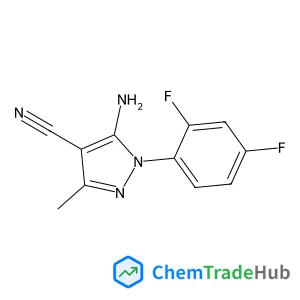
5-Amino-1-(2,4-difluorophenyl)-3-methyl-1H-pyrazole-4-carbonitrile
CAS Number:
1020057-92-4
Molecular Formula:
C11H8F2N4
Recommended Suppliers





Disclaimer
This page provides academic journal information for reference and research purposes only. We are not affiliated with any journal publishers and do not handle publication submissions. For publication-related inquiries, please contact the respective journal publishers directly.
If you notice any inaccuracies in the information displayed, please contact us at support@chemtradehub.com. We will promptly review and address your concerns.