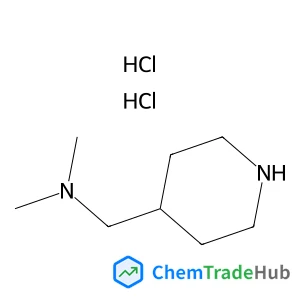
N,N-dimethyl(piperidin-4-yl)methanamine hydrochloride
CAS Number:
172281-72-0
Molecular Formula:
C8H20Cl2N2
Minijie Xu, Tao Song, Quan Quan, Dei-Cai Fang, Chi-Kit Siu, Ivan K. Chu
Fragmentation of radical cationic peptides [R(G)n−2X(G)7−n]˙+ and [R(G)m−2XG]˙+ (X = Phe or Tyr; m = 2–5; n = 2–7) leads selectively to an+ product ions through in situ Cα–C peptide backbone cleavage at the aromatic amino acid residues. In contrast, substituting the arginine residue with a less-basic lysine residue, forming [K(G)n−2X(G)7−n]˙+ (X = Phe or Tyr; n = 2–7) analogs, generates abundant b–y product ions; no site-selective Cα–C peptide bond cleavage was observed. Studying the prototypical radical cationic tripeptides [RFG]˙+ and [KFG]˙+ using low-energy collision-induced dissociation and density functional theory, we have examined the influence of the basicity of the N-terminal amino acid residue on the competition between the isomerization and dissociation channels, particularly the selective Cα–C bond cleavage via β-hydrogen atom migration. The dissociation barriers for the formation of a2+ ions from [RFG]˙+ and [KFG]˙+via their β-radical isomers are comparable (33.1 and 35.0 kcal mol−1, respectively); the dissociation barrier for the charge-induced formation of the [b2 − H]˙+ radical cation from [RFG]˙+via its α-radical isomer (39.8 kcal mol−1) was considerably higher than that from [KFG]˙+ (27.2 kcal mol−1). Thus, the basic arginine residue sequesters the mobile proton to promote the charge-remote selective Cα–C bond cleavage by energetically hindering the competing charge-induced pathways.
Christopher W. Dilbeck, Barbara J. Finlayson-Pitts
DOI: 10.1039/C3CP51237A
Kritapas Laohhasurayotin, Duangkamon Viboonratanasri
DOI: 10.1039/C3CP50872B
Qingsen Meng, Tuo Wang, Enzuo Liu, Xinbin Ma, Jinlong Gong
DOI: 10.1039/C3CP51476E
Catiúcia R. M. O. Matos, Fabio S. Miranda, José W. de M. Carneiro, Carlos B. Pinheiro, Célia M. Ronconi
DOI: 10.1039/C3CP51957K
Jens Niklas, Kristy L. Mardis, Brian P. Banks, Gregory M. Grooms, Andreas Sperlich, Vladimir Dyakonov, Serge Beaupré, Mario Leclerc, Tao Xu, Luping Yu, Oleg G. Poluektov
DOI: 10.1039/C3CP51477C
Yoshihiro Ogi, Hiroshi Kohguchi
DOI: 10.1039/C3CP51680F
Xuguang Liu, Lei Xu
DOI: 10.1039/C3CP51170G
Peter D. Haynes
DOI: 10.1039/C3CP52043A
Mario Chiesa, Maria Cristina Paganini, Stefano Livraghi, Elio Giamello
DOI: 10.1039/C3CP50658D
Ethyl 4-chlorothieno[2,3-b]pyridine-5-carboxylate (CAS: 59713-58-5) can be synth...
5-Methyl-1H-indole-3-carbaldehyde (CAS: 52562-50-2) is subject to various regula...
(1,3-Dimethyl-2,4-dioxo-1,2,3,4-tetrahydro-5-pyrimidinyl)boronic acid is a white...
Waste containing Sulfocostunolide A (CAS: 1016983-51-9) should be handled with c...
When handling Murraxocin (CAS: 88478-44-8), ensure proper personal protective eq...
Formvar (CAS: 63148-64-1) is an alkyd resin characterized by a high molecular we...
(S)-4-benzyl-2-((benzyloxy)methyl)morpholine is generally safe when handled with...
Methyl 1-(5-bromo-2-pyrimidinyl)cyclopropanecarboxylate (CAS: 1447607-69-3) is p...
2-Methyl-1-phenyl-1-propanamine hydrochloride (CAS: 24290-47-9) is generally con...
3-(4-Bromophenyl)-2-methylpropanoic acid is synthesized through a multi-step pro...

Physical Chemistry Chemical Physics (PCCP) is an international journal co-owned by 19 physical chemistry and physics societies from around the world. This journal publishes original, cutting-edge research in physical chemistry, chemical physics and biophysical chemistry. To be suitable for publication in PCCP, articles must include significant innovation and/or insight into physical chemistry; this is the most important criterion that reviewers and Editors will judge against when evaluating submissions. The journal has a broad scope and welcomes contributions spanning experiment, theory, computation and data science. Topical coverage includes spectroscopy, dynamics, kinetics, statistical mechanics, thermodynamics, electrochemistry, catalysis, surface science, quantum mechanics, quantum computing and machine learning. Interdisciplinary research areas such as polymers and soft matter, materials, nanoscience, energy, surfaces/interfaces, and biophysical chemistry are welcomed if they demonstrate significant innovation and/or insight into physical chemistry. Joined experimental/theoretical studies are particularly appreciated when complementary and based on up-to-date approaches.