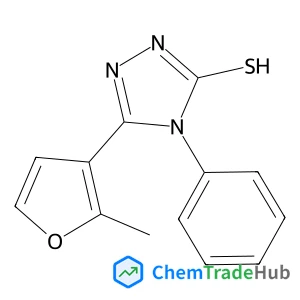
5-(2-Methyl-3-furyl)-4-phenyl-2,4-dihydro-3H-1,2,4-triazole-3-thione
CAS Number:
346464-59-3
Molecular Formula:
C13H11N3OS
Qichi Hu, Peng Wang, Julia Laskin
Ion soft landing (SL) enables highly selective modification of substrates for applications in materials science, nanotechnology and biology. Our previous study [P. Wang and J. Laskin, Angew. Chem., Int. Ed., 2008, 47, 6678–6680] showed that SL can be used for preparation of conformation-selected peptide arrays. Here we present a first study of the effect of the surface on the secondary structures of peptides soft-landed onto self-assembled monolayer surfaces (SAMs). Conformations of soft-landed peptide ions were examined using a newly constructed instrument that enables in situ infrared reflection absorption spectroscopy (IRRAS) characterization of surfaces during and after ion deposition. Polyalanine peptides, Ac-AnK and Ac-KAn (n = 7, 15), that have been extensively studied both in solution and in the gas phase were used as model systems in this study. We demonstrate that physical and chemical properties of SAM surfaces have a strong effect on the conformations of soft-landed peptide ions. For example, deposition of the α-helical [Ac-A15K + H]+ ion on the CH3-terminated (HSAM) surface results in immobilization of both the α- and 310-helical conformations. In contrast, a significant fraction of Ac-A15K molecules are present in the β-sheet conformation on the CF3-(FSAM) and COOH-terminated (COOH-SAM) surfaces. We show that the kinetic energy of the polyalanine ion, the charge, and the initial conformation have only a minor effect on the conformation of deposited species suggesting that the interaction between the molecule and the surface plays a major role in determining the secondary structures of immobilized polyalanines. This study demonstrates that SL of mass-selected ions can be utilized for obtaining fundamental understanding of the intrinsic properties of biomolecules and surfaces responsible for conformational changes upon adsorption.

Canadian Metallurgical Quarterly

Advances in Colloid and Interface Science

Bulletin of the Chemical Society of Japan

Anti-Corrosion Methods and Materials

Journal of the Chinese Chemical Society

Chemistry of Natural Compounds

Corrosion Science

Cement and Concrete Research

Chemistry of Heterocyclic Compounds

Australian Journal of Chemistry
Adérito J. R. Amaral, George Pasparakis
DOI: 10.1039/C7PY01386H
Shinan Geng, Qianwen Fu, Hao Zhao, Xiaole Peng, Chun Zhang, Yanbing Zhao, Jiangling Wan, Xiangliang Yang
DOI: 10.1039/C7PY02081C
N. Guigo, M. Pożycka, M. Delgado, J. Soares, P. V. Mendonça, J. F. J. Coelho, N. Sbirrazzuoli, A. J. D. Silvestre
DOI: 10.1039/C7PY01627A
Yohei Adachi, Yousuke Ooyama, Yi Ren, Xiaodong Yin, Frieder Jäkle, Joji Ohshita
DOI: 10.1039/C7PY01790A
Yang Chen, Laibing Wang, Xiangqiang Pan, Jin'an Wu, Wei Zhang, Zhengbiao Zhang, Xiulin Zhu
DOI: 10.1039/C8PY00199E
Jiang Xiao, Junyan Tan, Rujian Jiang, Xiongliang He, Yanzhi Xu, Ying Ling, Shifang Luan, Haoyu Tang
DOI: 10.1039/C7PY01393K
Abdeld Khoukh, Kamel Chougrani, Valérie Alard
DOI: 10.1039/C7PY02111A
En-Cheng Liu, Qiao-Yan Qi, Kaijia Xu, Guo-Fang Jiang, Xin Zhao
DOI: 10.1039/C7PY01927K
Xiaotong Fan, Ruizhen Tian, Shengda Liu, Shanpeng Qiao, Quan Luo, Tengfei Yan, Shuang Fu, Xin Zhang, Jiayun Xu, Junqiu Liu
DOI: 10.1039/C7PY02068F
Kyle C. Bentz, Muhammad Ejaz, Scarlett Arencibia, Naomi Sultan, Scott M. Grayson, Daniel A. Savin
DOI: 10.1039/C7PY00342K
When handling lithium chloride hydrate (1:1:1) (CAS: 16712-20-2), it is importan...
4-(4H-1,2,4-Triazol-4-yl)piperidine is generally considered safe for use in phar...
Waste containing 1,3-Thiazole-2-carboxamide (CAS: 16733-85-0) should be collecte...
5-(Difluoromethyl)-2-fluorobenzonitrile (CAS: 934175-58-3) is subject to regulat...
Methyl 3-acetamido-2-thiophenecarboxylate can be synthesized by the reaction of ...
4-Isoquinolinecarbonitrile is a chemical compound with the CAS number 34846-65-6...
Store Methyl 1H-1,2,3-triazole-4-carboxylate (CAS: 877309-59-6) in a cool, dry p...
6-Bromo[1,3]thiazolo[5,4-b]pyridin-2-amine (CAS: 1160791-13-8) is subject to the...
(2S,3S)-2-Ammonio-3-(3,4-dihydroxyphenyl)-3-hydroxypropanoate (CAS: 23651-95-8) ...
7-Bromo-3-methyl-3,4-dihydroquinazolin-4-one is a solid with a crystalline form....

Physical Chemistry Chemical Physics (PCCP) is an international journal co-owned by 19 physical chemistry and physics societies from around the world. This journal publishes original, cutting-edge research in physical chemistry, chemical physics and biophysical chemistry. To be suitable for publication in PCCP, articles must include significant innovation and/or insight into physical chemistry; this is the most important criterion that reviewers and Editors will judge against when evaluating submissions. The journal has a broad scope and welcomes contributions spanning experiment, theory, computation and data science. Topical coverage includes spectroscopy, dynamics, kinetics, statistical mechanics, thermodynamics, electrochemistry, catalysis, surface science, quantum mechanics, quantum computing and machine learning. Interdisciplinary research areas such as polymers and soft matter, materials, nanoscience, energy, surfaces/interfaces, and biophysical chemistry are welcomed if they demonstrate significant innovation and/or insight into physical chemistry. Joined experimental/theoretical studies are particularly appreciated when complementary and based on up-to-date approaches.
![1-[4-(4-Methyl-1H-imidazol-1-yl)phenyl]ethanone structure](https://static.chemtradehub.com/structs/142/142161-53-3-7f55.webp "1-[4-(4-Methyl-1H-imidazol-1-yl)phenyl]ethanone structure")
![5,10-Dihydroindeno[2,1-a]indene structure](https://static.chemtradehub.com/structs/654/6543-29-9-71ca.webp "5,10-Dihydroindeno[2,1-a]indene structure")